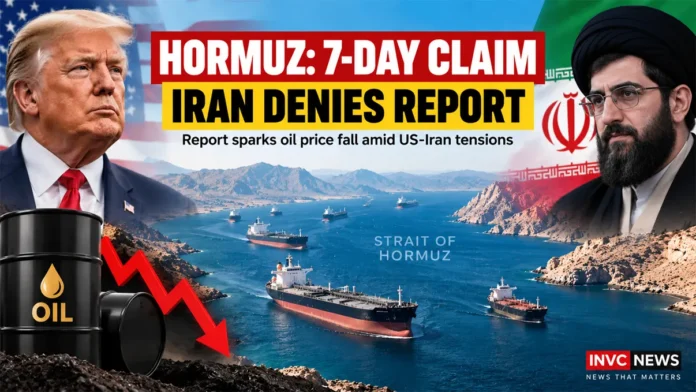
NEW YORK, United States | September 23, 2026 — A report suggesting that Iran could reopen the Strait of Hormuz within seven days if the United States eases military pressure and lifts its blockade on Iranian ports sent oil prices lower, but conflicting signals from Tehran quickly clouded expectations of an imminent breakthrough.
Reuters reported on September 22 that a senior Iranian official said Tehran could reopen the strategically crucial waterway within a week if Washington reduced military pressure and lifted the blockade on Iranian ports. The official also said Iran’s delegation attending the United Nations General Assembly in New York had authority to pursue renewed diplomacy with the United States.
However, Iran’s semi-official Fars News Agency later pushed back on the reports attributed to Iranian officials.
Fars cited Iranian sources as saying reports published by Reuters and Japan’s Kyodo News were invalid and untrue. That denial means there is still no publicly confirmed agreement between Tehran and Washington to reopen the Strait within seven days.
What Did the Senior Iranian Official Tell Reuters?
According to Reuters, the senior Iranian official said the Strait of Hormuz could reopen within seven days if the United States takes two significant steps.
The first condition would involve easing military pressure.
The second would require Washington to lift its blockade on Iranian ports.
The official said Washington would also need to formally signal that it wanted to resolve the confrontation through diplomacy and agree on a timeline for negotiations.
The official further said that an Iranian proposal had been delivered to the United States through mediators on September 16.
That does not mean the United States accepted the proposal.
Nor does it establish that Iran has formally committed to a seven-day reopening timetable.
For now, it remains a proposal described by an unnamed senior Iranian official and disputed by another Iranian media-linked account.
Fars News Agency Rejects Seven-Day Claim
The picture became considerably more complicated within hours.
Iran’s semi-official Fars News Agency rejected the Reuters and Kyodo reports, citing Iranian sources that described them as inaccurate.
Fars also suggested that reports about an imminent reopening were being circulated in a way that could push oil prices lower.
That contradiction is important.
Tehran has repeatedly used different political, military and media channels during the conflict, and statements from unnamed officials do not necessarily amount to a final government decision.
As of the morning of September 23, there is therefore no confirmed seven-day agreement to reopen the Strait of Hormuz.
Oil Prices Fell After the Report
Energy markets reacted quickly to the possibility of improved shipping conditions.
Oil prices fell on Tuesday as traders weighed the Iran report alongside increasing Saudi crude flows and the restart of Saudi Arabia’s East-West Pipeline.
November Brent crude settled at $99.25 a barrel, down $1.09 or 1.09%.
US West Texas Intermediate’s October contract settled at $94.99 a barrel, down $1.19 or 1.24%.
At their session lows, both benchmarks had fallen by more than $2 a barrel.
Brent also briefly slipped below the psychologically important $100 level as markets reacted to the prospect of reduced supply disruption.
Hormuz Report Was Not the Only Reason Oil Fell
The possible Iran-US diplomatic opening was only one factor behind the oil decline.
Saudi Arabia has restarted operations at its East-West Pipeline, an alternative route that can move crude toward the Red Sea.
Saudi oil movements through the Strait of Hormuz have also increased in recent days.
Reuters reported that Saudi flows through Hormuz averaged about 2.9 million barrels per day over six days, sharply higher than roughly 700,000 barrels per day in August.
Together, these developments eased some immediate concerns that Gulf oil supplies could tighten even further.
Why Strait of Hormuz Matters So Much
The Strait of Hormuz is one of the world’s most important energy corridors.
Before the current US-Iran conflict escalated in late February 2026, roughly one-fifth of global oil and liquefied natural gas supplies moved through the waterway, according to Reuters.
That is why even a report about possible reopening can move crude prices, currencies and stock markets within minutes.
Any sustained improvement in traffic through Hormuz could increase available Gulf oil supplies.
Conversely, renewed attacks, shipping restrictions or military escalation could quickly push risk premiums higher again.
Shipping Through Hormuz Remains Far Below Normal Levels
Despite signs of increased oil movements, normal commercial traffic has not returned.
Preliminary shipping data showed that only two commodity vessels crossed the Strait on Monday, compared with 10 the previous day.
Before the conflict escalated on February 28, about 125 large commercial vessels per day typically moved through the waterway.
The data may not capture vessels operating with their tracking systems switched off, but it nevertheless demonstrates how dramatically normal maritime activity has been disrupted.
Two vessels were also recently struck by unidentified projectiles in or near the Strait, underlining the continuing security risk.
Diplomacy Takes Centre Stage at UN General Assembly
The timing of the reports is particularly important because senior US and Iranian officials are in New York for the United Nations General Assembly.
The Iranian official cited by Reuters described the gathering as an opportunity to revive diplomacy.
The official said Iran would welcome renewed talks if Washington took tangible steps.
US Secretary of State Marco Rubio has also indicated that Washington remains open to dialogue under appropriate circumstances.
However, US President Donald Trump used his UN appearance to maintain pressure on Tehran and indicated that a broader settlement may not come immediately.
Reuters reported that Trump’s remarks reduced some of the earlier optimism in oil markets.
No Pezeshkian-Trump Meeting Currently Planned
Iranian President Masoud Pezeshkian travelled to New York for the UN gathering.
However, the senior Iranian official cited by Reuters said Pezeshkian was not planning to meet President Trump at UN headquarters.
That does not rule out indirect contacts through mediators.
Middle Eastern governments and other intermediaries have repeatedly attempted to create channels between Washington and Tehran during the conflict.
What Happens Next?
Three developments now matter most.
First, markets will watch whether either the Iranian government or the United States publicly confirms that a specific Hormuz proposal exists.
Second, actual vessel traffic through the Strait will provide stronger evidence than diplomatic speculation about whether restrictions are easing.
Third, any formal US-Iran talks on the sidelines of the UN General Assembly could significantly change expectations surrounding the conflict.
Until then, the reported seven-day timetable should be treated as an attributed proposal, not a confirmed agreement.
The fall in oil prices shows how strongly markets want to believe that supply conditions could improve.
But the rapid Iranian denial shows why the situation remains highly uncertain.