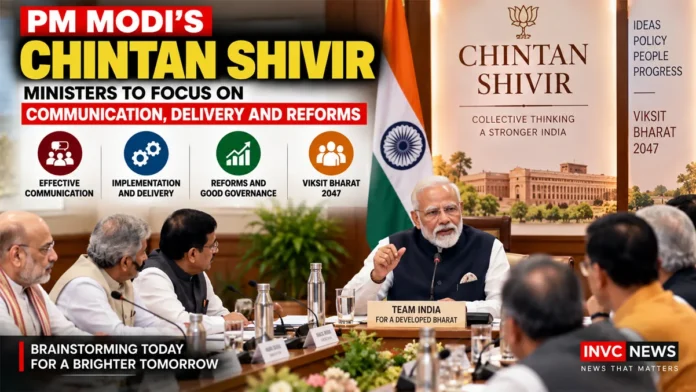
NEW DELHI, India | September 23, 2026 — Prime Minister Narendra Modi will chair a Chintan Shivir of the Union Council of Ministers beginning Wednesday at Seva Teerth, with the government using the brainstorming exercise to review implementation, sharpen public communication and identify its next set of governance priorities.
Current reporting describes the programme as a two-day exercise on September 23 and 24, bringing ministers together for structured discussions around governance, reforms and the Viksit Bharat 2047 agenda.
For ministers, the exercise is expected to function as much like a workshop as a conventional government meeting.
Presentations, group discussions and performance reviews are expected to focus on how ministries can improve implementation, communicate outcomes more effectively and translate policy decisions into measurable results.
Four Broad Themes at the Centre
The Chintan Shivir is expected to feature presentations around four major themes.
Current reporting specifically identifies effective communication and implementation of government programmes among the areas under discussion, along with self-improvement and broader governance priorities.
Ministers including Hardeep Singh Puri and Piyush Goyal are expected to participate in presentations.
Preparatory discussions were held earlier this week, with ministerial groups of around 16-17 members working on different subjects before the main session.
Why Communication Has Become Important
One of the more interesting elements of the exercise is its emphasis on communication.
For any government, announcing a scheme and implementing it are only part of the administrative process. Ministers also have to explain what a policy does, who benefits from it and what measurable outcomes it has produced.
The current Chintan Shivir is therefore expected to examine how ministers communicate government programmes and receive public feedback.
An assessment relating to Cabinet ministers’ social-media presence has also been shared as part of the wider exercise, according to current reporting.
That does not mean communication will replace performance reviews.
Rather, the discussions appear designed to connect policy implementation, public engagement and measurable delivery.
Focus on Viksit Bharat 2047
The larger policy framework remains Viksit Bharat 2047.
Ministries have been asked to consider ways to increase public participation in the long-term development agenda and turn government initiatives into broader citizen-engagement programmes.
The government is also examining ways to involve young people through universities and colleges.
Another proposal under discussion involves using the experience of older citizens in mentorship and government-related initiatives as India’s demographic profile changes.
The Social Justice Ministry has reportedly been asked to work on this mentorship concept.
Ministers Will Be Expected to Look Beyond Their Own Departments
A Chintan Shivir differs from a routine ministry review because the discussion can cut across departmental boundaries.
Work carried out by ministries and departments, the Cabinet Secretariat, NITI Aayog and groups of secretaries can feed into the wider exercise.
Issues such as reforms, ease of living, reduction of compliance burdens and implementation of government programmes are expected to form part of the discussions.
The objective is to identify areas where ministries can coordinate more closely rather than operate in isolated administrative silos.
PM Modi Has Already Started Reviewing Ministers
The Chintan Shivir does not come in isolation.
Earlier this month, Prime Minister Modi held a roughly four-hour meeting with around 20 Ministers of State and ministers holding independent charge.
That September 7 review covered government schemes, implementation on the ground, welfare programmes and departmental progress.
Reports from the meeting said ministers were asked to focus on timely completion, implementation quality and transparency.
They were also encouraged to use digital platforms to communicate work and gather public feedback.
The Chintan Shivir therefore appears to form part of a broader series of internal government reviews rather than a standalone event.
Seva Teerth Becomes the Venue
The venue also carries administrative significance.
Seva Teerth, inaugurated earlier this year, houses the Prime Minister’s Office, the National Security Council Secretariat and the Cabinet Secretariat.
The complex was formally inaugurated in February 2026 as part of the government’s restructuring of central administrative infrastructure.
Holding the ministerial brainstorming exercise there places the meeting at the centre of the government’s new administrative complex.
Is This a ‘Class’ for Ministers?
Politically, such exercises are sometimes described informally as a “class” for ministers because the prime minister reviews work, hears presentations and offers guidance.
But officially, the exercise is a governance and policy brainstorming session.
The emphasis is expected to be on performance, implementation, communication and future priorities rather than classroom-style instruction.
That distinction is useful for readers because the phrase “Modi Sir’s class” is a media framing, not the formal description of the programme.
What Could Come Out of the Chintan Shivir?
The most important outcome will be whether the discussions translate into specific administrative priorities.
Ministers could leave with clearer targets on project implementation, departmental coordination, citizen engagement and communication.
The meeting may also help identify the government’s next set of reforms and priority areas as the third Modi government approaches the middle phase of its term.
For citizens, however, the meaningful test will remain implementation.
Training ministers to communicate policy more effectively may improve public understanding, but ultimately the government’s programmes will be judged by measurable outcomes on the ground.