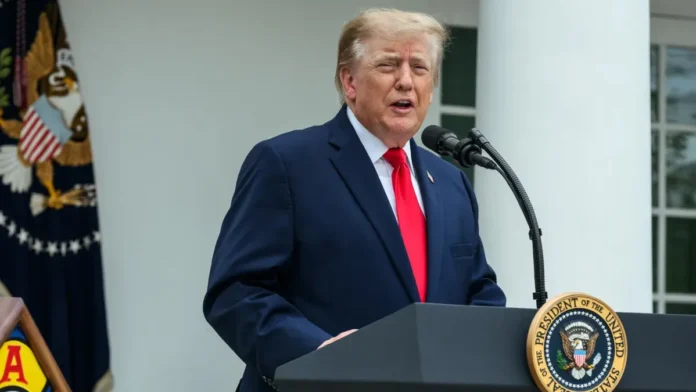
Washington | November 2, 2026 : US President Donald Trump used his final campaign rallies ahead of Tuesday’s midterm elections to defend his administration’s military action against Iran, dismiss concerns about Chinese and Russian espionage, and argue that rising fuel costs are justified by national security. Addressing supporters in Iowa and Kansas on Sunday, Trump also claimed that inflation had fallen and predicted a sharp decline in oil prices once the conflict with Iran ends.
The remarks came as Republicans seek to retain control of both chambers of Congress. The November 3 elections will determine the balance of power in the House of Representatives and the Senate, making the final campaign appearances particularly significant for both parties.
Trump held rallies in Dubuque, Iowa, and Salina, Kansas, delivering an extended defence of his foreign policy and economic record.
Trump says US spies on China and Russia more effectively
During his speech in Dubuque, Trump brushed aside concerns that China and Russia were conducting intelligence operations against the United States. He acknowledged that both countries spy on America but argued that Washington conducts similar operations more effectively.
“Somebody said, China’s spying on us, sir. I said, yeah, and we’re spying on them, too. Don’t worry about it,” Trump told supporters.
He continued by referring to both China and Russia, saying that although they were gathering intelligence on the United States, America was doing the same to them and doing it better.
The comments came amid continuing concerns in Washington over foreign intelligence activities, cyber operations and the protection of sensitive government and defence information.
Trump did not provide specific details about the intelligence operations he was referring to. His remarks were framed as a response to concerns about foreign espionage rather than an announcement of any new intelligence policy.
Trump defends military action against Iran
The Iran conflict was another major focus of Trump’s speech. The president defended the US military campaign and claimed that Iranian military capabilities had been severely weakened.
“We didn’t start it. We’re finishing it. We’re beating the crap out of them,” Trump said.
He claimed that Iran no longer had functioning radar systems, anti-aircraft weapons or an effective leadership structure.
“They have no radar. They have no anti-aircraft weaponry. They have no leaders,” he said.
Trump also suggested that the military campaign had gone so far in targeting Iranian leaders that Washington was struggling to identify someone with whom it could negotiate.
“We might have gotten a little far with the leaders. There’s nobody to talk to. I’m trying to find somebody to talk to. Nobody wants to be president,” he said.
These were Trump’s characterisations of Iran’s military and political situation. He did not provide independent evidence during the rally to substantiate the full extent of the damage he described.
The remarks underline the administration’s effort to present the military campaign as a success while acknowledging that the absence of a clear negotiating counterpart could complicate diplomatic efforts.
Trump says higher oil prices are a price for security
At his second rally in Salina, Kansas, Trump shifted attention towards the economy, particularly inflation and energy prices.
He claimed that inflation over the preceding three months had fallen to 1.7 per cent and blamed the high prices inherited by his administration on former President Joe Biden.
“Your inflation for the last three months is 1.7 per cent way down. I inherited high prices from sleepy Joe Biden. I didn’t cause it,” Trump said.
The figure was presented by Trump during his campaign speech. It should not be confused with a separately verified official inflation measure without further information about the period and calculation being referenced.
Trump also defended higher fuel costs associated with the Iran conflict, arguing that the increase was a relatively small price to pay for the security of the United States and the wider world.
He claimed that oil prices were lower than during the presidencies of Biden and Barack Obama. He further predicted that prices would fall sharply once the war ended.
“When that war is over, it’s going to come plunging,” Trump said.
The comments highlight the political challenge facing the administration: defending the strategic objectives of the Iran campaign while addressing the impact of energy costs on American households and businesses.
Trump claims Iran has been prevented from obtaining nuclear weapons
The president also repeated his claim that his administration had prevented Iran from acquiring a nuclear weapon.
“I stopped Iran from having a nuclear weapon,” he told supporters.
The statement formed part of his broader argument that the military campaign was necessary to protect US and international security.
Iran’s nuclear programme has been a longstanding source of tension between Tehran and Washington. The conflict has also raised concerns about regional stability and the security of energy supplies.
For American voters, the issue connects foreign policy directly with domestic economic concerns, particularly fuel prices and the cost of living.
Midterm elections put Congress in focus
Trump’s appearances in Iowa and Kansas marked the closing stretch of his campaign activity before the November 3 midterm elections.
All 435 seats in the House of Representatives are up for election, while approximately one-third of the Senate seats are being contested. The results will determine which party controls Congress for the next two years.
The outcome will have implications for the administration’s legislative agenda, budget priorities, domestic policies and ability to secure congressional support.
Republicans are seeking to retain their majorities, while Democrats are campaigning to gain control of one or both chambers.
The political environment has also been shaped by concerns over tariffs, inflation, energy costs and the consequences of the war with Iran. These issues have become central to the debate over the administration’s record.
Foreign policy and household costs dominate the closing message
Trump’s final rallies brought together several issues that have shaped his second term: military action against Iran, competition with China and Russia, energy security and the cost of living.
His comments on espionage sought to portray American intelligence capabilities as stronger than those of its rivals. His statements on Iran defended the administration’s military approach, while his remarks on oil prices attempted to explain the economic consequences of the conflict.
With Americans heading to the polls on Tuesday, control of Congress is at stake. The election will provide an important measure of how voters assess the administration’s policies, including its handling of international conflicts and the domestic economy.
For now, Trump’s message to supporters is that the costs associated with the Iran conflict are justified by national security and that energy prices will decline once the fighting ends. Whether voters accept that argument will be reflected in the results of the midterm elections.