
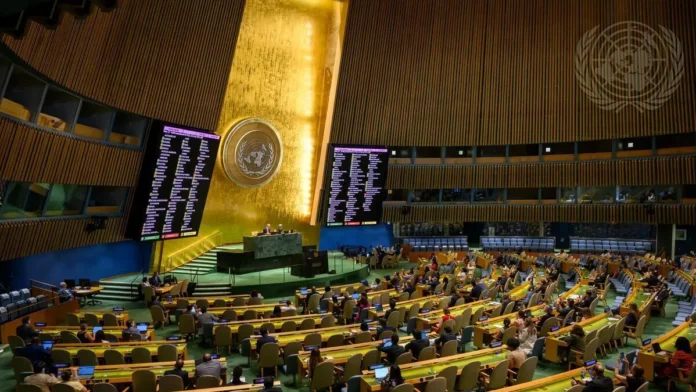
United Nations, New York : India has voted against a United Nations resolution calling for a global moratorium on the death penalty, joining 32 other countries in opposing the initiative. The resolution, introduced by Mexico, secured 133 votes in favour, 33 against and 16 abstentions in the UN General Assembly’s Third Committee on November 13. India’s position reflects its longstanding view that sovereign nations have the right to determine their own judicial systems and criminal penalties.
The vote has brought renewed attention to the international debate over capital punishment, with countries divided over human rights, national sovereignty and the role of the death penalty in criminal justice. India maintains that capital punishment should remain available for the rarest of rare cases, subject to strict judicial safeguards.
60-Second Brief
- 133 countries voted in favour of the resolution.
- 33 countries, including India, opposed it.
- 16 countries abstained from voting.
- Mexico introduced the resolution seeking a worldwide moratorium on executions.
- India defended national sovereignty over judicial and criminal law.
- Amnesty International recorded at least 2,707 executions worldwide in 2025.
- The resolution is a recommendation, not a legally binding worldwide ban.
What Happened at the United Nations?
The resolution, titled “Moratorium on the Use of the Death Penalty”, was introduced by Mexico and considered by the Third Committee of the UN General Assembly, which deals with social, humanitarian and human rights matters.
On November 13, the committee approved the draft by a recorded vote of 133 in favour, 33 against and 16 abstentions.
India voted against the proposal alongside countries including the United States, China, Japan, Iran, Pakistan, Saudi Arabia, Iraq, Bahrain, Egypt, Kuwait, Qatar and Oman.
The voting outcome reflects broad international support for suspending executions, although a significant group of countries continues to defend the right to retain capital punishment within their domestic legal systems.
Importantly, the committee’s approval does not establish a legally binding prohibition on the death penalty. The resolution calls on governments to introduce a moratorium on executions with the eventual objective of abolishing capital punishment. The draft is expected to proceed to the full General Assembly for consideration in December.
What Does the UN Resolution Recommend?
The resolution urges countries that continue to impose the death penalty to establish an immediate moratorium on executions as part of a gradual move towards abolition.
It also calls on countries that have already abolished capital punishment not to reintroduce it.
Among its key recommendations are:
- Restricting the use of capital punishment and reducing the number of offences punishable by death.
- Avoiding death sentences for offences committed by people under 18.
- Protecting pregnant women from capital punishment.
- Restricting the use of the death penalty against people with mental or intellectual disabilities and older persons.
- Reviewing mandatory death penalty provisions.
- Strengthening legal safeguards to prevent wrongful and irreversible executions.
The resolution also expresses serious concern over the sharp increase in recorded executions worldwide during 2025.
Why Did India Oppose the Proposal?
India’s position is based primarily on national sovereignty and the independence of domestic legal systems.
India’s First Secretary at the United Nations, Bhavika Mangalanandan, defended the country’s approach, arguing that there is no global consensus on abolishing the death penalty. She maintained that every sovereign nation has the right to determine its judicial framework and appropriate criminal punishments.
India reiterated that capital punishment is imposed only in the rarest of rare cases. The country’s legal framework provides several safeguards before a death sentence can be carried out.
These include mandatory confirmation of a death sentence by a High Court, judicial review through the established appellate process and the constitutional provision allowing convicted individuals to seek clemency from the President.
India also objected to interpretations that place judicially imposed capital punishment in the same category as extrajudicial killings or torture.
The broader Indian argument is that decisions taken through an established judicial process should be distinguished from arbitrary or unlawful state killings.
Which Other Countries Opposed the Resolution?
India was not alone in rejecting the proposal. The United States, China, Japan, Saudi Arabia, Iran, Iraq, Pakistan, Bahrain, Egypt, Kuwait, the Maldives, Oman and Qatar were among the countries voting against it.
The United States also maintained that decisions concerning capital punishment should remain within domestic democratic processes, subject to international legal obligations.
On the other side, France and several European countries welcomed the resolution, viewing international efforts to suspend executions as an important step towards the eventual universal abolition of the death penalty.
Global Executions Rose Sharply in 2025
The debate is taking place against a backdrop of a significant rise in executions.
According to Amnesty International’s annual report, at least 2,707 people were executed in 17 countries during 2025. This represented a 78 per cent increase from the 1,518 executions recorded in 2024.
It was the highest annual figure documented by the organisation since 1981.
Iran accounted for a substantial share of the increase, with at least 2,159 executions recorded during the year. Saudi Arabia recorded at least 356 executions.
Amnesty International has cautioned that the actual global total could be higher because reliable execution figures are unavailable for countries such as China, where relevant data is treated as a state secret.
The figures highlight the contrast between growing international support for abolishing capital punishment and the continued use of executions in several countries.
Death Penalty in India: What Do the Numbers Show?
India continues to retain capital punishment in its criminal justice system, although executions are relatively rare.
According to the Square Circle Clinic’s Death Penalty in India: Annual Statistics Report, trial courts sentenced 128 people to death in 2025. These sentences do not automatically mean that all 128 individuals will ultimately be executed. Death sentences must undergo the prescribed judicial review and confirmation process.
India’s last executions took place on March 20, 2020, when the four convicts in the 2012 Nirbhaya gang rape and murder case were hanged at Tihar Jail.
The gap between the number of death sentences handed down by trial courts and the actual number of executions also highlights the importance of appellate scrutiny and constitutional safeguards in capital cases.
Why the UN Vote Matters for India
India’s vote highlights an important divide in international criminal justice policy. While a growing majority of countries supports a moratorium on executions, India believes that the question of capital punishment must remain within the constitutional and legal framework of individual nations.
For New Delhi, the issue is not simply whether the death penalty should be abolished globally. It is also about preserving the authority of sovereign states to determine punishments for the most serious crimes through their own judicial institutions.
The December consideration by the full General Assembly will provide the next opportunity to assess international support for the initiative.
The Bottom Line
The UN committee’s vote has strengthened the international campaign for a global moratorium on executions, but it has also exposed continuing disagreements over national sovereignty and criminal justice. India’s opposition signals that New Delhi is not prepared to accept a universal approach to capital punishment and will continue to defend its rarest-of-rare standard and domestic judicial safeguards.