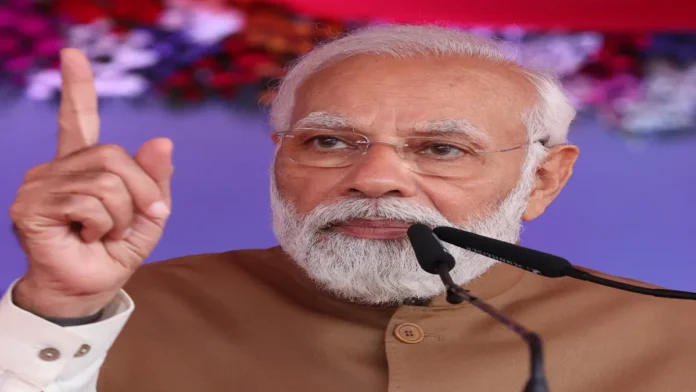
Manila, Philippines : Prime Minister Narendra Modi is in the Philippines for a series of high-level regional engagements, with maritime security, defence cooperation, trade and Indo-Pacific stability expected to feature prominently on India’s agenda. During the visit, Modi will participate in the 23rd ASEAN-India Summit and the 21st East Asia Summit, hosted by the Philippines under its 2026 ASEAN chairmanship. The proposed Quad leaders’ meeting in Manila has also drawn attention, particularly amid questions about the group’s strategic direction under US President Donald Trump.
The visit comes at a significant moment for India’s engagement with Southeast Asia. New Delhi is seeking stronger maritime partnerships, closer defence ties with regional countries and more balanced economic relations with the Association of Southeast Asian Nations (ASEAN).
60-Second Brief
- Visit: Prime Minister Narendra Modi’s official Manila programme is scheduled for November 16–17, 2026, according to the Prime Minister’s Office.
- ASEAN-India Summit: The 23rd edition will review the Comprehensive Strategic Partnership and future cooperation.
- East Asia Summit: Regional security, maritime stability and economic cooperation will be key areas of discussion.
- Quad: A leaders’ meeting involving India, the US, Japan and Australia is expected in Manila, although the Indian government had not formally confirmed the arrangement.
- Trade: India-ASEAN bilateral trade reached $128.38 billion in financial year 2025–26.
- Defence: The Philippines’ BrahMos missile deal with India remains an important milestone in bilateral defence cooperation.
- Myanmar: Political instability and regional connectivity remain important concerns for India.
Why Is PM Modi Visiting the Philippines?
Modi’s visit follows an invitation from Philippine President Ferdinand R. Marcos Jr. The Philippines is hosting the regional summits as ASEAN chair for 2026.
According to the Prime Minister’s Office, Modi will participate in the 23rd ASEAN-India Summit and the 21st East Asia Summit on November 17. The programme also includes bilateral meetings with other participating leaders.
The visit is particularly important because 2026 has been designated the ASEAN-India Year of Maritime Cooperation. India and ASEAN are also preparing to mark 35 years of dialogue relations and five years of their Comprehensive Strategic Partnership in 2027.
The ASEAN-India Summit will review progress under the existing partnership, including the ASEAN-India Plan of Action for 2026–2030, and discuss future areas of cooperation.
Maritime Security: A Major Priority for India
Maritime security is expected to be one of India’s central priorities during the meetings.
The Indo-Pacific region contains some of the world’s busiest shipping routes, making freedom of navigation and secure maritime trade essential for regional economies.
India wants like-minded countries to strengthen cooperation between their navies, improve maritime domain awareness and coordinate responses to emerging security challenges.
The South China Sea is particularly important in this context. Territorial disputes, competing maritime claims and tensions between China and several Southeast Asian countries have made the region a major focus of international diplomacy.
India has consistently supported freedom of navigation, peaceful resolution of disputes and respect for international law, including the United Nations Convention on the Law of the Sea (UNCLOS).
New Delhi also wants any proposed Code of Conduct between ASEAN and China for the South China Sea to remain consistent with international law.
Trade: India and ASEAN Look to Strengthen Economic Relations
Economic cooperation is another major part of Modi’s regional agenda.
India’s bilateral trade with ASEAN reached approximately $128.38 billion in financial year 2025–26, according to India’s Ministry of Commerce and Industry.
However, trade imbalances remain a concern for New Delhi. India is seeking an early conclusion to the review of the ASEAN-India Trade in Goods Agreement (AITIGA), which governs a significant part of merchandise trade between the two sides.
The review is intended to address concerns relating to market access, trade barriers and the distribution of economic benefits.
India believes that stronger trade and investment ties should be accompanied by more balanced commercial arrangements.
The discussions also offer an opportunity to explore cooperation in manufacturing, supply chains, digital technology, connectivity and infrastructure.
BrahMos Missiles: A Key Element of India-Philippines Defence Ties
India’s defence partnership with the Philippines has gained importance through the BrahMos supersonic cruise missile agreement.
In January 2022, the Philippines signed a $375 million contract with India for three batteries of the shore-based anti-ship missile system.
The agreement marked a significant step in India’s defence export ambitions and strengthened military cooperation between the two countries.
The Philippines has shown interest in expanding its defence capabilities, including additional missile systems. Any further procurement would be subject to separate negotiations and official agreements.
For India, the partnership demonstrates how its defence industry can contribute to the security requirements of friendly countries while expanding its strategic presence in Southeast Asia.
Quad Summit: Will Modi Meet Trump in Manila?
The expected Quad leaders’ meeting has added another important dimension to Modi’s visit.
The Quadrilateral Security Dialogue brings together India, the United States, Japan and Australia. The grouping focuses on maritime security, regional stability, critical technologies, infrastructure and a free and open Indo-Pacific.
US Secretary of State Marco Rubio had earlier indicated that Manila would host the next Quad leaders’ summit.
Reuters reported on November 14, citing people familiar with the preparations, that the four leaders were expected to meet on Tuesday, November 17. Critical minerals and the security of commercial shipping routes are among the issues expected to feature in discussions.
The proposed meeting would be the first Quad leaders’ summit since September 2024 and the first during Trump’s current presidential term.
However, India’s Ministry of External Affairs had not formally confirmed the meeting at the time of its earlier briefing.
A separate bilateral meeting between Modi and Trump has also attracted attention. The two leaders’ schedules and any formal announcement regarding their meeting remain important developments to watch.
Why Is the Quad Facing Questions?
The Quad has faced renewed scrutiny over its future direction and the level of political commitment among its members.
A November 14 report by Politico raised questions about the grouping’s effectiveness under the Trump administration, citing concerns over US engagement.
The US State Department rejected suggestions that the Quad was becoming inactive. Assistant Secretary Dylan Johnson pointed to regular meetings among senior officials and repeated ministerial-level engagements as evidence of continued cooperation.
The proposed Manila leaders’ summit is therefore significant not only for its potential policy announcements but also for demonstrating the group’s continued engagement.
Myanmar Crisis: Why India Cannot Ignore the Situation
Myanmar remains another important issue for India because of its geographical proximity and strategic importance.
India shares a 1,643-kilometre land border with Myanmar. Political instability in the neighbouring country has implications for border security, regional connectivity and development projects.
One of the most important initiatives is the Kaladan Multi-Modal Transit Transport Project, designed to improve connectivity between India’s northeastern states and Myanmar’s Sittwe port.
India has maintained engagement with multiple stakeholders in Myanmar rather than supporting a complete diplomatic isolation of the country.
The situation also presents a challenge for ASEAN, which has struggled to achieve progress on its Five-Point Consensus for addressing the crisis.
Myanmar’s representation at the Manila meetings is expected to be handled by a foreign ministry official rather than a senior political leader.
Who Is Attending the Manila Summit?
The Philippines is hosting a wide-ranging gathering of international leaders and representatives of global institutions.
Among the prominent participants expected at the regional meetings are Chinese Premier Li Qiang, United Nations Secretary-General António Guterres, Brazilian President Luiz Inácio Lula da Silva and Canadian Prime Minister Mark Carney.
The presence of major global powers makes the Manila meetings an important platform for discussing regional security, international trade and geopolitical developments.
What Does the Visit Mean for India’s Act East Policy?
India’s engagement with ASEAN is a central pillar of its Act East Policy.
The strategy aims to deepen India’s economic, diplomatic and security relationships with Southeast Asian countries and strengthen its role in the wider Indo-Pacific.
The Philippines partnership, particularly in defence technology, reflects the growing importance of India’s regional security engagement.
At the same time, cooperation with ASEAN provides opportunities to improve trade, infrastructure, connectivity and supply-chain resilience.
The Manila meetings will allow India to advance these priorities through both multilateral discussions and bilateral diplomacy.
The Bottom Line
Modi’s Philippines visit brings together several important dimensions of India’s foreign policy: maritime security, defence exports, regional trade and strategic cooperation with major Indo-Pacific partners.
The ASEAN-India and East Asia summits will provide an opportunity to strengthen regional partnerships, while the expected Quad meeting could add another layer to India’s engagement with the United States, Japan and Australia.
For New Delhi, the central objective is to reinforce its presence in Southeast Asia while promoting a stable, secure and economically connected Indo-Pacific.