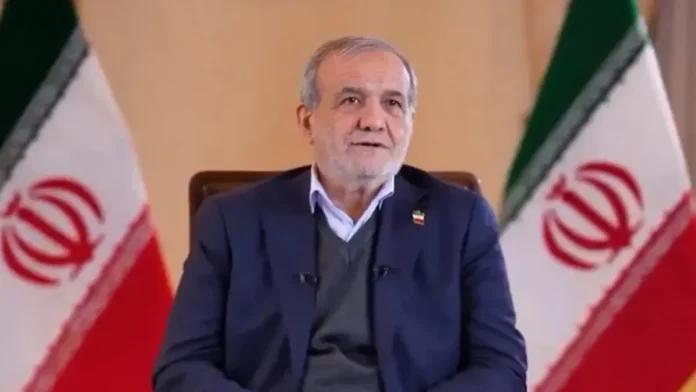
Tehran | November 9, 2026 : Iranian President Masoud Pezeshkian has reiterated that his country is willing to pursue dialogue and negotiations to resolve its differences with the United States, but will not accept any agreement imposed through pressure, threats or coercion. He stressed that any diplomatic engagement must be based on justice, equality and mutual respect, making it clear that Tehran is prepared to negotiate but will not surrender its national rights.
According to Iran’s state news agency ISNA, Pezeshkian made the remarks on Sunday while attending an event marking the 72nd anniversary of the establishment of Iran’s Pegah dairy company. The ceremony was attended by company executives and employees.
His comments come amid continuing tensions involving Iran, the United States and Israel, with diplomatic efforts focused on finding a way to end the prolonged confrontation.
Pezeshkian Says Iran Is Open to Dialogue
Addressing the gathering, Pezeshkian emphasized that Iran believes disputes should be resolved through dialogue whenever a diplomatic solution is possible.
He said negotiations could lead to a peaceful resolution if both sides approached the process with dignity and respect.
The Iranian president argued that if the country’s legitimate rights could be secured through negotiations, there would be no reason to expose the nation to the costs and consequences of another war.
However, he drew a clear distinction between genuine diplomacy and negotiations conducted under pressure.
Pezeshkian maintained that Iran would not surrender to force or accept terms that undermine its national interests.
His remarks reflect Tehran’s stated position of remaining open to diplomatic engagement while rejecting what it considers attempts to dictate the terms of an agreement.
What Did the Iranian President Say About the US and Israel?
Pezeshkian referred to the United States and Israel as adversaries of Iran and accused them of seeking to attack the country.
He also referred to instructions from Iran’s Supreme Leader, Ayatollah Mojtaba Hosseini Khamenei, saying the leadership had directed officials to end the prolonged situation of neither war nor peace.
The president said Iran wanted to resolve the confrontation through negotiations conducted with dignity.
He emphasized that his country was not opposed to reaching an agreement, provided the process respected the principles of fairness and equality.
Pezeshkian’s remarks underline the difference between Iran’s willingness to negotiate and its refusal to accept what it describes as coercive diplomatic conditions.
Iran Wants Negotiations on Fair and Equal Terms
The Iranian president reiterated that any negotiations must be founded on justice and equal conditions.
According to ISNA, he referred to his earlier address at the United Nations General Assembly, where he had also emphasized Iran’s willingness to engage in dialogue while protecting its rights.
Tehran has repeatedly argued that negotiations cannot produce a sustainable agreement if one side attempts to dictate terms through economic or military pressure.
For Iran, the central issue is not simply returning to the negotiating table but ensuring that any diplomatic arrangement recognizes its stated national interests.
This position could remain a significant factor in future discussions with Washington, particularly on sanctions, security arrangements and Iran’s broader regional concerns.
Why Pezeshkian’s Statement Matters
Pezeshkian’s latest remarks come at a time when diplomatic efforts are continuing to address tensions between Tehran and Washington.
The comments are significant because they combine two messages: Iran is prepared to pursue negotiations, but it does not intend to compromise under pressure.
The distinction matters for any future diplomatic initiative. A willingness to talk does not necessarily mean that an agreement is close, particularly when the two sides continue to disagree over the conditions under which negotiations should take place.
The United States and Iran will need to address these differences if diplomatic engagement is to produce a lasting settlement.
What Happens Next?
The next stage will depend on whether Washington and Tehran can establish mutually acceptable conditions for renewed negotiations.
Issues involving sanctions, security, military tensions and Iran’s national interests are likely to remain central to any potential agreement.
For now, Pezeshkian’s statement signals that Tehran continues to leave the door open to diplomacy while maintaining a firm position against external pressure.
The Bottom Line: Iran’s President Masoud Pezeshkian has signaled that his country is willing to negotiate with the United States, but only on the basis of justice, equality and mutual respect. His message is clear: Tehran wants a diplomatic solution, but it will not accept an agreement imposed through force or coercion.