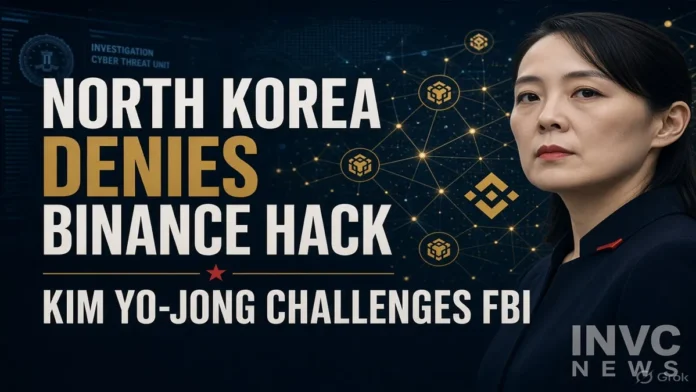
SEOUL, November 3, 2026 — North Korea has strongly rejected the US Federal Bureau of Investigation’s (FBI) claim that it was responsible for a cryptocurrency theft worth more than $6 billion from Binance, the world’s largest cryptocurrency exchange. Kim Yo-jong, the influential sister of North Korean leader Kim Jong-un, accused Washington of using the investigation to damage Pyongyang’s international reputation and described the allegation as a serious political provocation.
The response is notable because Kim Yo-jong rarely comments publicly on individual cyber incidents. Her statement, carried by North Korea’s state-run Korean Central News Agency (KCNA), signals that Pyongyang is treating the Binance case as more than a financial crime allegation. It has framed the dispute as part of a wider confrontation with the United States over sovereignty, international standing and what it describes as Washington’s hostile policy.
What Did the FBI Say About the Binance Theft?
The FBI issued a cyber alert on October 31, saying North Korea was responsible for the theft of more than $6 billion in virtual assets from Binance on or around October 29, 2026. The agency identified the operation as TraderTraitor, a name it uses for the specific North Korean-linked cyber activity.
According to the FBI, investigators observed the actors moving the stolen assets primarily into Ether, the cryptocurrency associated with the Ethereum network. The agency said the funds could subsequently be routed through decentralized finance platforms and instant-swap services as part of an effort to launder them.
The FBI issued the alert in coordination with the US Secret Service and the Internal Revenue Service’s Criminal Investigation division. It urged cryptocurrency exchanges, blockchain infrastructure operators, decentralized finance services and analytics companies to block transactions connected to wallet addresses associated with the suspected operation.
The FBI’s attribution is an official US investigative assessment. North Korea has rejected it, and the public statements available so far do not establish that Pyongyang accepts the findings or that the dispute has been independently resolved.
Kim Yo-jong Accuses Washington of a Political Campaign
In her statement, Kim Yo-jong said the FBI was attempting to portray the Democratic People’s Republic of Korea (DPRK), North Korea’s official name, as a “cyber criminal state.” She objected to the suggestion that a hacking organization supported by the North had been involved in the Binance incident.
Kim described the allegation as a serious political move against her country. She accused the United States of linking North Korea to cybercrime incidents around the world and presenting those accusations to the international community as established conclusions.
She also argued that the FBI’s announcement was intended to undermine North Korea’s dignity, reputation and standing abroad. Pyongyang, she said, regarded the accusation as another violation of its sovereignty in cyberspace.
North Korea has repeatedly denied allegations that it conducts or supports international cyber theft. Its latest response, however, stands out because it came directly from Kim Yo-jong rather than through the Foreign Ministry, the channel Pyongyang has often used for statements on similar disputes.
North Korea Turns the Accusation Back on the United States
Kim also questioned what would happen to the cryptocurrency if the stolen assets were recovered. She referred to statements by the Trump administration about seizing illegally obtained cryptocurrency and using it for a strategic reserve.
She suggested that examining who would ultimately benefit from the recovery of the allegedly stolen assets could offer clues about the people behind the incident. Her remarks did not provide evidence that the United States was involved in the Binance theft.
Kim said North Korea was closely monitoring what she described as repeated US provocations. She warned that Washington’s hostile approach could force Pyongyang to reconsider its position on several issues.
The remarks add a political dimension to a case that already has major implications for cryptocurrency exchanges, blockchain service providers and international cybercrime investigations.
Why the TraderTraitor Label Matters
The FBI’s use of the name TraderTraitor places the Binance incident within a wider pattern of cyber activity that US authorities have associated with North Korea. The name has previously been linked to other cryptocurrency thefts.
The Associated Press has reported that the same hacking group was also associated with last year’s $1.5 billion attack on the Bybit exchange. South Korea’s National Intelligence Service estimated in December 2022 that North Korean hackers had stolen about 1.5 trillion won, or approximately $1.1 billion, in cryptocurrency and other virtual assets over the preceding five years.
Cybersecurity experts have long examined cryptocurrency theft as a possible source of foreign currency for North Korea, which faces extensive international sanctions. Analysts have argued that illicit cyber operations can help the country obtain funds despite restrictions on its access to the global financial system. These broader assessments, however, should not be treated as independent proof of responsibility for the latest Binance incident.
South Korea Sees a Significant Change in Pyongyang’s Response
A senior official at South Korea’s Unification Ministry said Kim Yo-jong’s statement was the first public response from her on allegations of North Korean involvement in a cyberattack.
The official suggested that Pyongyang was taking the issue seriously because the Binance incident had triggered international attention and could have consequences beyond the immediate investigation.
In the past, North Korea generally responded to similar accusations through statements issued by its Foreign Ministry. The decision to have Kim Yo-jong address the issue directly may indicate that the leadership wants to underline the political importance it attaches to the allegations.
The official also said Pyongyang appeared concerned about its international image as it seeks to present itself as a “normal country.” The statement could therefore be an attempt to prevent the cyber allegations from becoming a broader international campaign against North Korea.
Could the Dispute Affect Trump-Kim Diplomacy?
The Binance case is unfolding at a time when US President Donald Trump has expressed interest in restoring diplomatic engagement with Kim Jong-un. North Korea has not publicly responded to Trump’s repeated overtures for a possible summit.
The impact of the latest dispute on any future meeting remains uncertain. South Korean officials have said it is difficult to assess whether the hacking allegations and Pyongyang’s reaction will affect the prospects for renewed talks.
There is also an important distinction between the FBI’s assessment and Trump’s public comments. The FBI formally attributed the theft to North Korea in its October 31 alert. But, according to the Associated Press, Trump later said investigators were still examining whether North Korea was responsible and that the United States did not yet know for certain.
That difference underlines the need to distinguish between the agency’s official attribution, the political leadership’s public comments and North Korea’s categorical denial.
What Happens Next?
The immediate focus will be on whether US authorities and their international partners can trace, freeze or block the movement of the stolen cryptocurrency. The FBI has already published wallet addresses associated with the suspected operation and called on private-sector firms to prevent transactions linked to them.
For Binance and the wider digital-asset industry, the case highlights the risks posed by large-scale cyber theft and the difficulty of stopping stolen funds once they move across multiple blockchain networks and services.
For North Korea and the United States, the dispute has added another point of friction to an already complicated relationship. Whether it becomes an obstacle to renewed diplomacy will depend on how the investigation develops and how both governments choose to respond.
Bottom Line: The FBI has formally blamed North Korea for the theft of more than $6 billion in cryptocurrency from Binance, while Kim Yo-jong has rejected the allegation as a politically motivated attack. Until further evidence and investigative findings emerge, the responsibility claim remains disputed by Pyongyang.