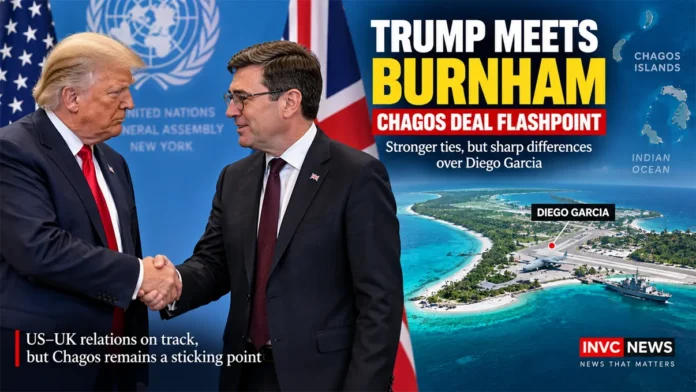
NEW YORK, United States | September 23, 2026 — US President Donald Trump and Britain’s new Prime Minister Andy Burnham struck a positive tone during their first face-to-face meeting at the United Nations General Assembly, but a major strategic disagreement over the Chagos Islands and the Diego Garcia military base remains unresolved.
The two leaders met in New York on September 22 and emphasized the importance of the long-standing US-UK relationship.
Trump also spoke positively about Burnham’s business instincts, describing him as a natural businessperson, while suggesting that relations between Washington and London had improved under Britain’s new prime minister.
However, that warmth did not extend to Britain’s agreement with Mauritius over the Chagos Archipelago.
Trump has strongly objected to the plan under which Mauritius would receive sovereignty over the islands while Britain would retain long-term rights over Diego Garcia to ensure continued operation of the strategically important UK-US military base.
Trump and Burnham Hold First Face-to-Face Meeting
The New York meeting marked the first in-person encounter between Trump and Burnham since Burnham became prime minister in July.
The two had already spoken by phone several times.
According to Downing Street, they began the meeting by discussing the closeness of the UK-US relationship and welcomed the economic benefits generated by bilateral trade.
Burnham also outlined his domestic economic agenda, including reindustrialisation and efforts to strengthen British growth.
Migration, Ukraine, Iran, the Strait of Hormuz, the Falkland Islands and the case of British citizen Jimmy Lai were also discussed.
Trump Praises Burnham’s Business Approach
Trump publicly offered an encouraging assessment of Burnham during the meeting.
He highlighted Burnham’s business-oriented approach and indicated that he believed the two leaders could develop a productive working relationship.
Burnham separately described the early relationship as a good connection and stressed the importance of maintaining close cooperation between London and Washington.
The positive language was notable because the two governments continue to disagree on several international issues.
Those differences include aspects of artificial-intelligence regulation, Middle East policy and the future of the Chagos Islands.
Why Did Trump Object to the Chagos Deal?
The core dispute concerns the Chagos Archipelago, a strategically located group of islands in the Indian Ocean.
Britain and Mauritius signed an agreement in May 2025 dealing with sovereignty over the islands.
Under the framework, Mauritius would hold sovereignty over the Chagos Archipelago, including Diego Garcia.
However, Britain would retain authority necessary to operate the military base on Diego Garcia under a 99-year arrangement.
The purpose of that arrangement is to allow the UK-US military facility to continue operating well into the next century.
Trump has argued that the arrangement is strategically flawed.
He has objected to Britain transferring sovereignty over the islands while relying on a lease arrangement to preserve access to Diego Garcia.
His criticism has contributed to political and legislative complications surrounding implementation of the deal.
Why Diego Garcia Matters to the United States
Diego Garcia is far more important than its remote location might suggest.
The island hosts a major joint UK-US military facility in the Indian Ocean.
Britain agreed in 1966 to make the territory available for defence purposes involving both countries.
The base has since become an important strategic platform for military operations across the Indian Ocean, Middle East and surrounding regions.
Its position gives the United States and Britain access to a strategically valuable area stretching toward the Gulf, South Asia and East Africa.
That is why Washington views any change to the legal status of Diego Garcia through a national-security lens.
What Does the UK-Mauritius Agreement Actually Do?
The original UK-Mauritius framework does not call for closing the Diego Garcia base.
Instead, it attempts to do two things simultaneously.
First, it recognises Mauritian sovereignty over the Chagos Archipelago.
Second, it seeks to preserve the long-term operation of the existing UK-US military base.
The agreement provides for Britain to exercise the rights and authorities needed to operate Diego Garcia for an initial 99-year period.
Supporters of the agreement argue that it attempts to resolve the long-running sovereignty dispute while protecting the base.
Trump and other critics have questioned whether transferring sovereignty creates unnecessary strategic uncertainty around a facility that is important to Western defence planning.
Deal Has Faced Delays
The Chagos agreement has not moved forward smoothly.
Earlier in 2026, Mauritius said it would wait for Britain to finalise the arrangement after London put implementation on hold amid objections from Trump.
Those US concerns became an important factor in the continuing dispute over how the agreement should proceed.
The issue has therefore moved beyond a bilateral disagreement between London and Port Louis.
Washington’s security interests now make it a three-way diplomatic problem involving Britain, Mauritius and the United States.
Burnham Says He Wants a Solution
Burnham has signalled that he does not want the disagreement to damage broader UK-US relations.
Before meeting Trump, the British prime minister spoke with Mauritian Prime Minister Navin Ramgoolam.
During that conversation, Burnham said he wanted Britain, Mauritius and the United States to work together on a solution that guarantees continued operation of the Diego Garcia base while protecting British national-security interests.
He repeated that position during his meeting with Trump.
The official Downing Street account states that Burnham told the US president he was committed to working with all parties to find a solution on Diego Garcia.
Why Britain Cannot Simply Ignore Mauritius
The Chagos dispute has a long legal and diplomatic history.
Mauritius has maintained that the islands belong to it, while Britain historically administered the territory as the British Indian Ocean Territory.
After years of international pressure and negotiations, London and Port Louis reached the sovereignty framework that culminated in the May 2025 agreement.
That means Burnham inherits a complicated problem.
Walking away from the deal could reopen disputes with Mauritius and raise broader international-law and diplomatic questions.
Proceeding without satisfying Washington could strain cooperation with Britain’s most important military partner on Diego Garcia.
Trump’s Objection Creates a Strategic Dilemma for Burnham
Burnham therefore faces three competing objectives.
He needs to preserve Britain’s close defence partnership with the United States.
He also wants to maintain constructive relations with Mauritius.
At the same time, his government must determine whether and how the existing Chagos agreement can be implemented.
The political challenge is finding a formula that all three governments can accept without weakening the military base.
Hormuz and Iran Also Enter the Conversation
Diego Garcia was not the only major strategic issue discussed.
Trump and Burnham also spoke about reopening commercial shipping through the Strait of Hormuz and preventing Iran from acquiring a nuclear weapon.
Burnham linked instability in the Middle East to higher living costs in Britain, reflecting the impact that energy prices and shipping disruptions can have on European economies.
Ukraine was another major subject.
Downing Street said both leaders discussed securing a lasting peace, while Trump acknowledged Britain’s support for Ukraine.
Falkland Islands Also Raised
Burnham also used the meeting to reiterate Britain’s position on the Falkland Islands.
The Downing Street statement said the prime minister made clear that Britain would stand firm regarding threats to the islands.
That discussion adds another sovereignty issue to Burnham’s first major diplomatic engagement with Trump.
However, the Chagos question remains more immediately complicated because the United States itself operates a military base on Diego Garcia.
What Happens Next?
The disagreement is unlikely to disappear after one meeting.
Britain is now expected to continue talks with both Washington and Mauritius.
Foreign ministers from Britain and Mauritius were also expected to use the UN General Assembly gathering to continue discussions over the future of Diego Garcia.
The first Trump-Burnham meeting therefore produced two very different signals.
On the broader relationship, both sides emphasized cooperation and personal rapport.
On Chagos and Diego Garcia, however, the underlying strategic dispute remains unresolved.
For Burnham, solving that dispute may become one of the earliest tests of his foreign policy.