
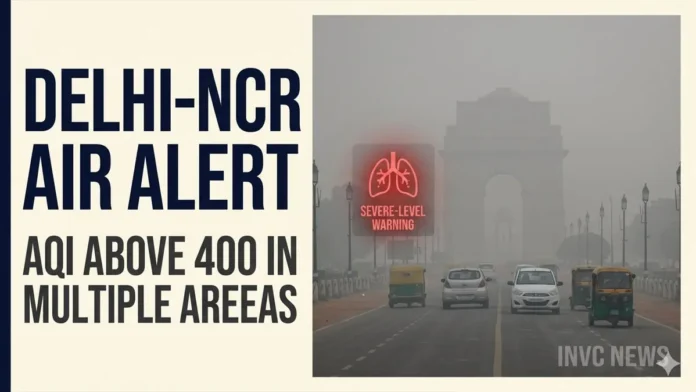
New Delhi, November 3, 2026: Air pollution across Delhi-NCR has deteriorated sharply, with several monitoring stations recording Air Quality Index (AQI) readings above 400 on Tuesday morning. The national capital’s average AQI stood at 331 at around 7 a.m., placing it in the ‘very poor’ category under the Central Pollution Control Board’s (CPCB) classification. Noida recorded an AQI of 307 in the reported CPCB-based city readings.
Although the city-wide averages in Delhi and Noida were below 400, pollution at several individual locations had entered the ‘severe’ category. The worsening air quality has raised concerns about respiratory health, outdoor activities and the effectiveness of pollution-control measures as winter approaches.
Delhi’s Worst-Affected Areas: AQI Above 400
The CPCB’s monitoring data showed that eight locations in Delhi had crossed the 400 mark by Tuesday morning.
Jahangirpuri recorded an AQI of 449, making it one of the most polluted locations in the capital. Other severely affected areas included:
- Rohini: 429
- Punjabi Bagh: 424
- Alipur: 413
- Vivek Vihar: 410
- Bawana: 408
- Delhi Technological University: 407
- Narela: 406
Out of 58 monitoring stations with valid readings, 57 recorded AQI levels above 200, while 41 were above 300. This indicates that poor air quality was widespread rather than restricted to a few pollution hotspots.
The IITM’s Delhi Air Quality Early Warning System also showed severe readings at several stations, including Jahangirpuri, Punjabi Bagh, Rohini and Bawana.
Noida, Ghaziabad and Gurugram Also Face Poor Air Quality
Pollution levels were elevated across neighbouring NCR cities.
According to the reported CPCB city-level readings:
- Noida: 307
- Manesar: 302
- Gurugram: 284
- Ghaziabad: 259
- Greater Noida: 213
- Faridabad: 111
Noida and Manesar were in the very poor category, while Gurugram, Ghaziabad and Greater Noida also recorded unhealthy air quality.
Some independently updated air-quality platforms reported substantially higher real-time readings for Noida and other NCR locations. Such figures can differ because of monitoring networks, update times and calculation methods. For an official comparison, CPCB’s city averages and station-level readings should be distinguished from third-party real-time estimates.
Why Is Delhi-NCR’s Air Quality Getting Worse?
The deterioration is being driven by a combination of pollution emissions and weather conditions that make it difficult for pollutants to disperse.
1. Low wind speed
When wind speeds remain low, pollutants can stay concentrated close to the ground instead of being carried away. This can increase the accumulation of particulate matter over residential and commercial areas.
2. High humidity and atmospheric conditions
High humidity, cooler temperatures and unfavourable atmospheric conditions can contribute to the formation and persistence of haze. These conditions can also reduce the effectiveness of natural pollution dispersal.
3. Vehicle emissions and road dust
Heavy traffic, vehicle exhaust, road dust and congestion remain important sources of pollution in the capital region. Construction activity and industrial emissions can add to the overall burden.
4. Crop-residue burning
Farm fires in Punjab and Haryana are another seasonal contributor. Satellite observations cited in recent reporting detected 1,561 farm fires in the two states between October 1 and November 2, including 167 on November 2. However, crop burning is only one part of the pollution picture; local emissions and weather conditions also matter.
PM2.5: The Invisible Threat in the Air
Fine particulate matter, particularly PM2.5, has been identified as a prominent pollutant across several Delhi monitoring stations.
PM2.5 particles are extremely small and can penetrate deep into the lungs. Some particles can enter the bloodstream, increasing health risks, particularly with repeated or prolonged exposure.
High pollution levels can cause or aggravate:
- Coughing and throat irritation
- Breathlessness and wheezing
- Eye irritation
- Asthma symptoms
- Respiratory infections and other lung-related problems
- Cardiovascular stress, particularly among vulnerable individuals
Even people without an existing respiratory condition may experience discomfort when exposed to severely polluted air.
GRAP Stage II Restrictions Across Delhi-NCR
The Commission for Air Quality Management (CAQM) invoked Stage II of the Graded Response Action Plan (GRAP) across Delhi-NCR on November 2 after the capital’s AQI reached 324 at 4 p.m.
The decision followed forecasts indicating that air quality could remain in the very poor category over the coming days.
Key measures under GRAP Stage II include:
- More frequent mechanical or vacuum-based road sweeping.
- Water sprinkling with dust suppressants on heavily trafficked roads.
- Stronger inspections at construction and demolition sites.
- Action against identified pollution hotspots.
- Staggered office timings for government and municipal employees, as directed.
- Higher parking charges to discourage unnecessary private vehicle use.
- Efforts to increase public transport services.
The authorities have also been directed to strengthen enforcement across Delhi, Haryana, Uttar Pradesh and Rajasthan’s NCR areas.
These measures are intended to reduce emissions and prevent further deterioration. Their effectiveness depends on consistent implementation and cooperation from residents, businesses and public agencies.
What Does an AQI Above 400 Mean?
Under India’s CPCB National Air Quality Index classification, the categories are:
- 0–50: Good
- 51–100: Satisfactory
- 101–200: Moderate
- 201–300: Poor
- 301–400: Very Poor
- 401–500: Severe
An AQI above 400 indicates severe pollution. Prolonged exposure can affect healthy people, while those with existing respiratory or cardiovascular conditions face greater risks.
It is important not to confuse India’s AQI scale with the different scales used by some international or private air-quality platforms.
How Can Residents Protect Themselves?
With pollution levels elevated across the capital region, residents should take practical precautions.
Limit outdoor exercise: Avoid running, cycling and strenuous workouts outdoors when air quality is very poor or severe.
Use a well-fitted N95 mask outdoors: A properly fitted particulate respirator can help reduce exposure to fine particles. Ordinary cloth masks may not provide equivalent protection.
Keep windows closed during high-pollution periods: Ventilate indoor spaces when outdoor air quality improves.
Use an appropriate air purifier: A correctly sized HEPA air purifier may reduce indoor particulate pollution. Keep doors and windows closed while it operates.
Protect children and vulnerable people: Children, older adults, pregnant people and those with asthma, heart disease or other chronic conditions should take extra care and follow medical advice.
Seek medical help when needed: Persistent breathlessness, chest pain, severe wheezing or worsening respiratory symptoms should not be ignored.
Will Delhi-NCR’s Air Quality Improve?
The short-term outlook remains concerning. The Air Quality Early Warning System indicated that Delhi’s air quality could remain in the very poor category from November 3 to November 5, with a possibility of gradual improvement afterwards.
However, forecasts are not guarantees. Wind speed, atmospheric mixing, temperature, humidity, local emissions and regional pollution sources will influence actual conditions.
Residents should check current CPCB monitoring data and official advisories before planning outdoor activities.
The Bottom Line
Delhi-NCR is facing another serious air-pollution episode. Delhi’s city-wide AQI reached 331 in the CPCB morning snapshot, while eight monitoring locations crossed 400. Noida’s reported CPCB city reading stood at 307, with other NCR cities also experiencing elevated pollution.
The figures show why a single city-wide AQI number cannot tell the complete story. Conditions can vary sharply from one neighbourhood to another.
GRAP Stage II measures are now in force, but controlling the pollution crisis requires sustained action on vehicle emissions, road dust, construction pollution, industrial sources and seasonal crop burning. For residents, reducing outdoor exposure and monitoring local air quality are essential precautions.
INVC NEWS | Air Quality Update | November 3, 2026
This report uses the latest cited readings available for the morning of November 3. AQI values are time-sensitive and can change throughout the day. It is a public-interest news report, not a medical diagnosis or individual treatment advice.