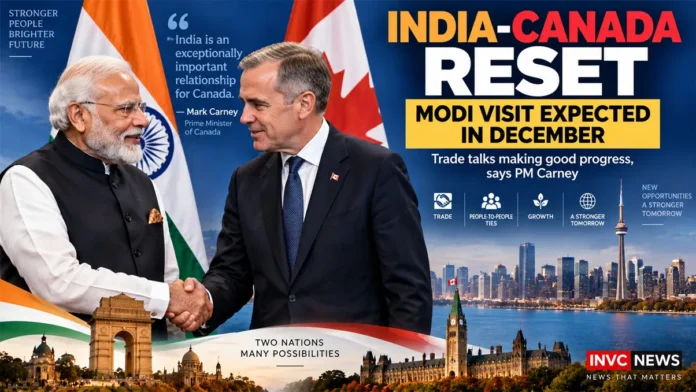
NEW DELHI, India | September 23, 2026 — India and Canada appear to be moving rapidly away from one of the most difficult periods in their modern relationship, with Canadian Prime Minister Mark Carney saying Prime Minister Narendra Modi is expected to visit Canada around December as both countries push to conclude a major trade agreement before the end of 2026.
Carney, speaking on the sidelines of the United Nations General Assembly in New York, described India as an “exceptionally important” relationship for Canada and said negotiations were making good progress across trade, security and people-to-people ties.
The development marks a striking turnaround from 2023 and 2024, when diplomatic relations deteriorated sharply following allegations surrounding the killing of Canadian Sikh separatist Hardeep Singh Nijjar.
However, the reset does not mean that every dispute has disappeared.
What Did Mark Carney Say About PM Modi?
Carney said Canada and India were making progress in their trade negotiations and stressed that the relationship mattered on several levels, including economic ties, security cooperation and links between the people of the two countries.
He also said Prime Minister Modi was expected to visit Canada around the time the two governments hope to complete their trade negotiations.
Carney said he looked forward to hosting the Indian prime minister.
Reuters separately reported, citing The Globe and Mail, that PM Modi is expected to travel to Canada in December in connection with efforts to finalise a trade agreement.
The exact date, however, has not yet been publicly announced by New Delhi.
Why December Could Become Crucial
India and Canada have set themselves an ambitious target: completing negotiations on a Comprehensive Economic Partnership Agreement, or CEPA, by the end of 2026.
The two governments formally launched CEPA negotiations during Carney’s visit to India earlier this year.
Their March joint statement set a broader ambition of expanding bilateral trade to around CAD 70 billion, or roughly ₹4.65 lakh crore, by 2030.
Canada’s International Trade Minister Maninder Sidhu said this month that Ottawa remained optimistic about finishing the negotiations before year-end.
That makes a possible Modi visit in December potentially significant.
If negotiations advance sufficiently, the visit could provide political momentum for completing or announcing a major trade framework.
India-Canada Relations Were Very Different in 2023
The current diplomatic atmosphere stands in sharp contrast to September 2023.
Relations deteriorated dramatically after then-Canadian Prime Minister Justin Trudeau said Canadian authorities were pursuing what he described as credible allegations of a potential link between Indian government agents and the June 2023 killing of Hardeep Singh Nijjar in British Columbia.
India rejected the allegation, calling it absurd and motivated.
The disagreement quickly expanded beyond the murder investigation.
Both countries expelled diplomats. India temporarily suspended visa services for Canadian citizens, while Canada reduced its diplomatic presence in India.
Trade negotiations also stalled.
The dispute escalated again in October 2024 when Canada linked several Indian diplomats to investigations involving Nijjar and alleged criminal activity.
India rejected those allegations as well and expelled Canadian diplomats in response.
Those allegations remain a sensitive part of the bilateral relationship and should not be treated as established findings against the Indian government.
What Changed Under Mark Carney?
The relationship began moving in a different direction after Mark Carney became Canadian prime minister.
Carney travelled to India from February 27 to March 2, 2026, becoming the first Canadian prime minister to make a bilateral India visit since 2018.
During that trip, Carney and Prime Minister Narendra Modi formally launched a new phase of engagement focused on trade, energy, critical minerals, technology, talent and defence cooperation.
Carney also invited PM Modi to visit Canada.
The leaders met again at the G7 summit in Évian, France, on June 16.
At that meeting, both governments publicly welcomed the “positive momentum” in relations and reiterated their goal of concluding CEPA negotiations during 2026.
Prime Minister Modi thanked Carney for the invitation to Canada, while the two governments said diplomatic channels would work on a mutually convenient date.
Trade Has Become the Engine of the Reset
Economics now sits at the heart of the India-Canada rapprochement.
The two countries see opportunities in energy, critical minerals, agriculture, technology, artificial intelligence and investment.
During Carney’s March India visit, Canada highlighted more than $30 billion in annual two-way trade and around $100 billion in two-way investment, while arguing that the economic relationship remained below its potential.
Canada also sees India as an increasingly important market for LNG, uranium and critical minerals.
India, meanwhile, could gain greater market access and investment opportunities through a comprehensive trade agreement.
The March agreements included cooperation on critical-mineral supply chains and a long-term uranium supply arrangement involving Canada’s Cameco and India’s Department of Atomic Energy.
Why Canada Is Pushing Harder Toward India
Canada’s foreign-economic strategy has also changed.
Carney’s government has repeatedly stressed the need to diversify Canada’s international economic partnerships rather than remain overwhelmingly dependent on the United States.
That strategy has become more important as Ottawa’s trade relationship with Washington has faced renewed tensions in 2026.
India, with its large market and growing demand for energy, minerals and technology, naturally fits that diversification strategy.
For New Delhi, stronger ties with Canada can also widen India’s network of economic partners at a time of increasing uncertainty in global trade.
People-to-People Ties Remain Central
Trade is only one part of the relationship.
Canada has one of the world’s largest Indian-origin communities, and education, migration, professional mobility and family connections create unusually deep links between the two countries.
The two governments have also launched a Canada-India Talent and Innovation Strategy aimed at expanding research, skills and institutional cooperation.
That makes stable diplomatic relations particularly important for students, families and businesses on both sides.
Have India-Canada Relations Fully Normalised?
Not entirely.
The pace of diplomatic and economic engagement has clearly accelerated, and both governments now publicly describe the trajectory positively.
However, the legacy of the Nijjar dispute and broader security concerns has not simply vanished.
The governments are instead rebuilding cooperation while managing areas where their positions have differed.
That distinction matters.
The emerging relationship is not a return to the past. It is a deliberate attempt to build a new framework around trade, energy, technology, security and mutual economic interests.
Could a Trade Deal Become the Symbol of the Reset?
Possibly — but negotiations still have to produce an agreement acceptable to both governments.
India and Canada have publicly committed to trying to finish CEPA negotiations in 2026, and Canadian officials say progress is encouraging.
If the negotiations reach their final stage before Prime Minister Modi’s expected Canada visit, a trade deal could become the most visible sign yet that relations have moved beyond the diplomatic crisis that began in 2023.
For now, three developments deserve watching closely:
the next rounds of CEPA negotiations,
an official announcement from India confirming PM Modi’s Canada travel dates,
and whether both governments can maintain cooperation on trade while continuing to manage unresolved security issues.
The direction of travel is unmistakably different from three years ago.
But December could reveal just how far the India-Canada reset has really progressed.