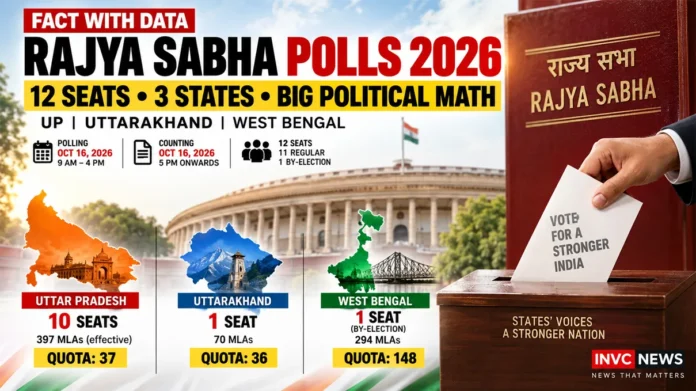
NEW DELHI, India | September 23, 2026 — Rajya Sabha Election 2026 has opened another important round of political arithmetic, with 12 Upper House seats across Uttar Pradesh, Uttarakhand and West Bengal scheduled for elections on October 16.
The Election Commission has announced biennial elections for 11 seats — 10 in Uttar Pradesh and one in Uttarakhand — along with a by-election for one West Bengal seat. Polling, if required, will take place on October 16.
But the headline number — 12 seats — tells only part of the story.
The real contest lies in the numbers inside the three state assemblies.
How many first-preference votes does a candidate need? How many MLAs does each major party have? Why is Uttar Pradesh much more complicated than Uttarakhand or West Bengal? And why can even a handful of MLAs become important when the final seat is calculated?
Here is the election arithmetic, based on current assembly strength and the Rajya Sabha voting formula.
First, the Election Schedule
The Election Commission’s timetable is:
Notification: September 29, 2026
Last date for nominations: October 6
Scrutiny of nominations: October 7
Last date for withdrawal: October 9
Polling: October 16, 9 AM to 4 PM
Counting: October 16 from 5 PM
Election process to be completed by: October 19
The polling time is important: voting is scheduled to end at 4 PM, not 5 PM.
How Is a Rajya Sabha MP Elected?
Rajya Sabha members are not elected directly by the public.
Elected members of a state’s Legislative Assembly form the electoral college.
The election uses proportional representation through the single transferable vote system.
An MLA marks preferences — 1 for the first preference, 2 for the second, and so on.
The quota is broadly calculated as:
Total valid votes ÷ (Number of seats to be filled + 1), ignoring the fraction, then +1
That final point is crucial.
It is why the Uttar Pradesh quota comes to 37, not 38.
Uttar Pradesh: 10 Seats, 397 MLAs — Quota Is 37
Uttar Pradesh has a sanctioned Assembly strength of 403, but the current effective strength is 397 because six seats are vacant.
For 10 Rajya Sabha seats:
397 ÷ (10 + 1) = 36.09
Ignore the decimal:
36 + 1 = 37
Therefore, assuming 397 valid votes, a candidate needs 37 first-preference votes to reach the quota.
Why 38 Is Incorrect
A common calculation takes 36.09 and rounds it upward before adding one.
That is not how the quota formula works.
The fraction is discarded first.
Therefore:
Correct quota: 37
Not: 38
That single-vote correction significantly changes the arithmetic for the tenth seat.
UP Assembly Numbers
Current reported party strength includes:
BJP: 256 MLAs
Samajwadi Party: 101
Apna Dal (S): 13
Rashtriya Lok Dal: 9
Suheldev Bharatiya Samaj Party: 6
NISHAD Party: 5
Congress: 2
Jansatta Dal (Loktantrik): 2
There are also unattached/independent legislators, while six seats are vacant.
The exact “bloc” total can vary in political reports depending on whether independents, unattached MLAs or outside supporters are counted with an alliance. For that reason, party membership and declared alliance strength should be kept separate.
BJP and Its Formal NDA Allies: What Does the Arithmetic Say?
Taking BJP and its listed NDA allies:
**BJP 256
- Apna Dal (S) 13
- RLD 9
- SBSP 6
- NISHAD Party 5
= 289 MLAs**
At a quota of 37:
7 quotas require 259 votes
That leaves:
289 − 259 = 30
An eighth full quota requires another:
37 − 30 = 7 votes
This does not itself determine an election result because candidates, additional support, abstentions, cross-voting and transfers can alter the final count.
Some current political reports place the wider NDA-backed number higher after including supportive legislators outside the formal alliance.
What If the Wider Supporting Bloc Reaches 294?
Some reports count the NDA-backed side at up to 294 when additional support, including Jansatta Dal (Loktantrik), is included.
At 294 votes:
Seven quotas consume:
37 × 7 = 259
Balance:
294 − 259 = 35
That is:
2 votes below an eighth 37-vote quota
This is why every additional MLA becomes important once the first seven quotas have been allocated.
SP-Congress Arithmetic
The Samajwadi Party currently has 101 MLAs, while Congress has 2.
Combined:
101 + 2 = 103
Two full quotas require:
37 × 2 = 74 votes
Balance:
103 − 74 = 29
A third full quota would require:
37 − 29 = 8 additional first-preference votes
Again, this is arithmetic rather than an election forecast. Actual outcomes depend on nominations, valid votes and preference transfers.
Why the 10th UP Seat Gets Attention
The first-preference arithmetic explains why most political attention is likely to focus on how votes are distributed after the larger blocs allocate their initial quotas.
Rajya Sabha voting is not simply a first-past-the-post contest.
Preferences can transfer when candidates exceed the quota or are eliminated.
Abstentions and invalid votes can also change the effective quota because the calculation ultimately depends on valid votes cast.
Therefore, the October 16 candidate list and actual voting strength will matter as much as today’s headline Assembly numbers.
Which UP Rajya Sabha Seats Are Falling Vacant?
Of the 10 UP seats involved, eight were held by the BJP, one by the Samajwadi Party and one by the BSP.
The members connected to these seats include:
Hardeep Singh Puri — BJP
Arun Singh — BJP
Neeraj Shekhar — BJP
Brij Lal — BJP
B.L. Verma — BJP
Seema Dwivedi — BJP
Geeta Shakya — BJP
Dinesh Sharma — BJP
Ram Gopal Yadav — Samajwadi Party
Ramji Gautam — BSP
Nine regular terms end on November 25, 2026.
Dinesh Sharma’s seat is already vacant after he resigned from the Rajya Sabha on September 11 following his appointment as Lieutenant Governor of the Andaman and Nicobar Islands.
What Makes the BSP Situation Different?
The BSP’s Ramji Gautam is among the members whose Rajya Sabha term ends in November.
The party currently has no MLA in the Uttar Pradesh Assembly, following the death of its remaining legislator in August.
That means the BSP does not independently possess the 37 first-preference votes required for a candidate under the present Assembly strength.
Any candidate associated with the party would therefore depend on votes from legislators belonging to other parties or groups.
Uttarakhand: One Seat, Much Simpler Formula
Uttarakhand has 70 MLAs.
Because only one Rajya Sabha seat is being filled, the quota calculation is:
70 ÷ (1 + 1) = 35
Then add one:
Quota = 36 votes
The current Uttarakhand Assembly party strength listed by the state’s National e-Vidhan portal is:
BJP: 47
Congress: 20
Independents: 2
BSP: 1
Total:
70 MLAs.
Numerically, BJP’s 47-member strength stands 11 above the 36-vote benchmark, while Congress has 20 MLAs.
The Rajya Sabha seat currently belongs to BJP MP Naresh Bansal, whose term ends on November 25.
West Bengal: One By-Election, 148-Vote Benchmark
West Bengal has a 294-member Assembly.
The final 2026 Assembly result gave:
BJP: 208 seats
Trinamool Congress: 80
Congress: 2
Aam Janata Unnayan Party: 2
CPI(M): 1
All India Secular Front: 1
The BJP’s final tally reached 208 after it won the delayed Falta contest as well.
For a single Rajya Sabha seat:
294 ÷ 2 = 147
Add one:
Quota = 148
Therefore, if all 294 MLAs cast valid votes, the benchmark is 148 first-preference votes.
BJP’s Assembly strength of 208 is 60 above that number; TMC’s 80 is 68 below it.
Those numbers describe the present legislative arithmetic without accounting for any future candidate choices, abstentions or voting changes.
Why Is There a By-Election in Bengal?
The vacancy followed the resignation of Rukmini Mallik, who is widely known by her professional name Koel Mallick.
She resigned from the Rajya Sabha on July 16, 2026.
Her original term was due to continue until April 2, 2032, so the October election is a by-election for the remainder of that term rather than a fresh six-year term.
This also explains why some reports call it the “Rukmini Mallik seat” while others call it the “Koel Mallick seat.”
They refer to the same former MP.
Fact Check: Three Numbers to Remember
For readers trying to understand the entire election quickly, these are the key figures:
Uttar Pradesh
Seats: 10
Effective MLAs: 397
First-preference quota: 37
Uttarakhand
Seats: 1
MLAs: 70
First-preference quota: 36
West Bengal
By-election seats: 1
MLAs: 294
First-preference benchmark: 148
Why Second Preferences Matter More in UP
Uttarakhand and Bengal each have only one seat in this election cycle.
Uttar Pradesh has 10.
That makes UP’s election far more dependent on proportional representation and transferable preferences.
An MLA can rank candidates in order of preference.
If a candidate receives more votes than required, the transferable value of surplus votes can move to subsequent preferences under the counting rules.
Similarly, preferences on ballots belonging to eliminated candidates can become relevant.
That is why simply dividing an alliance’s MLA count by 37 does not necessarily reproduce the final result in a contested election.
The Biggest Data Point: 37, Not 38
Among all the numbers in this election, the most important correction is Uttar Pradesh’s quota.
With the current effective Assembly strength of 397, the first-preference quota for 10 seats works out to:
37 votes per candidate
—not 38.
That means every calculation about the eighth, ninth or tenth seat should start from 37.
And as October 16 approaches, the decisive data will not simply be how many MLAs each party has on paper, but how many valid first-preference votes are actually cast and how subsequent preferences transfer during counting.