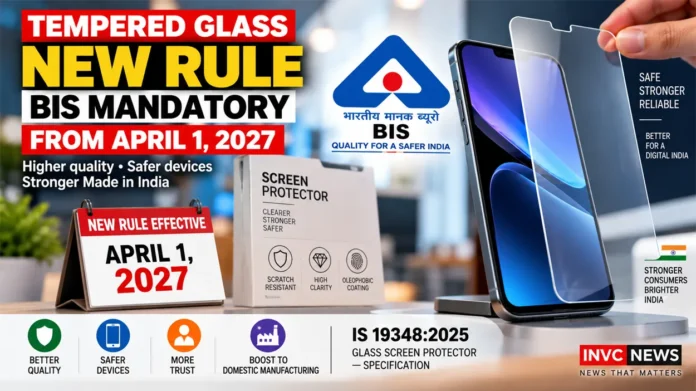
NEW DELHI, India | September 23, 2026 — That ₹100 or ₹200 tempered glass placed on your expensive smartphone will soon have to meet a defined Indian quality standard.
The government has brought screen protectors for smartphones under mandatory BIS registration, a major change aimed at bringing greater quality control to one of India’s largest and most fragmented mobile-accessory markets.
The new requirement will take effect from April 1, 2027.
Under the notification issued by the Ministry of Electronics and Information Technology, smartphone screen protectors must conform to IS 19348:2025 — Glass Screen Protector — Specification.
That means manufacturers and importers will no longer be able to legally treat smartphone glass protectors as an entirely unregulated accessory once the rule comes into force.
What Exactly Has the Government Changed?
The government amended the Electronics and Information Technology Goods (Requirement of Compulsory Registration) Order, 2021 on September 21, 2026.
It inserted smartphone screen protectors as entry No. 66 in the compulsory-registration schedule.
The notification specifies:
Product: Screen Protectors for Smartphones
Indian Standard: IS 19348:2025
Standard: Glass Screen Protector — Specification
Effective Date: April 1, 2027
The BIS website now also lists the product under its compulsory registration scheme.
Does This Mean Cheap Tempered Glass Will Be Banned?
Not simply because it is cheap.
The government has not announced a price-based ban.
Instead, the rule makes conformity with the prescribed Indian standard compulsory.
A low-cost protector could continue to be sold if it meets the applicable standard and registration requirements.
However, products that fail to meet the mandatory requirements will face a much more difficult path into the legitimate market.
For consumers, therefore, the important distinction will increasingly become:
certified vs non-compliant, rather than simply expensive vs cheap.
What Will BIS Check?
The Indian standard establishes specifications and testing requirements for glass screen protectors.
Industry reporting indicates that compliance testing can involve areas such as:
Dimensional tolerance
Glass thickness
Visual quality
Optical performance
Surface stress
Depth of strengthened layer
and other performance requirements associated with chemically strengthened or tempered glass.
The underlying standard describes a glass screen protector as a multi-layer protective covering that can include strengthened glass along with components such as adhesive, anti-shatter film, oleophobic coating, anti-glare treatment, privacy layers or fingerprint-resistant coatings.
In simple language, a manufacturer will no longer be able to rely solely on marketing claims such as “9H,” “military grade,” or “premium tempered” without meeting the applicable mandatory standard once enforcement begins.
Why Has the Government Acted Now?
Smartphone screen protectors look like a small accessory business, but the Indian market is enormous.
The Indian Cellular and Electronics Association has estimated the domestic screen-protector market at roughly ₹12,000 crore to ₹15,000 crore annually.
Industry estimates also suggest Indian consumers buy more than 500 million screen protectors a year.
A large portion of the market operates through local accessory shops, small distributors, online sellers and unorganised supply chains.
As a result, two products sold under nearly identical descriptions can differ dramatically in glass quality, adhesive performance, optical clarity and durability.
Mandatory standards attempt to reduce that inconsistency.
Imported Screen Protectors Will Also Have to Comply
The change is not limited to Indian manufacturers.
Imported products sold in India will also need to comply with the applicable BIS requirements.
That is particularly significant because industry representatives say imported and grey-market products currently account for a large share of India’s screen-protector business.
This could force overseas suppliers to either meet Indian standards or lose access to compliant retail channels.
Could Tempered Glass Become More Expensive?
Possibly — at least in some segments.
Testing, registration, quality-control systems and compliant manufacturing can increase business costs.
Those costs could eventually reach consumers.
However, a major price increase is not guaranteed.
Greater domestic production, larger manufacturing volumes and competition among certified suppliers could offset some of those compliance costs.
Therefore, claims that every ₹100 screen protector will suddenly become dramatically more expensive would be premature.
Made-in-India Manufacturers See an Opportunity
Domestic manufacturers view the regulation as more than a consumer-protection measure.
They believe it could create a more level playing field against low-cost imports.
Optiemus Infracom, for example, has said mandatory standards can support the development of a quality-led domestic manufacturing ecosystem and has announced plans to expand screen-protector production capacity.
Industry representatives also believe local manufacturing could create new opportunities for MSMEs, component suppliers and testing laboratories.
Still, those claims represent industry expectations rather than guaranteed economic outcomes.
Why Is the Rule Starting Only in April 2027?
The government has provided a transition period rather than enforcing the rule immediately.
The notification was issued on September 21, 2026, while mandatory compliance starts on April 1, 2027.
That gives manufacturers, importers and suppliers time to:
prepare products for testing,
develop quality-control processes,
complete registration requirements,
adjust supply chains,
and clear or reorganise inventories.
Testing capacity will also need to expand as hundreds of millions of screen protectors move through the Indian market every year.
Is the Rule Only for Smartphones?
This distinction is important.
The Indian standard IS 19348:2025 covers the specification for glass screen protectors, while the September 21 compulsory-registration notification specifically adds “Screen Protectors for smartphones” to the mandatory schedule.
Therefore, this particular notification should primarily be reported as a smartphone screen-protector rule.
It would be premature to automatically claim that every protector sold for tablets, laptops or other electronic displays has been made compulsory under this same notification.
What Should Consumers Check After April 1, 2027?
Consumers should increasingly look beyond packaging claims such as:
“Ultra Strong”
“Premium Glass”
“9H Hardness”
“Anti-Break”
or “Military Protection.”
Instead, buyers should check whether the product carries the applicable BIS registration and conformity information.
A familiar brand name alone does not necessarily establish that a product meets the mandatory Indian standard.
Consumers should also retain bills or invoices for branded accessories where possible.
BIS allows consumers to raise complaints about the quality of certified products and misuse of BIS marks.
Your ₹1 Lakh Smartphone May Finally Get a More Regulated ₹200 Protector
The irony of India’s smartphone market has been difficult to miss.
Consumers routinely spend ₹20,000, ₹50,000 or even more than ₹1 lakh on phones, then depend on a low-cost accessory of uncertain origin to protect the most vulnerable part of that device.
From April 1, 2027, the government wants to bring greater standardisation to that final layer of protection.
The rule will not make a screen protector unbreakable.
Nor will BIS certification guarantee that a smartphone display can survive every fall.
But it should create a measurable quality baseline for a product category where buyers today often have very little reliable information beyond the seller’s claims.
For millions of smartphone users, that could be the biggest change of all.