By Team INVC | INVC NEWS
Published: August 29, 2026 | 07:20 PM IST
Updated: August 30, 2026 | 10:23 AM IST
TASHKENT, Uzbekistan | August 30, 2026 —
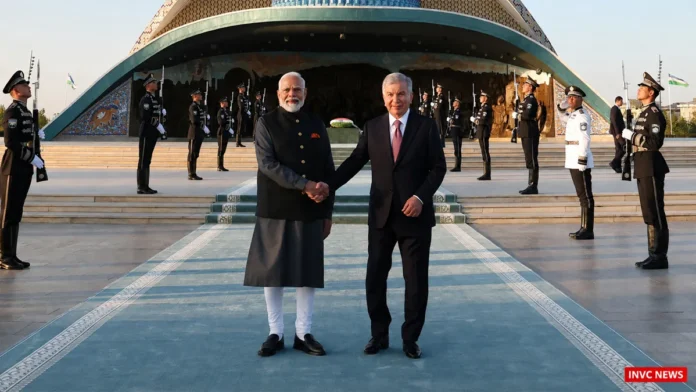
PM Modi in Uzbekistan received a striking display of personal diplomacy as President Shavkat Mirziyoyev welcomed him at Tashkent-Humo International Airport and then travelled with the Indian prime minister in the same car.
The gesture immediately gave the state visit a warmer—and politically more interesting—tone.
Airport welcomes by the host president are generally reserved for relationships a country wants to visibly elevate. The shared car ride added another layer of what can fairly be described as “car diplomacy”: a carefully watched moment of personal engagement before formal talks on trade, energy, defence, critical minerals and regional security.
But the smiles and ceremonial welcome are only the opening scene.
The serious business begins today, when Modi and Mirziyoyev attempt to convert political warmth into investment, supply-chain access and a larger Indian economic footprint across Central Asia.
Mirziyoyev Personally Welcomes Modi at Airport
President Mirziyoyev received Modi after the Indian leader arrived in Tashkent for a two-day state visit.
A guard of honour was presented and the national flags of India and Uzbekistan were displayed at the airport. The two leaders then travelled together rather than immediately separating into their respective official convoys.
That shared journey created the visit’s first powerful visual.
It suggested familiarity between the leaders and allowed them additional informal interaction before the delegation-level negotiations.
Modi later expressed appreciation for the welcome and highlighted the growing strategic partnership between the two countries.
The visit is his fourth to Uzbekistan, reflecting New Delhi’s sustained attempt to build influence in a region where China and Russia already possess deep economic and security networks.
Car Diplomacy Sends a Message Before Formal Talks
A shared car ride does not produce a trade agreement or defence contract by itself.
However, diplomacy is not conducted only through signed documents. Personal comfort between leaders can help resolve difficult questions, accelerate pending proposals and give officials political space to pursue ambitious projects.
The airport reception therefore matters because Modi and Mirziyoyev have a demanding agenda.
India wants better access to Uzbekistan’s market and mineral resources. Uzbekistan wants Indian investment, pharmaceutical capacity, technology, healthcare expertise and manufacturing partnerships.
The diplomatic warmth will now be measured against tangible outcomes.
Can the two leaders turn an airport embrace into bankable deals?
Trade, Investment and Critical Minerals Lead the Agenda
India and Uzbekistan are expected to review cooperation in:
- Trade and investment
- Energy and critical minerals
- Defence and security
- Digital connectivity
- Pharmaceuticals and healthcare
- Agriculture and food processing
- Education and people-to-people relations
Uzbekistan possesses valuable reserves of gold, copper, uranium, critical minerals and rare-earth resources. It has been inviting Indian companies to explore investments in mining and metallurgy.
For India, the opportunity is strategically important.
Critical minerals are essential for electric vehicles, renewable-energy systems, electronics, defence manufacturing and advanced technologies. Reducing dependence on a small number of global suppliers has therefore become a national economic and security priority.
Uzbekistan, meanwhile, wants more than raw-material exports. It is seeking investment, local processing, technology and industrial partnerships capable of creating jobs inside the country.
Connectivity Remains India’s Biggest Obstacle
The relationship has commercial potential, but geography remains a stubborn problem.
India has no direct land access to Central Asia. Pakistan’s location blocks the shortest overland route, while instability and sanctions complicate alternative corridors through Afghanistan and Iran.
New Delhi has consequently backed multimodal transport links connecting Indian ports with Iran and onward routes into Central Asia.
However, the continuing Strait of Hormuz confrontation and wider regional instability make reliable connectivity even more difficult.
Also Read This – : Iran Claims Full Control of Strait of Hormuz as India’s Oil Risk Intensifies
India and Uzbekistan are therefore likely to examine customs cooperation, digital trade systems, alternative transit arrangements and investment structures that can reduce logistical costs despite the absence of a direct land corridor.
Defence and Terrorism Add a Hard Security Edge
The talks are not limited to economics.
India and Uzbekistan share concerns about terrorism, radicalisation, narcotics trafficking and instability emerging from Afghanistan.
Defence training, military exchanges and counterterrorism cooperation already form part of the relationship. Modi is expected to seek deeper operational coordination as regional threats evolve.
The security message will become even sharper when he travels to Bishkek for the Shanghai Cooperation Organisation Summit.
Modi has said India’s SCO approach will remain centred on three priorities:
Security, Connectivity and Opportunity.
New Delhi is also expected to oppose double standards on terrorism and press member states to act against financing networks, safe havens and organisations supporting extremist violence.
Russia–Ukraine War Raises Central Asia’s Strategic Value
The continuing Russia–Ukraine war has altered economic and political calculations across Central Asia.
Countries in the region retain deep connections with Moscow but are also trying to diversify trade, investment and diplomatic partnerships. China has expanded rapidly through infrastructure, energy and commerce.
India sees an opening.
It offers technology, pharmaceuticals, education, healthcare and development partnerships without demanding that Central Asian countries abandon their existing relationships.
The region’s location between Russia, China, Iran, Afghanistan and Europe makes it both commercially valuable and geopolitically sensitive.
Also Read This – : Russian Drone Hits Ammo Depot Near Kyiv, Killing 37 as Zelenskyy Orders Negligence Probe
Shastri Memorial Adds an Emotional India Connection
Tashkent carries a powerful place in Indian political history.
Former Prime Minister Lal Bahadur Shastri died in the city in January 1966, shortly after signing the Tashkent Declaration following the 1965 India-Pakistan war.
Modi is expected to visit the Shastri Memorial during his stay.
These engagements add historical and cultural weight to a visit otherwise dominated by contemporary strategic competition.
No Agreements Should Be Reported Before Announcement
A “substantial package” of bilateral agreements is expected after the leaders’ talks. However, their final number, titles and financial value have not yet been officially announced.
Therefore, claims that India and Uzbekistan have already signed specific mining, defence or energy deals would be premature.
The correct position at this stage is:
- Formal talks are scheduled for August 30.
- Multiple sectors are on the negotiating table.
- Bilateral agreements are expected.
- Confirmed outcomes must wait for the official joint announcement.
Once the agreements are released, this same URL should be updated again with the signed deals, investment values and joint-statement language.
Tashkent Welcome Sets Up the Real Test
Mirziyoyev’s airport welcome and shared car ride have given Modi’s visit a strong opening image.
Now comes the harder part.
India wants access, connectivity, minerals and security cooperation. Uzbekistan wants investment, technology and a larger partnership with one of the world’s biggest markets.
The warmth is visible.