By Team INVC | INVC NEWS
Published: August 30, 2026 | 10:10 AM IST
MYLA, Ukraine | August 30, 2026 —
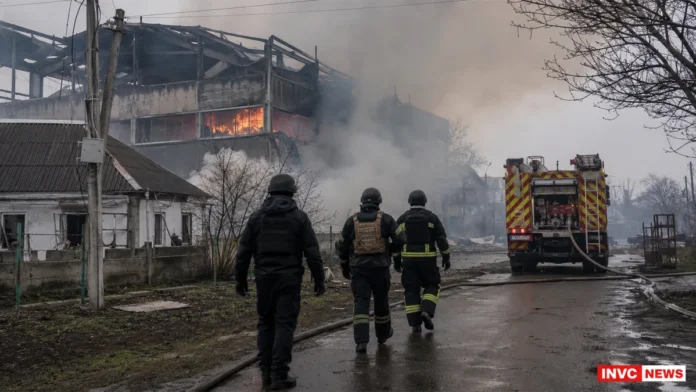
A Russian drone strike near Kyiv hit an ammunition warehouse and triggered a chain of massive explosions that killed at least 37 people, injured 42 and ripped through nearby homes in one of Ukraine’s deadliest attacks of 2026.
But the political shockwave did not stop with Moscow.
Ukrainian President Volodymyr Zelenskyy also turned his anger inward, accusing officials of “terrible negligence” for allowing shells, mines, drones and other explosives to be stored dangerously close to civilians.
The warehouse in Myla, a village west of Kyiv in the Bucha district, caught fire after the Russian strike on Friday night. Exploding ammunition then sent flames and debris across the surrounding area, damaging dozens of residential buildings and a care facility.
More than 370 people were evacuated as firefighters battled the blaze and emergency teams searched for victims.
The tragedy has opened two explosive questions:
Why did Russia target the warehouse—and why was so much ammunition stored beside civilian homes?
Russian Drone Triggered a Deadly Chain Reaction
The first strike hit a facility used to store ammunition and drone-related equipment. Shells, mines and other explosives then began detonating inside the warehouse.
The secondary explosions transformed a military strike into a wider civilian disaster.
At least 50 residential buildings were damaged, according to regional authorities.
Four children were reportedly among the injured.
Taras Didych, head of the Dmytrivka community, was also killed after arriving at the scene to assist with the emergency response.
The blasts were powerful enough to shake the surrounding area and force the closure of nearby roads while rescue crews attempted to control the fire.
Zelenskyy Orders Criminal Investigation
Zelenskyy acknowledged that the warehouse contained ammunition that should never have been stored so close to homes.
Ukrainian law restricts the storage of explosives near populated areas. The president said criminal proceedings had been opened and demanded accountability from everyone responsible for approving or ignoring the arrangement.
His response was unusually direct.
Rather than blaming every death solely on the Russian strike, Zelenskyy said the placement of the ammunition facility had multiplied the destruction.
Those who permitted the storage site to operate beside civilians, he said, must answer for their decisions.
Ukraine’s Defence Ministry has now ordered a wider audit of ammunition-storage locations amid concerns that other facilities could expose nearby communities to similar risks.
Ukraine Says the Same Deadly Mistake Happened Before
The anger inside Kyiv is intensified by the fact that this was not an entirely new warning.
A similar Russian strike on an ammunition facility in Vyshneve in July also triggered secondary explosions and caused extensive destruction in a residential area.
Ukrainian Prime Minister Serhii Koretskyi said the earlier tragedy should have forced authorities to change how and where weapons were stored.
Repeating the same mistake during the fifth year of the full-scale war, he argued, could amount to criminal negligence.
That accusation cuts deeply because Ukraine cannot relocate every military warehouse far from cities overnight. However, placing large quantities of explosive material near vulnerable residential facilities creates an obvious risk whenever Russia penetrates air defences.
Moscow Says It Targeted Long-Range Drone Supplies
Russia’s Defence Ministry said the warehouse contained components and launch boosters for Ukrainian long-range drones.
Moscow also claimed strikes against port, logistics and weapons-related facilities elsewhere in Ukraine.
Ukraine did not deny that military material was stored at the Myla facility. The dispute therefore centres less on whether the warehouse was connected to the war effort and more on the devastating civilian consequences of locating it near populated areas.
The attack came during days of sustained Russian drone and missile assaults on Kyiv and other Ukrainian regions.
Officials say Moscow is attempting to exhaust air defences by launching repeated waves rather than relying only on occasional large attacks.
Also Read This – : Zelenskyy Unleashes 1,000-Drone-a-Day War Plan Against Russia’s Fuel Network
Russia’s Jet-Powered Drones Create a New Threat
Ukrainian officials are increasingly concerned about Russia’s expanded use of jet-powered attack drones.
These weapons are faster than conventional propeller-driven drones and can be harder for existing interceptor systems to destroy. Ukraine is developing new countermeasures, but officials acknowledge that defensive technology is struggling to keep pace with rapidly evolving attack systems.
It has not been established whether a jet-powered drone struck the Myla warehouse. However, the broader Russian campaign shows how quickly the aerial battlefield is changing.
Every successful penetration places military warehouses, power facilities and civilian neighbourhoods at greater risk.
Ukraine Answers With Hundreds of Drones Against Russia
The attack occurred as Zelenskyy ordered an enormous expansion of Ukraine’s long-range drone campaign.
Kyiv currently claims an average capacity of more than 300 long-range drone launches and wants to increase that figure toward 1,000 per day.
Ukraine has targeted Russian oil refineries, fuel depots, military factories, logistics centres and other facilities supporting Moscow’s war effort.
Russia said it destroyed more than 300 Ukrainian drones during the latest exchange. Ukrainian attacks nevertheless caused fires and injuries in Russia’s Rostov region.
The conflict is therefore moving into an even more dangerous phase:
Russia is pounding Ukrainian cities and warehouses. Ukraine is attacking Russia’s fuel and military infrastructure. Civilians remain trapped between both campaigns.
Separate Russian Attacks Kill Two in Kherson
The Myla warehouse disaster was not the only deadly incident.
Russian attacks in the southern Kherson region killed two people and injured 27 others, including a child. Homes and apartment buildings were damaged as regional authorities warned residents about growing pressure on power and heating infrastructure ahead of winter.
Kherson remains particularly vulnerable because large parts of the region are under Russian control and communities close to the front face repeated artillery, drone and missile attacks.
Deadly Strike Exposes Ukraine’s Internal Weakness
The Myla tragedy is more than another entry in the war’s grim casualty count.
It demonstrates how a successful strike can become dramatically more destructive when military material is stored near civilians. It also exposes the difficult balance Ukraine faces between concealing weapons infrastructure and protecting nearby communities.
Russia launched the attack.
But Zelenskyy’s own response makes clear that Ukrainian officials may also face punishment for decisions that allowed one drone strike to unleash a catastrophic chain of explosions.
The battlefield question is whether Ukraine can protect its ammunition from Russian drones.
The accountability question is even harder: