
By Team INVC | INVC NEWS
Published: August 29, 2026 | 21 : 15 PM IST
KYIV, Ukraine | August 29, 2026 —
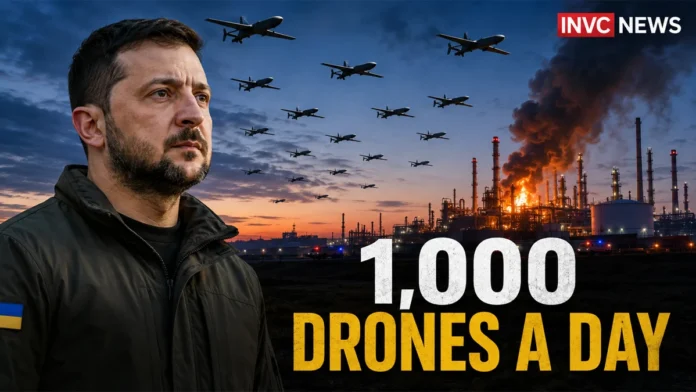
Ukrainian President Volodymyr Zelenskyy has ordered a massive escalation of the drone war against Russia, setting a target of launching as many as 1,000 long-range attack drones every day as Kyiv moves to cripple Moscow’s refineries, fuel depots and military supply lines.
The order could more than triple Ukraine’s current estimated launch capacity of around 300 long-range drones per day. If achieved, it would expose Russian energy and military infrastructure to an unprecedented, continuous wave of deep strikes.
The campaign is already drawing blood from Russia’s fuel system. Repeated Ukrainian attacks have forced major refineries to halt or reduce operations, cutting gasoline production to around 80,000 tons per day—enough to cover only about 70% of peak domestic demand.
Moscow is now extending fuel-export restrictions, importing gasoline and tightening regional sales as the war pushes deeper into Russia’s civilian economy.
Ukraine Turns Drone Swarms Against Russia
Zelenskyy has instructed Ukraine’s military and defence manufacturers to rapidly expand long-range drone production and deployment.
The objective is not a one-night barrage. Kyiv wants the capacity to maintain relentless daily pressure on targets hundreds—and sometimes more than 1,000 kilometres—inside Russian territory.
Ukraine’s target list includes oil refineries, fuel-storage facilities, military factories, ammunition depots, airfields and transport hubs supporting Moscow’s war machine.
These attacks have become Ukraine’s answer to Russia’s larger missile arsenal. Long-range drones cost less than conventional cruise missiles and can be launched in waves designed to exhaust or overwhelm Russian air defences.
Even drones that are intercepted can force Moscow to fire costly air-defence missiles and deploy additional systems far from the front line.
Russian Refineries Burn as Fuel Shortage Spreads
The latest strikes disrupted major refineries in Perm, Nizhny Novgorod and Yaroslavl, intensifying a fuel shortage that Russian authorities had struggled to contain.
Russia’s peak summer gasoline demand is estimated at approximately 115,000 tons per day. Production has reportedly fallen to about 80,000 tons, leaving a daily gap approaching 35,000 tons.
The damage has forced Moscow to bring in additional fuel from Belarus and Asian suppliers. However, imports and stockpiles have not fully restored supplies.
Some regions have reintroduced purchase limits and other sales controls. The disruption threatens civilian transport, farming, industrial activity and the military logistics required to sustain Russian forces across the enormous Ukrainian front.
Ukraine’s strategy is clear: instead of confronting Russia only in trenches and occupied territory, it is carrying the economic cost of the war directly into Russian cities and industrial regions.
Putin Responds With Export Bans and Air Defences
Russia has extended its diesel-export ban until September 30 as the Kremlin tries to protect domestic fuel availability.
Moscow has also restricted exports of gasoline, marine fuel and gas oils. The measures are significant because Russia is normally one of the world’s largest exporters of diesel and refined petroleum products.
The Kremlin is expected to strengthen air defences around refineries, move fuel into dispersed storage sites and accelerate repairs at damaged plants.
However, Russia faces a brutal defensive calculation. Every air-defence system moved to protect a refinery or factory is one less system available near the Ukrainian battlefield or other strategic installations.
Moscow Pounds Ukraine’s Cities and Supply Network
Russia is simultaneously intensifying its own aerial assault.
Successive drone and missile attacks have damaged homes, apartment buildings, warehouses and vehicles across the Kyiv region. Ukrainian officials say Russian strikes have also inflicted extensive damage on the country’s food, retail and transport infrastructure.
The conflict is therefore accelerating into a two-sided war against economic survival.
Russia is attempting to break Ukraine’s cities, energy supplies and logistics networks. Ukraine is striking the refineries and fuel arteries that keep Russia’s economy and military moving.
Neither campaign is limited to the battlefield, and civilians on both sides face growing risks from attacks on industrial facilities and urban infrastructure.
Also Read – : Latest Russia-Ukraine War Updates on INVC NEWS
Can Ukraine Really Launch 1,000 Drones Every Day?
The target is ambitious.
Producing and launching 1,000 long-range drones daily would require an enormous supply of engines, electronic components, explosives, navigation equipment, intelligence and trained personnel.
Ukraine would also have to protect its drone factories from Russian attacks while maintaining reliable funding and international access to essential components.
Moreover, 1,000 launches would not equal 1,000 successful strikes. Russian electronic warfare and air-defence systems would intercept or disable a significant number.
Yet Ukraine may not need every drone to hit. A sustained mass campaign could stretch Russian defences, force costly interceptions and allow a smaller number of drones to penetrate and damage high-value facilities.
Zelenskyy’s order has now opened a harder phase of the war: Ukraine is preparing to attack Russia’s fuel lifeline at a scale Moscow has never previously faced.










Comments are closed.