PERTH, Australia | September 25, 2026 —
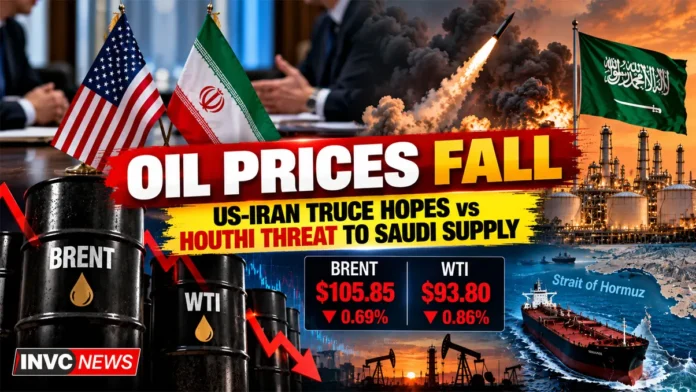
Oil prices edged lower on Friday as traders weighed tentative hopes for a US-Iran truce against a sharply different reality on the ground: fresh Houthi missile attacks on Saudi Arabia and continuing threats to some of the world’s most important energy infrastructure.
Brent crude fell 74 cents, or 0.69%, to $105.85 a barrel at 00:32 GMT, while US West Texas Intermediate dropped 81 cents, or 0.86%, to $93.80 a barrel.
The modest decline came only hours after one of the most volatile sessions of the week.
On Thursday, Brent surged as much as 5% before settling 3.4% higher at $106.60. WTI also jumped as much as 5% and closed 2.7% higher at $94.61 as Houthi attacks on Saudi Arabia revived fears of another disruption to global oil supplies.
The oil market is now caught between two powerful forces.
Diplomacy is pulling prices down.
War risk is pushing them back up.
THE 60-SECOND BRIEF
Brent eased to $105.85 a barrel early Friday.
WTI fell to $93.80.
US and Iranian negotiators in New York are exploring a phased route toward ending the conflict.
One element under discussion involves reopening the Strait of Hormuz in return for relief from Washington’s economic blockade of Iran.
But no truce has been agreed.
Saudi Arabia says it intercepted six Houthi ballistic missiles targeting the Taif province and the Yanbu area on the Red Sea.
That means traders are still pricing a significant geopolitical risk premium into crude.
One Headline Says Peace, Another Says Missiles
Oil traders rarely face such contradictory signals at the same time.
In New York, American and Iranian negotiators are exploring a possible path out of a conflict that has disrupted energy markets for months.
In Saudi Arabia, air defences are intercepting ballistic missiles.
And between them lies the Strait of Hormuz — one of the most strategically important oil routes on earth.
That explains why crude prices have been swinging so violently.
Any credible diplomatic breakthrough could remove a large part of the geopolitical premium embedded in oil.
But another successful strike on a major Saudi oil installation could send prices sharply in the opposite direction.
US-Iran Talks Give Traders a Reason to Hope
Negotiators from the United States and Iran are discussing a phased framework that could eventually reduce hostilities.
One crucial element involves the Strait of Hormuz.
Washington wants free passage for commercial shipping through the waterway.
Tehran wants relief from US economic pressure.
Neither side has surrendered its leverage, and no final agreement has been reached.
That is important for markets.
Oil prices are reacting not to a peace agreement, but to the possibility that one could emerge.
Iranian President Masoud Pezeshkian also said this week that Washington must decide whether it wants the conflict to end.
The diplomatic signals have been sufficient to prevent Thursday’s military escalation from driving crude even higher.
NUMBER THAT MATTERS: $105.85
That was Brent’s early-Friday price.
It remains dramatically higher than levels seen before the latest Middle East escalation.
The price also tells another story.
Despite hopes of diplomacy, crude has not returned to anything resembling normal pre-crisis trading.
Traders still see substantial supply risk.
Houthi Missiles Keep the Risk Premium Alive
The immediate reason for Thursday’s jump was renewed Houthi military action against Saudi Arabia.
Saudi Arabia said its defences intercepted six ballistic missiles fired by Yemen’s Houthis.
The attacks targeted the southern province of Taif and the Yanbu area on the Red Sea.
Yanbu matters enormously to the global oil market.
It is a major Saudi energy and export hub and forms the western end of the Kingdom’s East-West Pipeline.
That pipeline allows Saudi crude to move from eastern oil-producing regions toward the Red Sea, reducing dependence on the Strait of Hormuz.
A threat to Yanbu therefore strikes directly at one of Saudi Arabia’s most important alternatives for keeping oil flowing during a Gulf crisis.
Saudi Arabia Is Trying to Keep Oil Moving
Saudi Arabia has been increasing crude pumping through its East-West Pipeline.
The route has become strategically more important because of disruption around the Strait of Hormuz.
However, tanker loadings from Yanbu had not yet fully resumed when the latest market update was published.
That leaves the market watching Saudi infrastructure closely.
Saudi Arabia is not merely another producer.
It is one of the few countries with enough production and export capacity to significantly influence global supply during a crisis.
Anything threatening Saudi oil infrastructure therefore creates an immediate reaction in energy markets.
Why Thursday Was So Violent
Brent closed Thursday at $106.60, up 3.4%.
WTI finished at $94.61, up 2.7%.
At their session highs, both contracts had gained around 5%.
Brent recorded its highest closing price since September 15.
WTI, meanwhile, finally ended a six-session losing streak during which it had fallen roughly 13%.
That contrast shows just how unstable the oil market has become.
Prices can drop sharply on diplomacy one day and surge on missiles the next.
NUMBER THAT MATTERS: 20%
Since the US-Iran war began at the end of February, around one-fifth of global oil and gas shipments have been curtailed, according to Reuters reporting.
The disruption helped drive crude prices sharply higher earlier in the conflict.
That makes the Strait of Hormuz central to almost every serious discussion about where oil prices go next.
If shipping through the strait normalises, a major source of supply fear could ease.
If the route remains restricted while Saudi infrastructure also comes under attack, the opposite could happen.
The Strait of Hormuz Is the Real Prize
Much of the current diplomatic battle revolves around a narrow stretch of water.
The Strait of Hormuz connects the Persian Gulf with global markets.
For decades, it has been one of the world’s most important energy chokepoints.
The conflict has turned control and access into bargaining leverage.
Washington wants shipping restored.
Tehran wants relief from economic pressure.
For oil traders, therefore, diplomatic language about Hormuz can move prices almost as quickly as an air strike.
A confirmed agreement to reopen the waterway could remove a major supply-risk premium.
A collapse in negotiations could rapidly restore it.
WHY IT MATTERS FOR INDIA
For India, the distinction between $95 oil and $105 oil is far more than a trading statistic.
India imports most of the crude oil it consumes.
Higher global prices can increase the country’s import bill and raise demand for US dollars.
That can place additional pressure on the rupee.
A weaker rupee then makes imported crude even more expensive in domestic currency.
Higher oil costs can also feed into transport, aviation, chemicals, paints, plastics, manufacturing and eventually consumer inflation.
That is why every diplomatic signal coming out of US-Iran talks matters in New Delhi as much as it does in London or New York.
Petrol Is Only Part of the Story
Consumers often look at international crude prices primarily through petrol and diesel.
But an oil shock travels much further through an economy.
Airlines pay more for aviation fuel.
Trucking becomes more expensive.
Manufacturers face higher logistics costs.
Petrochemical inputs become costlier.
Packaging costs can rise.
Food transported over long distances becomes more expensive to move.
Governments then face difficult choices over taxes, subsidies and whether to allow global energy costs to pass fully through to consumers.
So even a small diplomatic breakthrough can have consequences far beyond commodity trading screens.
WHY IT MATTERS FOR STOCK MARKETS
Oil also has a complicated relationship with equity markets.
Energy companies may benefit from higher crude prices.
Many other industries do not.
Airlines, paints, chemicals, transport companies and manufacturers can face margin pressure.
Countries dependent on energy imports may also see inflation and currency risks increase.
For Indian investors, sustained oil prices above $100 would therefore remain a significant macroeconomic risk even if individual oil producers benefit.
Peace Hopes Are Doing More Work Than Supply Data
The Friday pullback is revealing.
Saudi Arabia had just reported another major Houthi missile attack.
Critical energy assets remained exposed.
Yet crude prices still edged lower.
Why?
Because markets are forward-looking.
Traders are trying to estimate what happens next rather than merely reacting to what happened yesterday.
If Washington and Tehran eventually agree on a path toward ending the war and reopening Hormuz, the supply outlook could improve dramatically.
That possibility is currently powerful enough to offset at least some immediate military risk.
But hope is not the same thing as an agreement.
WHAT COULD SEND OIL HIGHER AGAIN?
The list is straightforward.
Another successful attack on Saudi energy infrastructure could push prices higher.
A breakdown in US-Iran negotiations could remove the market’s current diplomatic optimism.
Further restrictions around the Strait of Hormuz could tighten supply.
A major disruption at Yanbu or along Saudi Arabia’s East-West Pipeline could also create a powerful reaction.
That is why the current decline should not automatically be interpreted as the beginning of a sustained fall in oil prices.
WHAT COULD SEND OIL LOWER?
A credible ceasefire would change the equation.
So would a concrete agreement on reopening the Strait of Hormuz.
Normalisation of Saudi export routes would reduce another layer of supply anxiety.
Markets would also respond strongly if actual physical crude flows recovered rather than merely diplomatic expectations improving.
Until then, volatility is likely to remain high.
THE BIGGER PICTURE
Oil is currently trading less like an ordinary commodity and more like a geopolitical barometer.
A missile launch moves it.
A diplomatic meeting moves it.
A shipping announcement moves it.
A statement from Tehran moves it.
A decision in Washington moves it.
That makes short-term price prediction unusually difficult.
The underlying struggle is between fear of physical supply disruption and hope that diplomacy can reopen the energy routes currently under pressure.
Neither side has won that struggle yet.
WHAT HAPPENS NEXT
The first thing traders will watch is progress in US-Iran negotiations in New York.
Any concrete framework for a truce could immediately affect crude.
The second is the Strait of Hormuz.
Words matter, but actual shipping volumes will matter more.
The third is Saudi Arabia.
Another Houthi attack on energy infrastructure could quickly erase Friday’s modest price decline.
And finally, markets will watch whether Saudi crude exports through its western infrastructure normalise.
Those four developments could determine whether Brent falls back toward $100 — or races higher again.
INVC NEWS BOTTOM LINE
Oil prices are slightly lower today, but the oil crisis is not over.
The decline reflects hope.
The price above $105 reflects fear.
US-Iran negotiations are offering traders a possible route toward de-escalation and the reopening of the Strait of Hormuz.
At the same time, Houthi missiles are reminding markets that Saudi energy infrastructure remains vulnerable.
That leaves crude balanced on an unusually narrow geopolitical line.
For oil markets, one credible peace announcement could remove billions of dollars in risk premium. One successful strike on critical energy infrastructure could put it straight back.