NEW YORK, United States | September 24, 2026 —
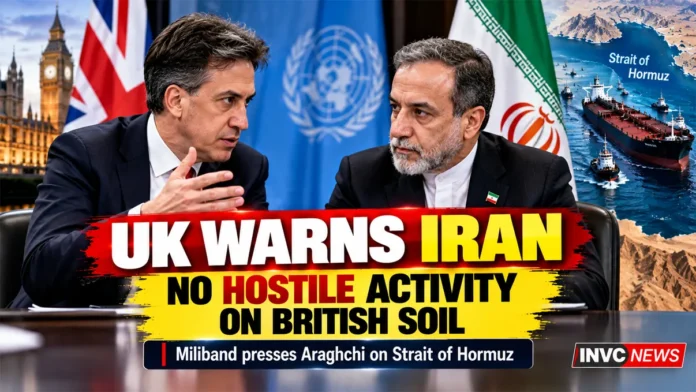
Britain has delivered a direct warning to Iran that it will not tolerate intimidation, threats or hostile activity on UK soil, as Foreign Secretary Ed Miliband confronted Iranian Foreign Minister Abbas Araghchi during talks on the sidelines of the United Nations General Assembly.
The meeting brought together three of the most sensitive issues in current UK-Iran relations: alleged Iran-linked activity inside Britain, disruption in the Strait of Hormuz and the wider US-Iran conflict.
Miliband urged Tehran to choose “de-escalation and diplomacy instead of prolonging the war” and pressed for the full reopening of the Strait of Hormuz, warning that continued disruption threatens global security and economic stability.
At the same time, the British foreign secretary made clear that London’s security concerns do not end in the Middle East.
He also raised what the UK describes as threats from Iranian-linked groups operating on British soil, including attacks targeting the British Jewish community.
THE 60-SECOND BRIEF
British Foreign Secretary Ed Miliband met Iran’s Abbas Araghchi in New York.
London warned Tehran that Britain will not tolerate intimidation, threats or hostile activity inside the UK.
Miliband specifically raised attacks targeting the British Jewish community.
He also called for the Strait of Hormuz to fully reopen.
Britain says continued disruption of the waterway is damaging global security and economic stability.
Iran, meanwhile, has separately indicated that it could reopen Hormuz if the United States reduces military pressure and eases its blockade.
The meeting therefore combined a warning with an attempt to keep diplomacy alive.
Britain Delivers a Message Face to Face
The significance of Thursday’s meeting lies partly in the fact that Britain delivered its warning directly to Iran’s foreign minister.
Miliband told Araghchi that the UK would not tolerate activity linked to Iran that threatens people inside Britain.
According to the British Foreign Office readout, the foreign secretary set out measures London has already taken in response to what it considers Iranian-linked threats.
The wording was unusually direct.
Britain did not merely raise concerns about Iran’s regional behaviour.
It linked the diplomatic conversation in New York to security incidents inside the United Kingdom.
Why the British Jewish Community Was Mentioned
London has become increasingly concerned about alleged plots, intimidation and attacks targeting Jewish, Israeli and Iranian dissident interests in Britain and elsewhere in Europe.
In June, the UK joined 23 other countries in condemning what they described as hostile activity connected to Iranian security services, including actions targeting Jewish and Israeli communities, Iranian dissidents and journalists.
The British government has also moved against groups it says are linked to Tehran.
In July, London sanctioned the Islamic Movement of Companions of the Right, also known as HAYI, after the group publicly claimed responsibility for attacks on locations linked to Jewish and Israeli communities and Persian-language media in Britain.
The UK said those incidents included an antisemitic arson attack on Hatzola ambulances in Golders Green.
Iran’s government has faced repeated accusations from Western states of using intelligence services, intermediaries and criminal networks to target opponents abroad.
Tehran has disputed or rejected many Western allegations involving its overseas activities.
UK Is Tightening Its Domestic Security Response
The warning to Araghchi also reflects a broader change in British policy.
Earlier this year, the government introduced new legislation designed to give authorities stronger powers against organisations acting on behalf of hostile foreign states.
The National Security (State Threats) Bill was introduced after what the government described as a wave of alarming foreign-linked activity and antisemitic attacks.
That means Miliband’s warning was not delivered in isolation.
Britain is simultaneously using diplomacy, sanctions and domestic law to address what it sees as Iranian-linked security threats.
Hormuz Becomes the Second Front in the Meeting
The other major issue was the Strait of Hormuz.
Miliband stressed the importance of restoring freedom of navigation and fully reopening the waterway.
That concern is economic as well as strategic.
The Strait of Hormuz has historically carried a major share of global oil and gas exports.
Recent disruption has reduced shipping traffic sharply and contributed to volatility in energy markets.
Britain, like many other major economies, is vulnerable to sustained energy-price shocks.
A prolonged restriction on shipping through Hormuz can raise crude prices, insurance costs and freight rates far beyond the Middle East.
Iran Has Its Own Conditions
Tehran has not simply rejected diplomacy.
Iranian officials have separately indicated that the country could reopen the Strait of Hormuz if the United States reduces military pressure and lifts its blockade on Iranian ports.
A senior Iranian official said Tehran could move toward reopening the waterway within a week if Washington makes corresponding concessions.
That creates a clear diplomatic gap.
Britain wants Hormuz fully reopened.
Iran wants sanctions and military pressure eased.
The United States has continued talks with Tehran but has not yet reached a final settlement.
WHY HORMUZ MATTERS
The Strait of Hormuz is one of the world’s most strategically important maritime chokepoints.
Before the current conflict, around one-fifth of global oil and gas supplies moved through or depended heavily on the route.
Any prolonged disruption can affect energy-importing economies from Europe to Asia.
That is why Britain’s demand for reopening the strait is not simply a foreign-policy position.
It is directly connected to inflation, shipping, fuel prices and economic stability.
Britain Wants De-escalation — But Not at Any Price
Miliband’s message to Araghchi contained two distinct elements.
The first was diplomatic.
Britain wants Iran to move toward de-escalation and help restore freedom of navigation.
The second was defensive.
London warned that diplomacy does not mean ignoring what Britain regards as threats to its own citizens and communities.
That combination is important.
The UK is trying to preserve a negotiating channel with Tehran while simultaneously raising the cost of alleged hostile activity inside Britain.
Detained British Couple Also Raised
Miliband also raised the detention of British nationals Craig and Lindsay Foreman.
The couple, from East Sussex, were arrested by Iranian authorities while travelling through Iran and are being held in Tehran’s Evin prison.
The foreign secretary called for their immediate release and stressed that their welfare remains a priority for the British government.
Their case adds another layer to an already difficult bilateral relationship.
Britain and Iran are therefore negotiating not only over war and shipping but also over consular cases and domestic security allegations.
WHAT EACH SIDE WANTS
Britain wants:
A fully reopened Strait of Hormuz.
An end to alleged Iran-linked hostile activity on UK soil.
Protection for Jewish communities and Iranian dissidents in Britain.
De-escalation in the wider Middle East conflict.
The release of detained British nationals.
Iran wants:
Reduced US military pressure.
Relief from economic restrictions and blockades.
Recognition of its security demands.
A diplomatic settlement that addresses the wider regional war.
Those objectives overlap in one important area:
Both sides continue to leave the door open to diplomacy.
THE BIGGER PICTURE
The Miliband-Araghchi meeting illustrates how the Iran crisis has moved far beyond nuclear negotiations.
It now involves shipping lanes, energy markets, cyber activity, intelligence allegations, domestic security and attacks on minority communities.
That makes the relationship much harder to manage.
Britain wants Iran engaged diplomatically abroad while demanding that Tehran and Iran-linked groups stay out of British domestic affairs.
Iran, meanwhile, is using its control and influence over regional pressure points as leverage in negotiations with Western powers.
The Strait of Hormuz has become one of the clearest examples of that leverage.
Britain Is Not Acting Alone
The UK’s concerns about Iranian-linked activity are shared by other Western governments.
In June, 24 countries issued a joint statement condemning alleged lethal plots and hostile activity connected to Iranian intelligence and security organisations.
The countries said such activity had targeted dissidents, journalists, Jewish communities and Israeli interests across Europe, North America and Australia.
That broader coalition gives London’s warning additional weight.
It also means UK-Iran tensions form part of a much larger confrontation between Tehran and Western governments.
WHAT HAPPENS NEXT
The most immediate question is whether diplomacy over Hormuz produces a concrete result.
Iran has offered a conditional route toward reopening the strait.
The United States and its allies are pressing for freedom of navigation.
If those positions move closer, energy markets could respond quickly.
But Britain will also be watching developments much closer to home.
Any new attack, cyber operation or alleged Iran-linked plot inside the UK could trigger additional sanctions or legal measures.
Miliband’s meeting therefore sent two messages at once:
Britain is prepared to talk.
But it is also prepared to act against threats it believes cross onto British soil.
INVC NEWS BOTTOM LINE
The meeting between Ed Miliband and Abbas Araghchi was not a routine diplomatic encounter.
Britain wants Iran to help reopen one of the world’s most important energy routes.
It also wants Tehran to understand that alleged foreign-state activity inside the UK has become a national-security issue.
Iran, meanwhile, sees economic pressure and military threats as issues that must be addressed before full de-escalation becomes possible.
That leaves London and Tehran facing a difficult equation.
Britain wants diplomacy abroad — while drawing a firm boundary against what it describes as Iranian-linked activity at home.