NEW YORK, United States | September 24, 2026 —
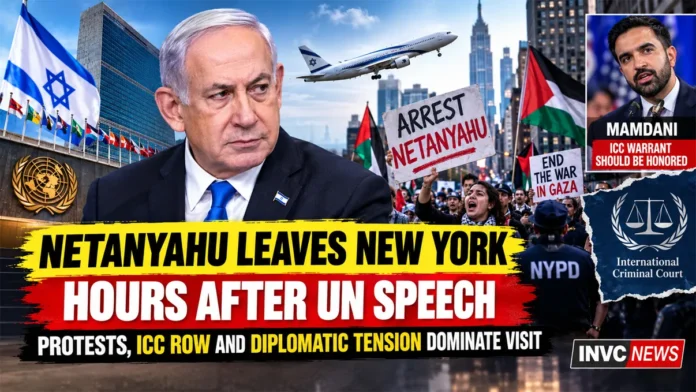
Israeli Prime Minister Benjamin Netanyahu left New York for Israel only hours after arriving on Thursday, ending an unusually brief United States visit dominated by a mass diplomatic walkout at the United Nations, street protests, an unresolved International Criminal Court arrest warrant and a public confrontation with New York City Mayor Zohran Mamdani.
Netanyahu departed aboard Israel’s official Wing of Zion aircraft after addressing the UN General Assembly and holding a final round of meetings with Latin American leaders.
Israeli officials had planned the visit as a compressed trip from the outset, citing Netanyahu’s tight schedule and the need to return before Sukkot.
That distinction matters.
Some Israeli media reports linked the extraordinary brevity of the visit to security concerns, but Israeli authorities have not publicly established security fears as the reason Netanyahu left immediately after completing his diplomatic programme.
What is clear is that few visits by an Israeli prime minister to New York have unfolded under such intense political pressure.
THE 60-SECOND BRIEF
Netanyahu arrived in New York and left for Israel on the same day.
His visit centred on his UN General Assembly speech and a limited series of diplomatic meetings.
Dozens of delegates walked out when he began speaking at the UN.
Large anti-Netanyahu and pro-Palestinian demonstrations took place outside.
Police sources cited by US media said around 100 people were taken into custody during protests.
New York Mayor Zohran Mamdani has called for the ICC arrest warrant against Netanyahu to be honoured, while acknowledging that New York City itself lacks the legal authority to enforce it.
After his UN speech, Netanyahu met Latin American leaders and pushed for deeper diplomatic, security and economic cooperation with Israel.
Netanyahu Arrives — and Leaves Hours Later
Netanyahu’s New York schedule was unusually compressed for an Israeli leader attending the annual UN gathering.
He landed in the city on Thursday, addressed the 81st United Nations General Assembly and completed a short series of meetings before taking off for Israel later that same day.
Israel’s Prime Minister’s Office had already signalled that the visit would be brief.
Officials said multiple world leaders had requested meetings with Netanyahu but that only some could be accommodated because of the tight timetable and his planned return before Sukkot.
That makes it important not to confuse a deliberately short visit with a confirmed emergency departure.
Nevertheless, the political and security atmosphere surrounding Netanyahu in New York was anything but routine.
UN Speech Begins With a Walkout
The defining image inside the United Nations came before Netanyahu had delivered much of his speech.
Dozens of diplomats left the General Assembly chamber as he began addressing world leaders.
Large sections of visible seating were left empty.
Netanyahu responded defiantly, attacking those who walked out while defending Israel’s military actions in Gaza and its wider regional strategy.
His supporters applauded.
His critics departed.
The spectacle turned the General Assembly chamber into a visual representation of the deep international divide surrounding Israel.
Outside the UN, Another Message Was Being Sent
While Netanyahu defended Israel inside the chamber, demonstrations unfolded across parts of Manhattan.
Hundreds of protesters gathered near the United Nations, with demonstrators demanding an end to US military support for Israel and calling for Netanyahu to be held accountable over the Gaza war.
Some protesters blocked First Avenue near UN headquarters.
Police moved in and made mass arrests.
Police sources cited by CBS News New York said approximately 100 people were taken into custody during the demonstrations, although final arrest and charging figures were still being compiled.
Earlier in the day, Reuters had independently confirmed at least 30 arrests.
Among those detained were actors, activists and elected political figures.
The protests ensured that Netanyahu’s confrontation with his critics followed him outside the diplomatic chamber.
The Mamdani Factor
New York City Mayor Zohran Mamdani has become one of Netanyahu’s most prominent American critics.
During his mayoral campaign, Mamdani said he would seek Netanyahu’s arrest if the Israeli leader came to New York.
The legal reality is more complicated.
In an interview with CNN ahead of Netanyahu’s UN appearance, Mamdani acknowledged that New York City does not itself have the authority to execute the International Criminal Court warrant.
But he maintained that the warrant should be honoured and argued that international law should apply regardless of political position.
Netanyahu used part of his UN address to attack Mamdani in return, accusing the mayor of spreading falsehoods about Israel and contributing to an environment in which Jewish New Yorkers feel unsafe.
Mamdani subsequently rejected Netanyahu’s accusations and again sharply criticised the Israeli leader.
The exchange transformed what was already a contentious UN visit into a direct political confrontation between Israel’s prime minister and the mayor of the city hosting him.
What Does the ICC Warrant Actually Mean?
The International Criminal Court issued an arrest warrant for Netanyahu in November 2024.
The court alleged that there were reasonable grounds to believe Netanyahu bore criminal responsibility for war crimes and crimes against humanity connected with the Gaza conflict.
Netanyahu and the Israeli government reject the allegations and dispute the ICC’s jurisdiction.
The United States is not a member of the ICC.
That is crucial.
New York City cannot simply enforce the international court’s warrant as though it were an ordinary local arrest order.
Legal experts have said US law provides no straightforward mechanism for the city to execute the warrant, while questions surrounding immunity and America’s relationship with the ICC create additional barriers.
Mamdani’s call for the warrant to be honoured therefore carries significant political symbolism, but far less direct legal power.
Netanyahu Turns to Latin America After UN Speech
Netanyahu did not leave immediately after stepping down from the UN podium.
He held meetings with Latin American leaders as Israel sought to deepen relationships in the region.
Netanyahu met the presidents of Paraguay, Panama and Bolivia in a discussion focused on political, economic, technological and security cooperation.
He encouraged closer alignment with Israel through the Isaac Accords, a strategic framework launched earlier this year by Israel and Argentina.
The initiative seeks to expand cooperation among Israel and like-minded governments in the Western Hemisphere in areas including security, technology, trade and counterterrorism.
Netanyahu also held a separate meeting with Argentine President Javier Milei, a key political partner behind the Isaac Accords initiative.
The diplomatic outreach offered a striking contrast to the scenes inside the General Assembly.
While some delegations walked away from Netanyahu, Israel was simultaneously working to deepen relationships with governments elsewhere.
Why Latin America Matters to Netanyahu
Israel sees parts of Latin America as an increasingly important diplomatic arena.
Several governments in the region have strengthened relations with Israel, while others remain sharply critical of Israeli policy toward Palestinians.
The Isaac Accords are designed to create a longer-term framework connecting Israel with governments that share strategic and political interests.
For Netanyahu, expanding those relationships offers an opportunity to demonstrate that international criticism does not equal universal isolation.
That point matters after the images from the UN walkout.
Israel faces intense diplomatic pressure.
But it is also actively building and strengthening relationships with other countries.
Both realities can exist simultaneously.
Was the Trip Cut Short Over Security Concerns?
This is where the available evidence requires caution.
Israeli media reports have raised security concerns as one explanation for Netanyahu’s exceptionally short stay in New York.
But the official account is different.
Before Netanyahu delivered his speech, the Prime Minister’s Office had already described the schedule as extremely tight and said he needed to return before Sukkot.
Earlier reporting also described the visit as a planned whirlwind trip.
Therefore, saying Netanyahu “fled New York” or was “forced to cut short his trip” would go beyond what has been publicly established.
The more defensible conclusion is that Netanyahu chose — or had already planned — to spend only a matter of hours in a city where his presence had become intensely controversial.
WHY IT MATTERS
A prime minister spending only hours in one of Israel’s most important allied countries would attract attention under any circumstances.
Netanyahu’s situation carries additional weight.
He remains the subject of an ICC arrest warrant.
His government faces intense international criticism over Gaza.
New York’s mayor openly believes the warrant against him should be respected.
Diplomats walked out of his UN address.
And large protests followed his arrival.
Yet the United States remains Israel’s most important strategic ally, and Netanyahu was able to enter New York, address the United Nations and conduct diplomatic meetings before returning home.
The trip therefore illustrated two competing realities.
Netanyahu faces extraordinary international pressure.
But he is not internationally cut off.
THE BIGGER PICTURE
The significance of Netanyahu’s New York visit lies less in its duration than in everything that surrounded it.
Inside the UN, diplomats walked out.
Outside, protesters demanded his arrest.
At City Hall, the mayor challenged his legitimacy under international law.
At the same time, foreign leaders continued meeting him and discussing deeper cooperation with Israel.
That makes the language of complete “isolation” too simplistic.
Israel is losing political support in some arenas while strengthening partnerships in others.
Netanyahu’s New York trip displayed both trends within a matter of hours.
WHAT HAPPENS NEXT
The ICC warrant will continue following Netanyahu during international travel.
His ability to visit individual countries will depend heavily on their legal obligations, domestic politics and relationships with Israel.
The confrontation with Mamdani is also unlikely to disappear.
And the diplomatic reaction to the Gaza war will continue shaping Israel’s relationships at the United Nations and beyond.
For Netanyahu, however, the immediate focus now shifts back to Israel and the mounting regional and domestic pressures facing his government.
INVC NEWS BOTTOM LINE
Benjamin Netanyahu came to New York for hours, not days.
He delivered his UN speech.
Diplomats walked out.
Protesters filled nearby streets.
Police made mass arrests.
The city’s mayor said an international arrest warrant against him should be honoured.
Netanyahu answered his critics from the world’s most prominent diplomatic podium.
Then he met foreign leaders, promoted new alliances — and flew home.
The speed of the visit was striking.
But the larger story was not how quickly Netanyahu left New York.
It was how much political confrontation followed him during the few hours he was there.