RIYADH, Saudi Arabia | September 25, 2026 —
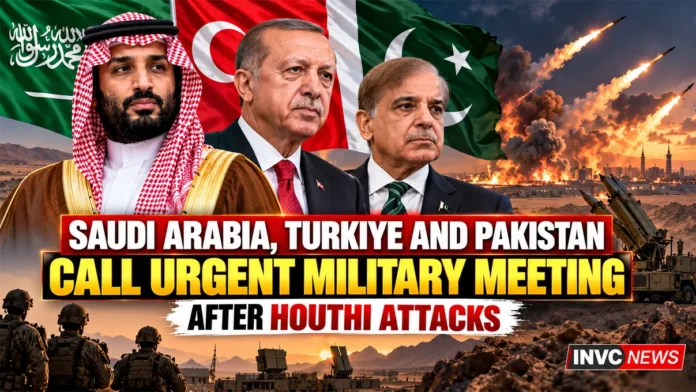
Saudi Arabia, Turkiye and Pakistan are preparing an urgent meeting of their military chiefs after escalating Houthi attacks on the Kingdom, putting their newly established collective defence arrangement under its first serious operational test.
The decision followed talks in New York between Saudi Foreign Minister Prince Faisal bin Farhan, Pakistan’s Deputy Prime Minister and Foreign Minister Ishaq Dar, and Turkish Foreign Minister Hakan Fidan.
The three ministers condemned attacks on Saudi territory and discussed how their armed forces could support the Kingdom under the Makkah Joint Defence Agreement, which treats an attack on one member as an attack on all.
No joint combat operation has been announced.
But the move to bring the three chiefs of staff together marks an important shift from diplomatic solidarity toward practical military planning.
THE 60-SECOND BRIEF
Saudi Arabia, Turkiye and Pakistan are arranging urgent chiefs-of-staff talks following intensified Houthi attacks.
The three countries are operating under a new defence pact built around collective security.
Turkiye has publicly indicated that it could help meet Saudi military and technical requirements.
Pakistan has strongly backed Saudi Arabia’s security while remaining cautious about direct participation in a wider regional conflict.
The next meeting could reveal whether the pact remains primarily a deterrent or begins evolving into a more operational military alliance.
Why the Meeting Matters Now
Saudi Arabia has faced renewed missile and drone attacks from Yemen’s Houthis as the regional conflict has intensified.
Recent attacks have placed Saudi cities, infrastructure and energy facilities under greater pressure and revived concerns over the security of Red Sea shipping and Gulf energy exports.
That has transformed the defence agreement from a strategic declaration into a live test.
The central question is no longer whether Riyadh, Ankara and Islamabad support one another politically.
It is what each country is prepared to do when one of them comes under sustained attack.
A New Defence Pact Faces Its First Crisis
The Makkah Joint Defence Agreement is built around a simple but consequential principle: an armed attack against one member is considered an attack against all three.
The pact is intended to deepen military coordination, strengthen deterrence and expand cooperation between the three armed forces.
The ministers meeting in New York also reviewed work to establish the agreement’s permanent secretariat, committees and working groups.
Those institutional details mattered when the pact was signed.
They matter even more now.
Military alliances are ultimately judged not by the language used at signing ceremonies but by what members do when security commitments are tested.
The Houthi escalation may provide that first test.
Saudi Arabia Wants Practical Support
Saudi Arabia already operates one of the Middle East’s largest and best-equipped militaries.
But repeated missile and drone attacks create a different challenge.
Modern air defence depends on early warning, intelligence, radar coverage, interception systems and the ability to detect relatively inexpensive drones before they reach high-value targets.
That creates several areas in which Turkiye and Pakistan could assist without entering directly into combat.
Possible cooperation could involve intelligence sharing, air-defence coordination, drone detection, technical support, training, logistics and protection of critical infrastructure.
Any decision involving combat aircraft, naval strikes or troops would represent a much more significant escalation.
No such move has been announced.
Turkiye Signals It Is Ready to Help
Turkiye has already indicated that it is prepared to respond to Saudi military requirements under the pact.
Ankara has particular relevance because of the rapid expansion of its defence industry.
Turkiye has developed significant capabilities in drones, missiles, electronic warfare, naval systems and battlefield technology.
It also possesses one of NATO’s largest armed forces.
That gives Ankara options ranging from equipment and technical assistance to deeper military coordination.
For now, Turkish officials have also continued to support diplomatic efforts to contain the wider regional crisis.
That combination — military readiness alongside calls for de-escalation — illustrates the difficult balance facing all three partners.
Pakistan Faces the Hardest Strategic Choice
Pakistan’s position is particularly sensitive.
Islamabad and Riyadh have maintained close military ties for decades, and Pakistan has repeatedly affirmed its commitment to Saudi security.
But Pakistan also maintains an important relationship with Iran and has tried to play a diplomatic role in reducing tensions between Tehran and Riyadh.
Direct involvement in fighting against the Houthis could complicate that position.
Pakistan therefore faces two competing strategic interests.
It wants to demonstrate that its defence commitments to Saudi Arabia are meaningful.
At the same time, it has strong reasons to avoid becoming another combatant in an expanding Middle Eastern war.
The chiefs-of-staff meeting could begin to show where Islamabad intends to draw that line.
Houthi Attacks Have Raised the Stakes
The Houthis have intensified military operations against Saudi Arabia during the latest phase of the Yemen conflict.
Missile and drone attacks have targeted Saudi territory, while the group has also threatened shipping and strategic infrastructure.
Saudi forces have intercepted a number of incoming attacks.
The confrontation has wider economic consequences because Saudi Arabia remains one of the world’s most important oil producers and the Red Sea is a major commercial shipping corridor.
A prolonged security crisis can therefore affect more than the immediate battlefield.
Oil prices, shipping costs, insurance premiums and global trade routes can all react to instability around Saudi Arabia and Yemen.
The Iran Factor
The Houthis maintain longstanding ties with Iran, adding another layer to the crisis.
Western governments and Saudi Arabia have accused Tehran of providing military support to the group.
Iran has sought to distance itself from direct responsibility for Houthi decisions and has argued that allied groups in the region act independently.
That disagreement matters because Riyadh, Islamabad and Ankara all maintain their own relationships with Tehran.
None has a clear interest in allowing the Yemen conflict to expand into a wider confrontation with Iran.
That limits how aggressively the new defence pact can be used without creating consequences far beyond Yemen.
WHAT EACH SIDE SAYS
Saudi Arabia says it has the right under international law to defend its territory, people and infrastructure.
Turkiye has condemned attacks on the Kingdom and expressed readiness to assist with Saudi military requirements.
Pakistan has pledged strong support for Saudi security while also supporting diplomacy and regional de-escalation.
The Houthis say their military operations are part of their wider confrontation with Saudi-backed forces and regional adversaries.
The gap between those positions remains wide.
Why This Goes Beyond Yemen
The importance of the meeting is also tied to a broader transformation in Gulf security.
For decades, Saudi Arabia and other Gulf states relied heavily on the United States and Western partners for external defence.
Those relationships remain significant.
But Riyadh is increasingly building additional military partnerships.
Turkiye offers defence technology, industrial capacity and a large military.
Pakistan brings extensive military experience and a longstanding strategic relationship with Saudi Arabia.
For Riyadh, those partnerships create more options.
For Turkiye and Pakistan, they offer greater influence in Gulf security.
The emerging model is not necessarily about replacing Washington.
It is about ensuring Saudi Arabia has more than one source of military support when a crisis erupts.
Could This Lead to Joint Military Action?
Possibly — but there is no evidence yet that such a decision has been made.
An urgent meeting of military commanders is not the same as an agreement to launch strikes.
The most immediate outcome could be defensive cooperation.
Air defence, intelligence, surveillance, radar systems, logistical assistance and technical personnel would all represent meaningful support without placing the three countries directly into a joint offensive operation.
Any announcement involving troops or coordinated strikes would mark a much more significant development.
That is why the statement after the chiefs-of-staff meeting will be crucial.
WHAT HAPPENS NEXT
Three things will show whether the alliance is entering a new phase.
The first is the scope of military assistance agreed at the meeting.
The second is whether Turkiye or Pakistan announces new deployments, equipment or operational support for Saudi Arabia.
The third is the Houthis’ response.
Another major attack could increase pressure on all three governments to demonstrate that their collective-defence commitment has practical consequences.
If the response remains limited to intelligence, technology and defensive coordination, the pact will remain primarily a deterrence framework.
If combat forces become involved, the geopolitical consequences will be considerably larger.
INVC NEWS BOTTOM LINE
Saudi Arabia, Turkiye and Pakistan are not announcing a joint war.
But they are moving beyond routine diplomacy.
The Houthis have presented their new defence arrangement with the question that eventually confronts every security alliance:
What does collective defence mean when one of its members actually comes under attack?
Saudi Arabia wants practical security support.
Turkiye says it is prepared to help.
Pakistan remains firmly aligned with Saudi security while navigating the risks of a wider regional conflict.
The answer may emerge from the coming military talks.
And it could determine whether the Makkah Joint Defence Agreement remains primarily a political deterrent — or develops into one of the most consequential new security partnerships in the Middle East.