By Team INVC | INVC NEWS
Published: September 1, 2026 | 01:54 PM IST
NEW DELHI, India | September 1, 2026 —
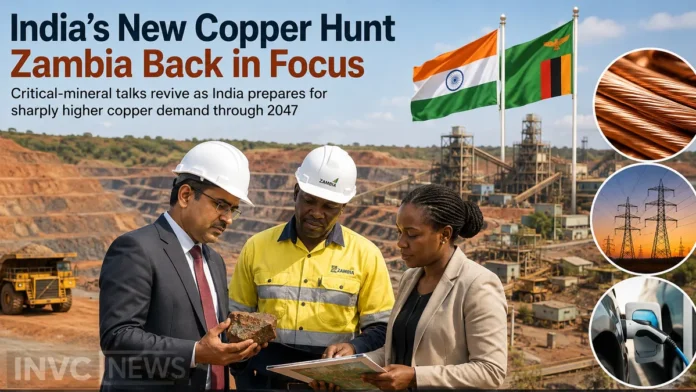
India Zambia Critical Minerals talks are back on the table as New Delhi searches for secure overseas copper supplies to support its rapidly expanding power grid, electric-vehicle industry, renewable-energy buildout and manufacturing ambitions.
Indian and Zambian officials held preliminary discussions on August 26 over opportunities for investment in critical minerals, including copper, reopening a strategic conversation at a time when India faces a sharp rise in long-term demand and limited domestic ore availability.
The renewed engagement puts Zambia, one of Africa’s major copper-producing nations, firmly inside India’s wider effort to diversify mineral sourcing and reduce exposure to concentrated global supply chains.
For India, copper is no longer simply an industrial metal. It has become increasingly important to energy security, manufacturing competitiveness and the transition toward an electrified economy.
Why India Is Looking to Zambia Again
India’s demand for copper is expected to accelerate significantly over the next two decades.
Electric vehicles require substantially more copper than conventional internal-combustion vehicles. Renewable power projects, electricity transmission networks, charging infrastructure, data centers, electronics and industrial machinery also depend heavily on the metal.
That creates a strategic problem.
India has refining and manufacturing ambitions, but its domestic copper ore resource base is relatively limited. As consumption rises, securing reliable concentrate supplies from overseas producers is becoming increasingly important.
Zambia offers an obvious opportunity.
The southern African nation has a long-established copper mining industry and is seeking fresh capital to expand production, modernize mines and increase the economic value generated from its mineral resources.
The renewed talks therefore bring together two complementary needs: India wants long-term mineral security, while Zambia wants investment and stronger markets for its mining sector.
India Could Face Extreme Copper Import Dependence by 2047
The scale of India’s challenge becomes clearer when long-term projections are considered.
India’s refined copper consumption could rise by roughly five to six times by 2047 as industrialization, electrification and clean-energy investment expand.
Domestic mining, however, is unlikely to keep pace.
Long-term projections indicate that domestic copper ore production could satisfy only a small fraction of India’s future concentrate requirement.
Under some projections, dependence on imported copper concentrate could reach roughly 91% to 97% by 2047 if new domestic resources, overseas investments and recycling capacity do not expand sufficiently.
That leaves India vulnerable to mine disruptions, geopolitical tensions, resource nationalism, shipping problems and sudden changes in international prices.
The problem is not simply whether enough copper exists globally.
The more important question is whether India will have reliable access to the right material at competitive prices when demand accelerates.
Sterlite Closure Changed India’s Copper Equation
India’s copper market has already undergone a significant shift.
The closure of Vedanta’s Sterlite Copper smelter in Tamil Nadu in 2018 reduced domestic smelting capacity and contributed to a major change in the country’s copper trade balance.
India, once a meaningful exporter of refined copper, became increasingly dependent on imports.
Although new domestic capacity and expansion projects can improve the situation, the underlying challenge of securing copper concentrate remains.
Smelters cannot operate without sufficient feedstock.
That is why overseas mining assets and long-term supply agreements are becoming increasingly important in India’s mineral strategy.
China’s Copper Dominance Adds Strategic Urgency
The global copper industry is also becoming more concentrated at the processing stage.
China has built an enormous position in copper smelting over the past two decades.
By 2025, China accounted for roughly half of global copper smelting capacity after contributing the overwhelming majority of worldwide smelter-capacity growth since 2005.
This does not mean India’s Zambia strategy is simply a bilateral competition with China.
The larger issue is supply-chain resilience.
When mining, refining or processing capacity becomes concentrated in a limited number of countries, disruptions can have consequences far beyond those borders.
India is therefore attempting to build a broader portfolio of mineral relationships rather than depend excessively on any single market or processing hub.
Zambia fits naturally into that diversification strategy.
Zambia Could Become More Important as Copper Market Tightens
Copper markets are already showing signs of structural pressure.
Prices have risen sharply as investors anticipate greater demand from electrification, power grids, artificial intelligence infrastructure, electric vehicles and renewable-energy systems.
At the same time, building a new copper mine can take many years.
Large deposits require exploration, environmental approvals, infrastructure, financing and lengthy construction periods before commercial production begins.
That creates a mismatch between rapidly rising demand and the slow pace at which new supply can enter the market.
Current global projections point to potential copper supply deficits through the next decade if investment fails to keep up.
Countries with established mineral resources, including Zambia and the Democratic Republic of Congo, are therefore becoming increasingly important to governments and companies seeking long-term supplies.
KABIL at Center of India’s Overseas Mineral Strategy
India has been steadily building an institutional framework for acquiring mineral assets abroad.
Khanij Bidesh India Ltd, commonly known as KABIL, has emerged as a key vehicle for identifying and securing overseas critical-mineral opportunities.
The company was created to help India acquire strategic mineral assets and develop long-term supply relationships in foreign markets.
Its search is not limited to Zambia.
India has explored opportunities across resource-rich countries including Australia, Argentina, Brazil, Canada and several African nations.
The objective is to build multiple supply channels for minerals that are increasingly essential to batteries, clean energy, electronics, defense systems and advanced manufacturing.
Copper has become a particularly important part of that effort because its use extends across almost every major electrification technology.
Earlier Zambia Mining Project Remains a Separate Issue
India and Zambia have discussed mineral cooperation before.
A previously proposed project involving a large exploration area in Zambia had faced delays and disagreements connected to mining rights.
The latest preliminary discussions did not center on resolving that older project.
Instead, the renewed engagement appears focused on identifying fresh opportunities for investment and mineral cooperation.
That distinction matters because it suggests New Delhi is keeping its options open rather than tying the entire relationship to one stalled mining proposal.
Future negotiations could include exploration assets, producing mines, expansion projects or long-term supply agreements.
Brownfield Mines May Offer India a Faster Route
For India, investing only in early-stage exploration could take too long to solve near-term supply concerns.
That is why producing mines and brownfield projects may prove particularly attractive.
A brownfield investment involves expanding or improving an existing mining operation rather than developing a completely new project from the beginning.
Such projects can often reach additional production more quickly because roads, power systems, processing facilities and mining infrastructure are already in place.
India could therefore pursue a combination of strategies: direct investment in overseas mining assets, long-term concentrate contracts, partnerships with established producers and support for new projects approaching commercial production.
Copper Is Becoming an Energy-Security Metal
Copper’s strategic importance is tied directly to the transformation of global energy systems.
A conventional electricity network already requires large quantities of copper wiring and equipment.
But electrification raises that requirement further.
Electric vehicles use copper in motors, batteries, inverters, charging systems and wiring. Solar and wind projects need copper for generation and transmission. Data centers require large electrical systems, while expanding national grids consume huge volumes of conductive material.
Artificial intelligence infrastructure is adding another layer of electricity demand.
As economies invest in AI data centers and higher-capacity power systems, competition for materials used in electrical infrastructure could intensify.
India’s mineral policy is therefore increasingly connected to its broader ambitions in manufacturing, digital infrastructure and energy.
Africa Moves Higher on India’s Critical Minerals Map
Zambia is part of a much larger strategic shift toward Africa.
The continent holds major reserves of copper, cobalt, manganese, graphite, lithium and several other minerals vital to modern industries.
India is seeking stronger government-to-government mineral partnerships with resource-rich African nations, including Zambia and the Democratic Republic of Congo.
For African producers, this creates an opportunity to attract new investment partners and reduce dependence on a narrow group of buyers.
However, mineral-producing governments are also demanding more local processing, job creation and economic value instead of simply exporting raw materials.
Any long-term Indian strategy in Africa will therefore need to balance supply security with the development priorities of host countries.
Recycling Will Also Be Critical for India
Overseas mining cannot solve the entire problem.
India will also need to expand copper recycling and scrap-processing capacity if it wants to reduce future import dependence.
Copper has a major advantage over many other materials because it can be recycled repeatedly without losing its core properties.
As India’s stock of vehicles, electrical equipment, buildings, renewable-energy systems and consumer electronics grows, the amount of recoverable copper scrap will also increase.
A more organized recycling industry could supplement mined supply, reduce pressure on imports and create a domestic circular economy around the metal.
But recycling alone will not eliminate the need for new primary copper supply, especially while demand is expanding rapidly.
India’s Copper Strategy Is Becoming a Long-Term Security Issue
The revival of India Zambia Critical Minerals discussions highlights how natural resources are becoming increasingly intertwined with foreign policy.
India is no longer looking at copper purely through the lens of commodity imports.
The country needs predictable mineral supplies to build transmission networks, electric vehicles, renewable-energy systems, electronics, industrial equipment and next-generation digital infrastructure.
At the same time, global processing capacity remains highly concentrated, copper demand is rising and new mines take years to develop.
That combination is pushing New Delhi toward a more aggressive diversification strategy.
Zambia could become an important part of that effort, particularly if India can move from preliminary discussions to investments that secure long-term access to copper concentrate.
The outcome will matter far beyond the mining industry.
By 2047, reliable access to copper could influence the cost and speed of India’s energy transition, industrial expansion and attempt to compete in a global economy increasingly shaped by control over critical raw materials.