
By Team INVC | INVC NEWS
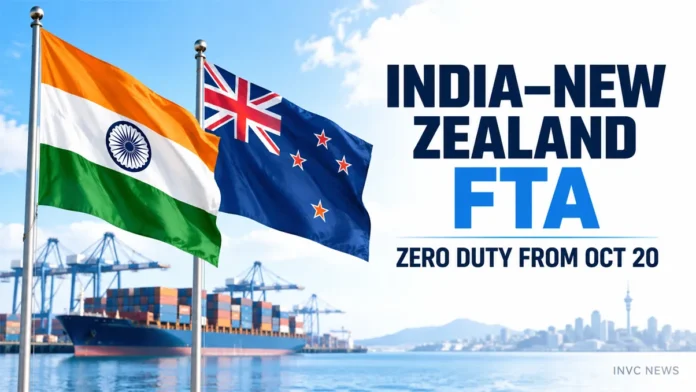
WELLINGTON, New Zealand | September 21, 2026 — India and New Zealand formally ratified their Free Trade Agreement on Monday, clearing the final major hurdle for a deal that will give Indian exporters duty-free access across all tariff lines in New Zealand and create new opportunities for students and skilled professionals.
The agreement will officially enter into force on October 20, 2026.
That means Indian exporters in sectors ranging from textiles and footwear to engineering goods, processed foods and automobiles will soon enter the New Zealand market with zero-duty access.
The deal also creates a dedicated employment pathway for Indian professionals and expands post-study work opportunities for students.
For businesses, workers and students, October 20 now becomes the date to watch.
India-New Zealand FTA Ratified Today
New Zealand Trade and Investment Minister Todd McClay announced on September 21 that both countries had formally ratified the agreement.
New Zealand completed its domestic procedures after its Parliament passed the necessary legislation earlier this month.
The two sides originally signed the FTA in New Delhi on April 27, 2026.
With ratification completed, the agreement will enter into force one month later on October 20.
100% of Indian Exports Get Duty-Free Access
One of the biggest benefits for India comes on the export side.
New Zealand has agreed to provide duty-free access to 100% of Indian exports covering all tariff lines from the date the agreement takes effect.
That includes several labour-intensive industries where India has significant export capacity.
Textiles and apparel.
Leather and footwear.
Engineering goods.
Processed foods.
Automobiles and auto components.
Gems and jewellery.
Chemicals and other manufactured products.
Before the agreement, some Indian products faced New Zealand tariffs of up to 10%.
Those barriers will disappear once the deal takes effect.
New 5,000-Worker Visa Pathway for Indians
The agreement is not limited to goods.
It also creates a Temporary Employment Entry visa pathway for Indian professionals, with a quota of up to 5,000 visas at any given time.
Eligible workers can receive stays of up to three years.
The pathway covers professions including IT, engineering, healthcare, education and construction.
It also includes Indian chefs, AYUSH practitioners, yoga instructors and music teachers.
For skilled Indian professionals considering New Zealand, this could become one of the most closely watched parts of the agreement.
Indian Students Get Expanded Post-Study Work Rights
Students also receive significant benefits.
Under the agreement, New Zealand has created a dedicated student mobility and post-study work arrangement with India.
Indian students will not face a numerical cap under the agreed framework.
They will also have guaranteed minimum work rights of 20 hours per week while studying.
STEM bachelor’s and master’s graduates can receive post-study work opportunities of up to three years.
Doctoral graduates can receive up to four years.
The agreement also provides for multiple-entry Working Holiday Visas for up to 1,000 young Indians every year.
$20 Billion Investment Commitment to India
Another major component of the FTA is investment.
The agreement includes a commitment aimed at facilitating approximately $20 billion in New Zealand investment into India.
The investment is expected to span areas including manufacturing, infrastructure, agriculture, startups, renewable energy, technology and digital services.
India and New Zealand have also established mechanisms to monitor investment delivery under the agreement.
India Keeps Dairy and Sensitive Farm Products Protected
The agreement does not open every Indian sector to unrestricted imports.
India has kept several sensitive categories outside full tariff liberalisation.
These include major dairy products such as milk, cream, cheese, yoghurt and whey.
Several agricultural products, including onions, chickpeas, peas, corn and some other sensitive goods, are also protected.
India has offered tariff liberalisation on about 70% of tariff lines covering roughly 95% of bilateral trade value, while maintaining exclusions for sensitive domestic sectors.
What Becomes Cheaper From New Zealand?
New Zealand will also receive greater access to the Indian market.
From day one, about 57% of New Zealand exports to India will become tariff-free, according to the New Zealand government.
That includes products such as sheep meat, wool, coal and a large share of forestry and wood exports.
Tariffs on additional products will be reduced gradually.
Kiwifruit and apples will receive preferential quota-based access under specific safeguards rather than unlimited zero-duty imports.
Pharmaceuticals Could Get Faster Market Access
India’s pharmaceutical and medical-device industries could also benefit.
The agreement allows regulatory authorities in New Zealand to recognise certain inspection reports and approvals from recognised international regulators.
That could reduce duplicate inspections and shorten approval processes for eligible Indian pharmaceutical and medical-device exporters.
For India’s pharmaceutical sector, the provision could reduce both compliance costs and time required to enter the New Zealand market.
Why October 20 Matters
Signing an FTA does not immediately change customs duties.
Ratification and entry into force are the key steps.
Those steps are now almost complete.
From October 20, 2026, the new tariff schedules, services commitments and mobility provisions will start operating under the agreement.
For Indian exporters, that means zero-duty access across New Zealand’s tariff lines.
For skilled professionals and students, it creates new employment and post-study pathways.
For businesses in both countries, it creates a new framework for trade and investment.
The agreement was signed in April.
Today it was formally ratified.
And from October 20, businesses, students and professionals will begin seeing what the deal means in practice.