By Team INVC | INVC NEWS
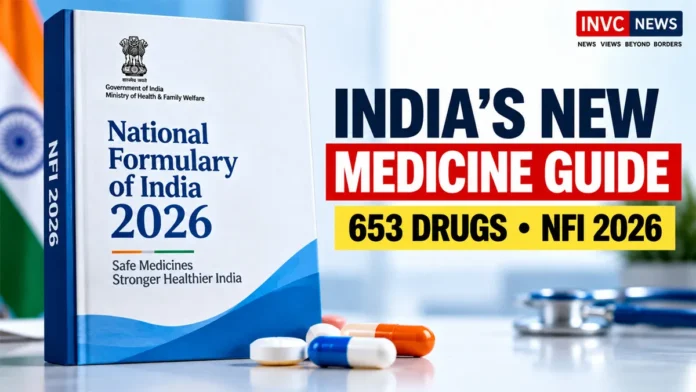
NEW DELHI, India | September 21, 2026 — India strengthened its medicine-safety framework on Monday with the launch of the National Formulary of India 2026, bringing updated guidance on 653 medicines alongside a new Biovigilance Programme designed to track safety concerns linked to biological products, organ and tissue transplantation.
Union Minister of State for Health and Family Welfare Anupriya Patel launched the seventh edition of the National Formulary of India, or NFI 2026, during the 6th National Pharmacovigilance Week programme in New Delhi.
The government also unveiled new tools for reporting adverse drug reactions and medical-device-related safety problems.
For patients, doctors, pharmacists and hospitals, the changes have one central goal:
Make medicines and medical products safer by detecting problems earlier and improving how adverse events are reported.
What Is the National Formulary of India 2026?
The National Formulary of India acts as a practical reference for healthcare professionals on the safe and rational use of medicines.
The 2026 edition includes:
653 drugs
42 fixed-dose combinations
30 immunological products
34 chapters
20 appendices
The Indian Pharmacopoeia Commission has revised drug information to align it more closely with the National List of Essential Medicines and India’s National Health Programmes.
NFI 2026 is available in both print and digital formats through NFI Online.
That digital access could make updated medicine information easier for doctors, pharmacists and other healthcare professionals to consult during routine clinical work.
What Does NFI 2026 Mean for Patients?
The formulary is primarily designed for healthcare professionals rather than as a self-medication guide for consumers.
Its purpose is to support better prescribing and safer medicine use.
Doctors and pharmacists can use the formulary to access standardised information while deciding how medicines should be prescribed, dispensed and monitored.
The broader objective is what health authorities describe as the rational use of medicines — ensuring patients receive an appropriate medicine, in an appropriate manner, while unnecessary or unsafe use is reduced.
However, patients should not use a formulary entry to start, stop or change prescription medicines without professional medical advice.
India Launches New Biovigilance Programme
The bigger structural announcement came with the government’s approval of the Biovigilance Programme of India.
The Indian Pharmacopoeia Commission will play a leading role in the programme.
Biovigilance focuses on identifying, assessing and preventing adverse events connected with biological materials and products used in transplantation and related medical procedures.
The programme will cover safety issues associated with medicines and biological products used for organ and tissue donors as well as recipients.
That adds another layer to India’s national patient-safety network.
Pharmacovigilance, Materiovigilance and Now Biovigilance
India already operates separate safety-monitoring systems for medicines and medical devices.
Pharmacovigilance focuses on adverse effects and safety concerns linked to medicines.
Materiovigilance monitors adverse events involving medical devices.
The new Biovigilance Programme expands monitoring into biological products and transplantation-related areas.
Together, these systems aim to identify safety signals that may not become obvious during initial clinical testing.
A medicine or medical device can continue generating important safety information even after regulators approve it and hospitals begin using it widely.
That is why post-market monitoring plays a critical role in modern healthcare.
New Medical Device Safety Guidance for Hospitals
The government also launched a Guidance Document for Hospitals in India for Safety Monitoring and Reporting of Medical Device-Related Adverse Events.
Medical devices cover a huge range of products used in healthcare.
When a device produces an unexpected problem, healthcare professionals need a structured mechanism to document and report the event.
The new guidance aims to strengthen that process across hospitals.
Better reporting can help regulators identify patterns rather than treating every incident as an isolated case.
New ADR-PvPI 2.0 App Launched for iPhone Users
Another announcement involves digital reporting.
The government launched the ADR-PvPI 2.0 mobile application for iOS users.
ADR stands for adverse drug reaction.
The app forms part of India’s effort to make medicine-safety reporting easier and more accessible.
The government already operates digital reporting systems and helplines through the Pharmacovigilance Programme of India.
Health authorities now want more patients themselves to participate in reporting suspected adverse reactions.
That matters because some medicine-related problems may only become visible when large numbers of people use a product in everyday conditions.
India Has Around 1,150 ADR Reporting Centres
India currently has approximately 1,150 adverse drug reaction reporting centres operating across public hospitals, private hospitals and medical colleges.
The government plans to expand medicine-safety monitoring further toward the primary healthcare level.
Such expansion could help capture safety information from communities that are currently far from major medical colleges or tertiary-care hospitals.
It could also broaden India’s national database of medicine-related safety signals.
India Climbs in Global Drug-Safety Reporting
India’s role in international pharmacovigilance has also grown significantly.
According to the Health Ministry’s announcement, India has moved from the 123rd position during 2009–2014 to eighth globally in contributions to the World Health Organization patient-safety database.
Around 25 countries also recognise or accept the Indian Pharmacopoeia.
Those figures demonstrate how India’s pharmaceutical role is expanding beyond manufacturing medicines.
The country is also building systems for generating and analysing its own medicine-safety evidence.
AI Could Play a Bigger Role in Medicine Safety
Artificial intelligence is also entering the pharmacovigilance discussion.
The Health Ministry highlighted the potential use of AI and advanced data analytics to strengthen medicine-safety systems.
That could become increasingly important as reporting volumes grow.
Thousands or millions of safety reports can contain patterns that may be difficult to identify manually.
Data-analysis systems can potentially help experts identify unusual clusters, recurring reactions or other signals requiring investigation.
However, such tools support rather than replace clinical and regulatory assessment.
Why NFI 2026 Matters
India is often described as one of the world’s major pharmaceutical manufacturing centres.
But producing medicines is only one part of healthcare safety.
The next challenge is ensuring that information about medicines remains current, doctors have reliable prescribing guidance and unexpected adverse events reach regulators quickly.
NFI 2026, expanded digital reporting and the new Biovigilance Programme all move in that direction.
The most important part of the announcement may therefore not be the number of medicines inside the new formulary.
It is the system being built around them.
From prescribing a medicine to monitoring what happens after a patient receives it, India is trying to create a more connected safety chain.
Because medicine safety does not end when a drug reaches the pharmacy shelf — that is where real-world monitoring begins.