By Team INVC | INVC NEWS
NEW DELHI, India | September 21, 2026 — That annoying promotional call arriving just when you are working, driving or expecting an important phone call could soon become harder for persistent spammers to hide behind.
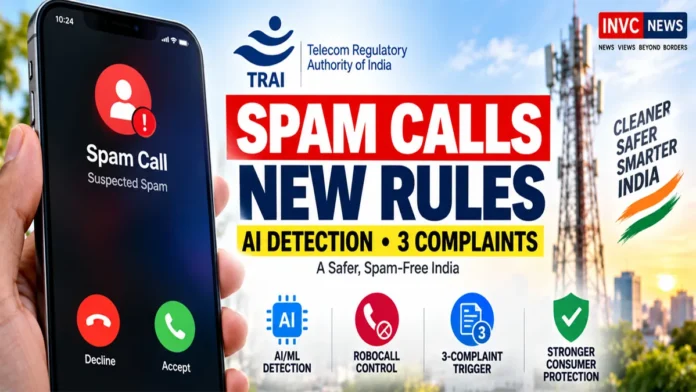
India’s telecom regulator has significantly strengthened its anti-spam framework, bringing AI-based detection, automated robocalls, artificial-voice commercial calls and faster complaint-based enforcement under tighter rules.
The Telecom Regulatory Authority of India, or TRAI, has introduced the Telecom Commercial Communications Customer Preference (Third Amendment) Regulations, 2026, expanding the fight against unsolicited commercial communication.
For ordinary mobile users, the biggest change is straightforward:
Telecom companies will no longer have to depend only on large numbers of consumer complaints before identifying suspicious spam activity.
Their own AI and machine-learning systems can now become part of the enforcement process.
Just Three Complaints Could Trigger Action
One of the most important changes lowers the complaint threshold in certain cases.
Previously, five or more unique complaints within 10 days could trigger action against a sender.
Under the revised system, action can begin when three or more unique consumers complain within 10 days, provided the sender’s number is also flagged by the telecom operator’s AI or machine-learning system as highly likely to be sending unsolicited commercial communication.
This creates a two-part test:
Real consumer complaints.
And technology-based detection.
The aim is to identify repeat spammers faster without relying entirely on one source of information.
AI Will Help Telecom Companies Hunt Suspected Spam
Major telecom operators already use AI and machine-learning systems to identify suspicious communication patterns.
The new framework formally strengthens that approach.
Telecom service providers will identify calling numbers that show a high probability of being used for unsolicited commercial communications and share relevant intelligence with other operators.
If five or more calling numbers associated with the same sender are flagged within 10 days, telecom providers can begin deeper investigation.
That may include KYC re-verification, physical verification, restrictions on outgoing services and, in repeated cases, disconnection of telecom resources.
For professional spam operations that rotate through multiple numbers, this could become particularly important.
Changing one number may no longer be enough if operators can identify a wider pattern connected to the same sender.
Robocalls and Artificial-Voice Calls Come Under Clear Rules
TRAI has also created a clearer framework for Application-to-Person, or A2P, calls.
These include commercial calls initiated by applications, software systems or automated platforms instead of somebody manually dialling a number.
The definition covers:
Autodialled calls.
Robocalls.
Pre-recorded calls.
Artificial-voice calls.
Businesses using such systems must declare their use to their telecom provider in advance and provide information about the calling numbers they intend to use.
Undeclared A2P calls can be treated as unsolicited commercial communication.
That matters as businesses increasingly use automated technology to contact huge numbers of customers at once.
A Cost Has Been Added to Automated Calling
TRAI has also introduced a termination charge of up to 5 paise per minute for certain A2P calls.
The terminating telecom provider can levy the charge on the originating provider.
Calls made through authorised numbering systems for regulated commercial communication, along with TRAI-authorised calls, can receive exemptions.
The charge itself is small.
However, at the scale of millions of automated calls, even a small per-minute cost can create an economic deterrent against indiscriminate bulk calling.
Asked About a Product? Seller Cannot Keep Calling Forever
Another change directly affects consumers who make online inquiries.
Suppose someone asks an e-commerce platform, insurance company, property portal or service provider about a product.
That inquiry cannot automatically become an unlimited licence for continued promotional communication.
Under the amended framework, commercial communication based on a consumer inquiry can continue for only seven days from the date of that inquiry.
The original inquiry must also exist in a verifiable written or digital form.
That could reduce one of the most familiar consumer frustrations: asking for information once and then receiving sales calls for weeks.
Consumers Get a New Appeal Route
TRAI has also strengthened the complaint process itself.
Consumers dissatisfied with the resolution of an unsolicited commercial communication complaint can now appeal.
The appeal can be filed within 15 days before the relevant Appellate Authority.
Consumers can use existing complaint channels, including the TRAI DND app, telecom operator apps or portals, and the 1909 call or SMS service.
This creates another layer of review when a consumer believes a spam complaint was not handled properly.
Misused Message Headers Face Faster Suspension
The rules also target misuse of SMS headers and message templates.
If a registered header or content template is misused, the originating telecom provider must suspend it within six hours after becoming aware of the misuse.
The sender will then have to take corrective action.
Where a telemarketer is responsible, its telecom resources across providers can be disconnected for one year and it can face further exclusion under the enforcement framework.
This provision targets another common problem: apparently legitimate-looking sender IDs being exploited for misleading or unauthorised messages.
What About 140 and 1600 Series Calls?
There is an important detail consumers should understand.
TRAI has designated number ranges for regulated commercial, service and transactional communication, including the 140xx, 1600xx and 1601xx series.
Call-management applications cannot automatically apply blanket spam blocking or tagging to every call from these regulated number ranges.
TRAI says such blanket treatment could cause users to miss genuine commercial or government communications.
However, individual users remain free to block or filter calls on their own devices.
The regulator is therefore trying to distinguish authorised commercial communication from uncontrolled spam rather than treating every business call as identical.
Why TRAI Is Changing the System
Spam has evolved.
Bulk communication no longer depends only on traditional telemarketing centres with employees manually dialling numbers.
Software can now place calls at enormous scale.
Artificial voices can deliver messages automatically.
One operator can use multiple numbers.
Commercial messages can also exploit registered sender IDs and templates.
TRAI’s latest framework attempts to make enforcement evolve alongside those technologies.
AI is therefore being used on both sides of the equation.
Companies can use automation to contact consumers.
Telecom operators can use AI to identify suspicious behaviour.
What Mobile Users Should Do
Consumers still play a crucial role.
People receiving unsolicited commercial calls or messages should use authorised complaint channels rather than simply deleting the communication.
Complaints can help telecom providers establish patterns, while AI systems provide another layer of detection.
Users should also be careful about giving consent to businesses and should pay attention when filling forms online that contain marketing permissions.
And if a complaint is rejected or handled unsatisfactorily, the new appeal mechanism provides another route.
The battle against spam calls is unlikely to disappear overnight.
But India’s regulatory system is becoming considerably more technology-driven.
For persistent spammers, that means an important change:
The phone may still ring — but hiding behind endless numbers, robocalls and automated systems could become much harder.