By Team INVC | INVC NEWS
MUMBAI, India | September 22, 2026 —
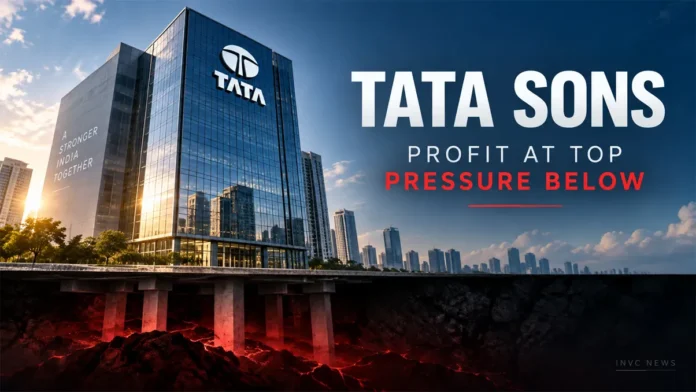
Tata Sons ended FY2025-26 with a number most companies would celebrate: ₹31,961 crore in profit after tax.
But dig one layer deeper, and the champagne quickly loses its fizz.
Behind the headline profit sits a far more uncomfortable reality. Some of the Tata Group’s biggest future-facing businesses — aviation, digital commerce and batteries — are still swallowing enormous amounts of money.
Air India, Air India Express, Tata Digital and Agratas together accounted for more than ₹25,500 crore of losses in FY26.
So the real Tata Sons story is not simply about profit.
It is about a giant corporate balancing act:
cash-rich champions at the top, money-hungry bets underneath, and a regulatory fight over the future structure of India’s most famous business house.
₹31,961 crore profit — but where did the money actually come from?
Here is the first twist.
Tata Sons reported total revenue of ₹42,366.55 crore in FY26 and profit after tax of ₹31,961.11 crore.
Impressive?
Absolutely.
But the composition matters.
Of Tata Sons’ ₹35,568 crore revenue from operations, a massive ₹32,528 crore came from dividend income.
Brand subscription and other service income contributed only a fraction of that amount.
In simple terms, Tata Sons remains financially powerful largely because its ownership in established Tata companies continues to throw off huge amounts of cash.
That is the sweet part of the story.
Now comes the chilli.
Below the surface, some of Tata’s biggest dreams are still burning cash
Tata Group has spent years building the businesses it believes will define its next generation.
Airlines.
Digital commerce.
Battery manufacturing.
Electronics.
New mobility.
These are not small side bets.
They are multi-billion-rupee strategic wagers.
And several of them are still deep in red.
The annual report shows:
Air India: loss contribution of about ₹15,368 crore
Air India Express: about ₹6,767 crore
Tata Digital: about ₹2,993 crore
Agratas Energy Storage Solutions: about ₹380 crore
Put them together and the bill crosses ₹25,500 crore.
That is where FY26 becomes fascinating.
The old Tata empire is helping fund the new Tata empire.
But the new empire is expensive.
Very expensive.
Air India remains the elephant in the boardroom
Nothing illustrates Tata’s high-stakes strategy better than Air India.
Tata Group did not buy the airline merely to own planes.
It bought a broken national aviation giant with the ambition of rebuilding it into a global carrier.
That requires new aircraft, technology, people, maintenance systems, lounges, routes, training and operational restructuring.
Transformation on that scale was never going to be cheap.
But a ₹15,000-crore-plus loss contribution means Air India is no longer a footnote in Tata Sons’ financial story.
It is one of the central questions.
How long will the turnaround take?
How much more capital will it need?
And when does prestige finally become profit?
Those are questions investors and analysts cannot ignore simply because Tata Sons itself remains profitable.
Tata Digital has another problem: money alone cannot buy a super-app
Then there is Tata Digital.
The group entered India’s digital consumer war with enormous ambition.
The dream was obvious: bring shopping, travel, groceries, hotels, electronics and financial services into a connected Tata ecosystem.
The reality has been tougher.
Tata Digital contributed a loss of nearly ₹3,000 crore in FY26.
And that exposes one of corporate India’s hardest lessons:
having strong brands is not the same thing as having strong digital economics.
In digital commerce, Tata is fighting companies that have spent years training consumers to live inside their apps.
Customer acquisition is expensive.
Discounting is expensive.
Technology is expensive.
Logistics are expensive.
And loyalty is difficult to manufacture.
Tata has patience.
But patience also has a price.
Agratas is burning money for a different reason
Agratas presents another kind of challenge.
Unlike Tata Digital, its losses are not simply about customer acquisition or app engagement.
The battery business requires massive upfront investment.
Factories have to be built before they can generate mature returns.
Technology has to be developed.
Supply chains have to be secured.
Production has to scale.
So Agratas’ losses may be understandable in the context of a long-term industrial build-out.
But understandable does not mean irrelevant.
Capital tied up today still has an opportunity cost.
And Tata is simultaneously spending heavily across aviation, electronics, semiconductors, batteries and other strategic sectors.
That makes capital allocation one of the most important words in Tata Sons’ future.
Meanwhile, the cash machine is still humming
Here is why nobody should mistake this for a financial crisis.
Tata Sons remains extraordinarily strong.
Its standalone total equity rose to about ₹1.79 lakh crore by March 31, 2026, from roughly ₹1.50 lakh crore a year earlier.
Retained earnings also climbed sharply.
And the company continues to sit on valuable stakes in some of India’s most powerful listed businesses.
That gives Tata Sons something many corporate groups would envy:
time.
Time to fix Air India.
Time to build batteries.
Time to make digital bets work.
Time to absorb losses that could break weaker promoters.
But deep pockets do not make losses disappear.
They merely make them survivable for longer.
And now comes the listing drama
The financial debate has become even more explosive because Tata Sons is also caught in a regulatory and governance battle over its future.
The company remains registered with the Reserve Bank of India as a Core Investment Company and is classified as a systemically important non-deposit-taking CIC.
Tata Sons had sought to surrender that registration, but the regulatory question has remained central to the debate over whether the holding company could eventually face listing pressure.
The issue has already spilled into the wider Tata universe.
Recent disputes over Tata Sons’ governance and potential listing have rattled investors, with several listed Tata companies seeing sharp market moves amid uncertainty over what happens next.
And that is where the story stops being just about accounting.
A listed Tata Sons would face a very different level of public scrutiny.
Every capital allocation decision would be dissected.
Every large loss would become a quarterly talking point.
Every bailout, investment and strategic bet would attract shareholder questions.
For a group accustomed to thinking in decades rather than quarters, that could change the rules of the game.
The real Tata Sons equation is brutally simple
Tata Sons currently has two worlds living inside one balance sheet.
One world contains businesses that generate enormous value and cash.
The other contains businesses that may define Tata’s future — but are still demanding huge amounts of capital today.
So far, the first world is strong enough to finance the second.
That is the good news.
The risk begins if the losses in the second world stay large for too long.
Because sooner or later, even the deepest pockets ask the same question:
When does investment become return?
This is why ₹31,961 crore does not tell the whole story
If someone looks only at Tata Sons’ profit figure, FY26 looks spectacular.
₹31,961 crore profit.
₹1.79 lakh crore equity.
Massive dividend flows.
A portfolio of powerful businesses.
But that is only half the photograph.
The other half contains Air India’s losses, Tata Digital’s expensive struggle, battery investments, massive future commitments and growing regulatory scrutiny.
That does not make Tata Sons weak.
It makes the story far more interesting.
Because the group is attempting something unusually ambitious:
using the cash machines built by yesterday’s Tata to finance the businesses it hopes will dominate tomorrow.
If those bets work, FY26’s losses may eventually look like the price of transformation.
If they do not, the same numbers will look very different in hindsight.
For now, Tata Sons remains rich enough to keep playing.
But the stakes are getting bigger.
And so is the bill.