By Team INVC | INVC NEWS
WASHINGTON, United States | September 22, 2026 —
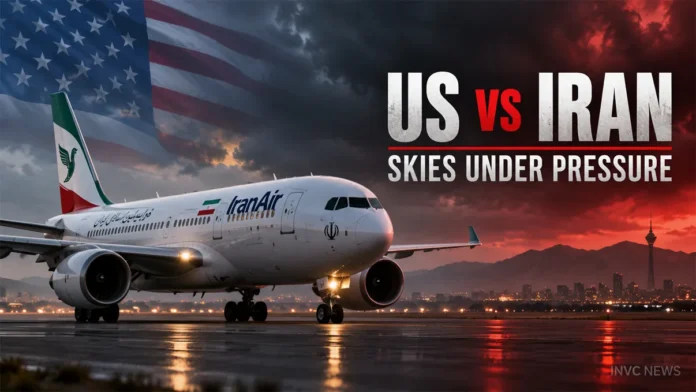
The United States has raised the pressure on Iran with a move that could hit one of the country’s most vulnerable global lifelines — its airlines.
This time, Washington is not firing missiles or sending warships.
It is going after runways, refuelling points, ticket counters and airport service chains.
From September 23, the US wants to make it painfully risky for airports, fuel suppliers, ground handlers and ticketing companies anywhere in the world to do business with Iranian airlines. The warning from US Treasury Secretary Scott Bessent was blunt: any company helping Iranian carriers with fuel, landing services or ticketing support could face American action.
In other words, Washington is trying to do something remarkable:
ground Iranian airlines globally without physically closing a single airport.
And Tehran is not taking the threat quietly.
Iran has fired back with a chilling warning of its own: if the United States launches fresh military action, American bases across West Asia could come under retaliatory attack.
That turns this from an aviation pressure story into something much bigger:
a sky war of sanctions above, and the threat of a ground war below.
Washington is targeting Iran’s aviation arteries
The new American pressure campaign does not work like a traditional flight ban.
The US is not telling every country in the world, “You must legally ban Iranian planes.”
Instead, it is weaponising financial fear.
The message is simple: if an airport, service company or travel-related business helps Iranian airlines keep flying, it could itself be punished under US sanctions pressure.
That includes:
- refuelling aircraft
- providing landing and airport services
- offering ticketing support
- facilitating operational logistics
This is why the move is so potent.
Airlines do not survive on aircraft alone. They need a global support system. Remove enough of that support system, and even a national carrier starts gasping for air.
That is exactly where Washington is applying pressure now.
The goal is not just inconvenience — it is isolation
This is not a warning designed to create a little turbulence.
It is designed to create isolation.
If airports refuse Iranian aircraft, if fuel providers back off, if ticketing systems stop cooperating and if service vendors step away, Iranian carriers could find themselves cut off from large parts of the international aviation network.
That is why Bessent’s warning has drawn such intense attention.
The United States is not merely sanctioning an airline name on paper.
It is trying to choke the ecosystem that allows those airlines to function.
That makes this one of the most aggressive aviation pressure moves Washington has used against Tehran in years.
Iran says the next blow will not go unanswered
Tehran’s answer has added an entirely different layer of danger.
Iran has warned that any fresh American military action could trigger strikes on US bases and interests across the region. Iranian officials have also warned regional governments not to assist Washington in any renewed escalation.
This matters because the Middle East is already tense enough.
One sanctions escalation can become a military escalation very quickly when both sides are speaking in the language of pressure and retaliation.
And that is what makes this story so combustible.
America is trying to hit Iran through commerce.
Iran is hinting that a wider confrontation could hit back through force.
September 23 is shaping up as a pressure-test day
The big question now is what actually happens once the deadline arrives.
Will airports stop handling Iranian planes?
Will fuel companies refuse to serve them?
Will aviation vendors quietly step away rather than risk trouble with Washington?
Will ticketing and travel systems start freezing Iranian carriers out?
If the answer to those questions is yes, Iran’s airlines could face a serious operational squeeze almost overnight.
If not, the world may discover where Washington’s secondary-sanctions power begins to weaken.
Either way, September 23 looks less like an ordinary sanctions date and more like a stress test for the global aviation system.
This is bigger than planes
At one level, this is about airlines.
At another, it is about power.
The United States is showing how far its financial influence can reach beyond its own borders. Iran is showing that it wants the world to know economic pressure may carry security consequences.
That means this is no longer just a story about takeoffs and landings.
It is about whether financial pressure can turn into geopolitical paralysis.
It is about whether airports and private companies around the world are willing to choose the US over Iran.
And it is about whether Tehran responds only with rhetoric — or with actions that make the region even more unstable.
The real message from Washington
The deeper message behind this move is brutally clear:
the US wants every company in the global aviation chain to think twice before touching Iran.
Not just governments.
Not just airlines.
Everyone.
Fuel companies.
Airport authorities.
Ground handlers.
Ticketing platforms.
Service providers.
This is sanctions warfare aimed at everyday commercial infrastructure.
And it shows how modern pressure tactics work: not always by bombing assets, but by making them commercially unusable.
The danger now is miscalculation
That is the real risk.
When one side tightens sanctions and the other side talks about retaliation, the room for miscalculation shrinks fast.
The United States may see this as financial coercion.
Iran may see it as another step in a larger strategy of siege.
Regional countries may find themselves caught in between.
And airlines — usually symbols of mobility and connection — could become the latest battlefield in a much wider confrontation.
The bottom line
Washington has decided to squeeze Iran where it hurts: its ability to stay connected to the outside world.
Tehran has replied with a warning that any new military push could set American interests in the region in the line of fire.
So the real story is not only that Iranian airlines may struggle to fly from September 23.
The real story is that the skies above this confrontation are getting tighter — while the ground below it is becoming more dangerous.
America is trying to ground Iran through sanctions.
Iran is warning that the cost of escalation may not stay in the air.