By Team INVC | INVC NEWS
LONDON, United Kingdom | September 20, 2026 —
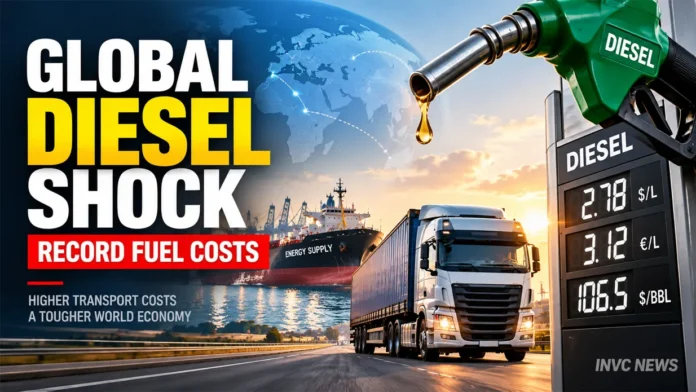
A worsening global diesel price crisis is pushing up transportation, farming and supply-chain costs as wars in Ukraine and the Middle East disrupt refineries, shipping routes and fuel supplies across major markets.
Diesel prices have reached record levels in several markets even though benchmark crude oil prices remain below their historical all-time highs.
In the United States, the national average diesel price crossed $6 a gallon for the first time earlier this month. In Europe, wholesale diesel prices have climbed above $210 a barrel, according to Reuters.
Meanwhile, Brent crude settled at $104.87 a barrel on September 18, while U.S. West Texas Intermediate closed at $100.30 a barrel.
The result is an unusual energy shock: crude oil is expensive, but the shortage and cost of turning that crude into diesel have made refined fuel even more painful for consumers and businesses.
Why Diesel Prices Are Hitting Records
The current diesel shock is not coming from one conflict alone.
Ukraine has repeatedly targeted Russian refining and energy infrastructure with long-range drones, reducing available refining capacity and putting pressure on Russian fuel exports.
At the same time, sanctions have made it harder for Russia to repair damaged facilities and maintain normal flows of refined petroleum products, according to Reuters analysis.
The Middle East has added another layer of disruption.
Fighting involving Iran, the United States, Israel, Saudi Arabia and Yemen’s Houthis has threatened major oil-production centres and some of the world’s most important shipping routes.
That combination has squeezed global diesel supplies at both ends: less reliable refining capacity and more expensive transportation of the fuel that remains available.
Shipping Oil Is Becoming Much More Expensive
The cost of transporting crude has also surged.
Rates for very large crude carriers travelling from the Gulf of Oman to China recently reached record levels, equivalent to roughly $11.50 per barrel, as security risks reduced tanker availability and pushed insurance and charter costs higher.
Threats around the Strait of Hormuz and Bab el-Mandeb have become especially important.
Together, these maritime corridors carry enormous quantities of crude oil, refined fuels and liquefied natural gas.
Even when oil continues to move, ships may need longer routes, additional security or more expensive insurance.
Those costs eventually enter the price paid by refiners, transport companies and consumers.
Diesel Hurts the Economy Differently From Crude Oil
The economic impact of high diesel prices can spread quickly because diesel sits deep inside the global supply chain.
Trucks use it to transport food and manufactured products.
Farm machinery uses it to plant and harvest crops.
Construction companies rely on diesel-powered equipment.
Ships, trains and generators also consume large quantities.
The U.S. Energy Information Administration says trucks and trains powered by diesel move much of the goods consumers use, while farming and construction equipment also depend heavily on the fuel.
That means the diesel shock does not end at the petrol station.
A trucking company pays more for fuel.
It raises freight charges.
A supermarket or manufacturer then pays more to move goods.
Those additional costs can eventually reach households through higher prices.
Refining Crisis Makes the Problem Worse
Crude oil prices explain only part of today’s fuel cost.
Refineries must convert crude into products such as petrol, jet fuel and diesel.
The difference between crude prices and the value of refined fuel — often measured through refining or “crack” spreads — has widened sharply.
The U.S. Energy Information Administration said on September 18 that tight distillate supplies combined with elevated crude oil prices and high refining margins have driven diesel prices higher.
Reuters has also reported historically low diesel inventories in important markets.
That leaves the system with little capacity to absorb another refinery shutdown, shipping disruption or military escalation.
Global Energy Safety Net Is Running Thin
Earlier in the Middle East conflict, world oil markets avoided an even larger shock by drawing down inventories, increasing production outside the Gulf and rerouting supplies.
But those buffers are weakening.
The International Monetary Fund said global inventories helped cover a market deficit of roughly 4 million barrels per day during the earlier phase of the Middle East disruption.
The IMF warned that much of that flexibility had already been used and that a slow supply recovery could cause greater damage to the world economy.
Executives from Shell and Equinor have issued similar warnings, saying the mechanisms that previously absorbed energy shocks are becoming less effective.
Inflation Risk Returns
Expensive energy is again complicating the global inflation outlook.
Higher transport and production costs can filter into prices for food, manufactured goods and services.
Financial markets are already paying close attention.
Global central banks have recently faced renewed pressure from elevated oil and diesel prices while trying to control inflation without unnecessarily weakening economic growth.
The danger is not simply a one-day spike in fuel prices.
If high diesel and freight costs persist for months, companies may have little choice but to pass a larger share of those expenses on to customers.
India Faces a Particularly Important Risk
India has substantial exposure because it relies heavily on imported crude oil.
Government data shows India’s crude-oil import dependence has remained around 88% in recent years.
That means sustained increases in global crude and shipping costs can raise India’s import bill and put additional pressure on the rupee.
The government’s own economic review has previously estimated that a 10% increase in crude prices, if fully passed through, could raise inflation by around 30 basis points.
India’s retail inflation already accelerated to 4.82% in August 2026, while higher oil prices have increased expectations that the Reserve Bank of India may need to take a more cautious approach to interest rates.
Russian Oil Creates Another Challenge for India
India also faces a geopolitical complication.
Russia remains an important crude supplier, but new U.S. sanctions powers could affect countries that continue making large purchases of Russian oil.
For New Delhi, significantly reducing Russian purchases could mean paying more for alternative supplies at a time when global oil markets are already tight.
Continuing those purchases, however, could expose India to additional trade pressure from Washington.
Energy security has therefore become closely tied to trade policy and diplomacy.
Governments Are Already Intervening
Some countries have started taking emergency measures to cushion the diesel shock.
Germany announced temporary reductions in energy taxes on petrol and diesel as fuel costs climbed.
Brazil’s state-controlled Petrobras has approved participation in a temporary government diesel subsidy programme.
Other governments face similar choices: cut taxes, introduce subsidies, release strategic stocks or allow consumers and businesses to absorb higher costs.
Each option carries a price.
Subsidies protect consumers but increase government spending.
Tax reductions cut revenue.
Strategic stock releases cannot continue indefinitely.
The Bigger Risk Is What Happens Next
Oil markets have already demonstrated that prices can move sharply when a refinery, pipeline, tanker or shipping corridor comes under attack.
The greatest risk now is another major disruption while global inventories and refining capacity remain stretched.
A sustained escalation could push crude prices higher again.
But diesel may remain the bigger economic problem because the world cannot instantly replace lost refining capacity.
That is why today’s energy crisis has moved beyond the oil market.
It is becoming a transportation, food, manufacturing and inflation story.
Crude oil above $100 a barrel is already painful.
Record diesel prices can spread that pain through almost every part of the economy.