By Team INVC | INVC NEWS
Published: October 10, 2026 | 12 : 35 PM IST
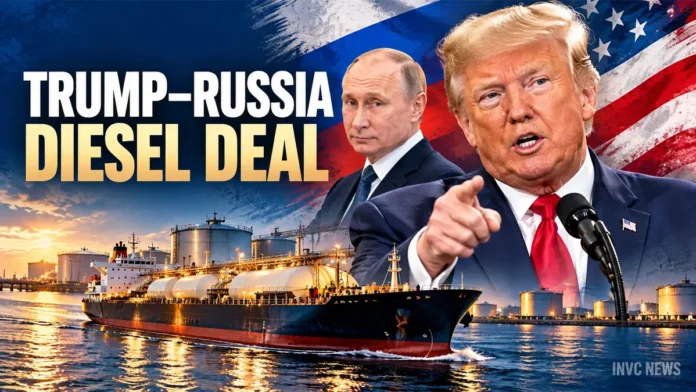
WASHINGTON, United States | October 10, 2026 — The Trump–Russia diesel deal has opened a confrontation between Washington’s push for cheaper fuel and Kyiv’s demand to maintain pressure on Moscow. President Donald Trump thanked Russian President Vladimir Putin for the supply agreement, while Ukrainian President Volodymyr Zelenskyy warned that the arrangement could help Russia prolong its war.
Speaking to reporters at the White House on Friday, October 9, Trump described the agreement as a major source of diesel for the United States. He emphasized America’s need for the fuel and presented additional supply as a way to address energy costs.
However, the announcement leaves important questions unanswered, including payment arrangements, delivery timing and whether Washington offered concessions in exchange.
Trump puts fuel supply at the center of his defense
Trump said the agreement would bring substantial quantities of diesel into the American and global markets.
“I want to thank President Putin,” he told reporters, emphasizing that diesel was the product the United States wanted.
His comments framed the arrangement primarily around supply and affordability. Earlier, he had identified lower fuel prices for farmers, ranchers and truckers as a priority.
That argument explains the administration’s public justification. It does not establish that the announced shipments have already arrived or that consumers have received a sustained price reduction.
What Trump announced about the shipments
According to Trump’s announcement, Russia would immediately supply more than 300,000 tons of diesel to the American and global marketplace.
He also outlined additional deliveries of 500,000 tons in November, followed by 1 million tons and a further 3 million tons within what he described as a short period.
These figures represent the president’s announced supply plan. They should not be interpreted as a verified tally of fuel already delivered to the United States.
Moreover, the reference to American and global markets matters. The announcement does not establish that every ton will go directly to American buyers.
Zelenskyy challenges the agreement’s wider consequences
Zelenskyy criticized the arrangement as a weak decision by strong partners and described it as a gift to Putin.
His objection centers on Russia’s ability to earn money from energy sales while continuing its war against Ukraine. He argued that allowing additional sales would give Moscow resources to sustain the conflict.
The Ukrainian president also expressed frustration over the timing of the announcement, as Ukrainian representatives held discussions with American officials about ending the war.
When reporters raised his criticism, Trump did not provide a detailed rebuttal. Instead, he continued to emphasize the diesel agreement’s importance.
Consequently, the exchange leaves two distinct positions: Trump argues that additional supply serves American consumers, while Zelenskyy argues that the arrangement weakens pressure on Russia.
Lower prices remain a promise rather than a settled outcome
Trump linked the deal to his effort to bring down energy costs. However, an announcement of additional supply does not guarantee a particular reduction at the pump.
Delivery schedules, market destinations and commercial terms will help determine the agreement’s practical effect. Those details remained incomplete in the reporting reviewed for this update.
For readers, the distinction is straightforward: the supply commitment is news, while its lasting effect on household and business fuel bills remains uncertain.
Similarly, neither Trump’s description nor Putin’s support for the arrangement settles the debate over its consequences for Ukraine.
Iran remarks add another layer to the energy debate
During the broader exchange with reporters, Trump also left open the possibility of further American military action against Iran.
He portrayed Iran as militarily weakened and claimed that inflation there had reached 300%. Those statements represent his assessment; this report does not independently verify that inflation figure or his sweeping description of Iran’s military capabilities.
Asked about a reported attack involving an airport in Riyadh, Trump expressed displeasure. His reaction did not independently establish who carried out the alleged attack or the extent of any damage.
The remarks underline how regional conflict and energy supply remain intertwined in the administration’s public messaging.
Fort Hood question concerns execution and proposed broadcast
Trump separately addressed questions about Nidal Hasan, the convicted perpetrator of the 2009 Fort Hood shooting, and a proposed broadcast of his execution.
He supported carrying out the death sentence and indicated that the execution itself mattered more to him than the manner of its presentation.
The discussion concerns a proposed execution by firing squad. It does not concern an execution that has already taken place.
The diesel agreement leaves a larger policy question
Trump’s thanks to Putin places the fuel agreement at the center of a difficult foreign-policy debate. The administration emphasizes supply and lower costs, while Ukraine warns that energy revenue can strengthen Russia’s war effort.
The next meaningful developments will involve implementation: where the diesel goes, who pays for it and what conditions govern the deliveries.
Until those details become clear, the agreement remains an announced supply arrangement with disputed strategic consequences—not proof of a lasting fall in fuel prices or progress toward ending the war.