By Team INVC | INVC NEWS
WASHINGTON, United States | September 22, 2026 —
The White House has opened a new front in its increasingly bitter relationship with the American news media.
This time, it is not another press conference, lawsuit or social-media post.
It is a television-style stream.
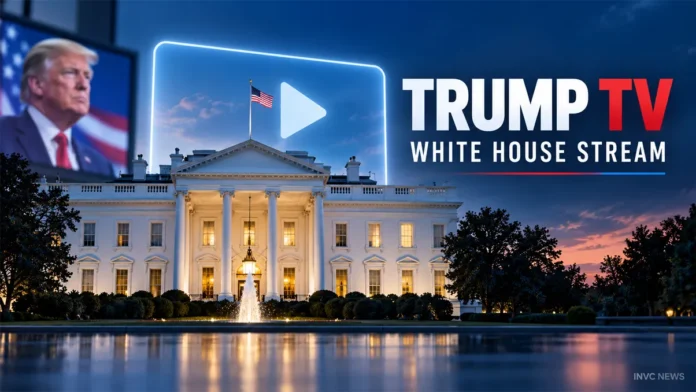
The White House on September 21 launched “TRUMP TV: The Essentials Station,” a digital video service designed to run around the clock with President Donald Trump’s speeches, administration announcements, major moments and selected video highlights.
The official White House description promises viewers the Trump administration’s “biggest moments” in one place, with major remarks and highlights streaming 24/7 and updated in real time.
On its own, that would already be a notable communications experiment.
But the timing has turned Trump TV into something much bigger.
Its launch comes as the White House is locked in an extraordinary fight with CNN, Politico and MS NOW over access to the president — a dispute that has already reached federal court and disrupted the traditional television press pool.
So what exactly is Trump TV?
Despite its name, Trump TV is not a conventional television network with reporters, anchors, independent correspondents and a traditional newsroom.
It is an official White House digital stream.
Its programming consists of material selected by the administration: presidential speeches, official announcements, ceremony footage, clips and other White House video content.
The White House video library prominently listed both “Trump TV is Here” and “TRUMP TV: The Essentials Station” on September 21.
That distinction matters.
Trump TV is therefore better understood as a direct government communications platform rather than an independent news organisation.
Viewers get the administration’s message without a journalist standing between the White House and the audience.
Why launch it now?
The timing is impossible to separate from the larger fight over media access.
President Trump announced on September 18 that CNN, MS NOW and Politico would no longer be allowed access to the White House.
Trump accused the organisations of producing what he described as “fake news” and later suggested that other media outlets could also face restrictions.
The affected organisations rejected that reasoning.
Their journalists were subsequently denied access to the White House grounds, and the organisations argued that excluding them because of their coverage violated constitutional protections for freedom of speech and the press.
Then the dispute moved to court.
CNN, Politico and MS NOW take Trump administration to court
On September 21, CNN, Politico and MS NOW sued the Trump administration, asking a federal court to challenge their exclusion from the White House.
The organisations argue that the restrictions violate their rights under the First and Fifth Amendments.
The Trump administration disputes that position and has defended its approach to press access while continuing to criticise news organisations it considers unfair.
The courts will ultimately have to decide the legal questions.
For the public, however, the fight has already created a practical problem.
The television press pool became part of the battle
Most presidential events cannot accommodate every television network simultaneously.
That is why the White House has traditionally relied on a press pool — a smaller rotating group of journalists and camera crews that covers an event and shares material with the wider media.
After CNN was barred, the television pool ran into trouble.
Major networks including ABC, CBS, Fox News and NBC declined to substitute for CNN in pooled coverage, effectively suspending traditional television pool participation during the dispute.
That meant some presidential events suddenly lacked the familiar shared television coverage Americans have seen for decades.
Against that backdrop, Trump TV appeared.
The sequence immediately raised a larger question:
Could the White House increasingly bypass independent television coverage and distribute its own version of presidential events directly to the public?
Trump TV gives the White House something traditional media cannot: total editorial control
This is the crucial difference.
When CNN, Fox News, NBC, CBS or another news organisation covers the president, journalists decide what deserves attention.
They can provide context.
They can question administration officials.
They can compare statements with available evidence.
They can also choose not to carry an entire speech live.
Trump TV operates differently.
Because it is produced by the White House, the administration controls what appears, how long it appears and which presidential moments are highlighted.
That does not automatically make the material false.
Official government video can provide useful primary-source footage of speeches, announcements and ceremonies.
But it also means viewers are watching material selected by the administration itself, rather than independently edited journalism.
That distinction is essential when assessing what Trump TV actually represents.
Is Trump TV replacing traditional news?
For now, there is no evidence that the White House has created a full replacement for conventional news organisations.
The official stream appears focused on administration content and White House video rather than independent reporting.
It can show what President Trump says.
It cannot independently investigate whether a policy succeeded, interview critics on equal terms or hold the administration accountable in the way an independent newsroom can.
So Trump TV and traditional journalism perform fundamentally different functions.
One communicates the administration’s message.
The other independently reports on the administration.
Supporters and critics see the project very differently
The administration and its supporters can point to an obvious advantage: direct communication.
Presidents have always looked for ways to bypass media filters.
Franklin D. Roosevelt used radio fireside chats.
John F. Kennedy mastered television.
Barack Obama used digital platforms aggressively.
Donald Trump built much of his political communication around social media.
Seen from that perspective, Trump TV is another stage in the evolution of direct presidential communication.
Critics, however, see a different danger.
Some media advocates argue that an official government stream becomes more concerning when it expands at the same time independent news organisations are losing access.
Some critics have described Trump TV as propaganda; that is an attributed political assessment, not a neutral description of the service itself. Reuters reported such criticism while covering the broader press-access dispute.
The real issue is bigger than one streaming channel
Trump TV itself may turn out to be only one part of a much larger transformation.
The deeper argument is about who gets to mediate presidential communication.
For decades, presidents spoke and journalists reported, questioned, analysed and sometimes challenged what they said.
Social media weakened that gatekeeping model.
A permanent White House stream pushes the transformation another step further.
The president can now potentially address supporters and the broader public continuously without depending on a television network to broadcast the message.
That gives the administration speed and control.
But independent news organisations argue that access remains essential because government-generated material cannot substitute for reporters asking questions directly.
Why this battle matters far beyond Washington
The legal fight over CNN, Politico and MS NOW is therefore about more than three media organisations.
It raises questions about whether an administration can deny access to particular outlets because it objects to their coverage.
The White House maintains that its restrictions are justified, while the organisations challenging the government say the exclusions amount to unconstitutional retaliation.
Those questions are now before the courts.
Trump TV adds another dimension.
If governments can distribute presidential content directly, they become less dependent on traditional news organisations.
But audiences then carry a greater responsibility to distinguish between official government communication and independent journalism.
What happens next?
For the moment, Trump TV is live.
The White House says the service will offer major Trump administration moments, top videos and important remarks around the clock.
At the same time, the court battle over press access continues.
That makes the launch much more than another White House media experiment.
It represents two competing models operating side by side:
The administration wants an increasingly direct route to the audience.
Independent news organisations insist that presidents must still face scrutiny from journalists they do not control.
Trump TV may therefore be remembered less for what it streams today than for the question its arrival has put at the centre of Washington:
In the age of direct presidential media, who gets to decide how America sees the White House?