By Team INVC | INVC NEWS
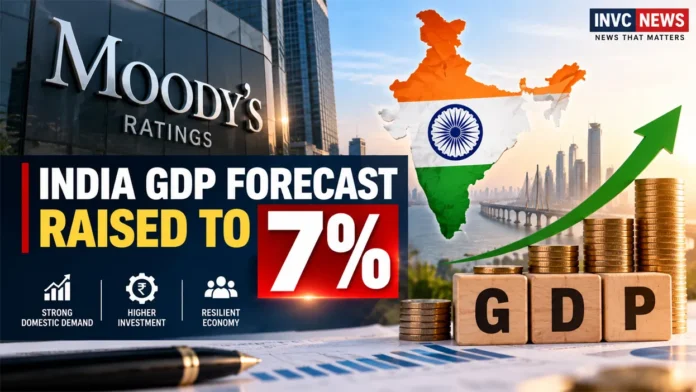
NEW DELHI, India | September 19, 2026 — Moody’s Ratings has raised its India GDP growth forecast for fiscal year 2026-27 to 7% from 6%, citing stronger domestic demand, investment and the economy’s resilience despite the ongoing conflict in West Asia.
The upward revision puts Moody’s among the more optimistic forecasters on India and reinforces expectations that the country will remain one of the fastest-growing major economies.
However, the ratings agency has also warned that elevated crude oil prices, higher energy costs, El Niño-related food inflation and geopolitical uncertainty could still weaken growth momentum.
Moody’s Raises India GDP Growth Forecast From 6% to 7%
Moody’s had previously expected India’s real GDP to expand by 6% in FY27.
It has now raised that estimate by a full percentage point to 7% after the economy performed more strongly than anticipated despite significant external shocks.
The agency said India continues to demonstrate greater resilience than many comparable emerging economies.
Strong household consumption, infrastructure investment, improving private investment and a robust services sector have helped support economic activity.
India Expected to Grow Faster Than Other G20 Economies
Moody’s expects India to continue growing faster than all other G20 economies as well as similarly rated emerging-market sovereigns.
That assessment is significant at a time when several large economies are facing slower growth, high borrowing costs and geopolitical uncertainty.
India’s relatively strong domestic demand provides an important buffer against weaker global trade.
A large consumer market and continuing infrastructure spending also reduce the economy’s dependence on exports compared with several other emerging markets.
India’s Economy Grew 7.8% in Q1 FY27
India entered the current financial year with strong momentum.
Real GDP expanded 7.8% year-on-year in the April-June quarter of FY27, supported by investment and manufacturing activity.
Moody’s also noted strong economic activity during the first half of calendar 2026.
Private consumption remained healthy, while government infrastructure spending and a revival in private investment continued to support growth.
That stronger-than-expected performance played an important role in the agency’s decision to upgrade its full-year forecast.
Crude Oil Remains India’s Biggest Risk
Despite the improved growth outlook, energy prices remain a major concern.
India imports most of the crude oil it consumes, meaning a prolonged period of high oil prices can increase the country’s import bill.
Higher crude prices can also push up transportation and manufacturing costs.
Those increases can eventually feed into consumer inflation.
The ongoing conflict in West Asia has already pushed global energy markets higher, creating additional uncertainty for oil-importing economies such as India.
Moody’s Warns Inflation Could Rise
Moody’s currently projects average inflation of around 4.8% in FY27.
However, it warned that inflation could rise above that level if energy prices remain elevated.
Weather is another concern.
El Niño-related disruption could affect agricultural production and increase food prices.
A combination of higher food and fuel costs could squeeze household budgets and weaken consumption, one of the main engines of India’s economy.
Strong Forex Reserves Provide a Buffer
India also enters this period with several important safeguards.
Large foreign-exchange reserves can provide protection against sudden currency-market volatility and external financing pressure.
India has also diversified its crude oil sourcing in recent years, reducing its reliance on any single supplier.
Strong domestic demand gives the economy another layer of protection against global shocks.
However, Moody’s cautioned that these buffers do not make India immune to sustained energy-price increases or a prolonged deterioration in the global environment.
Current Account Deficit Could Widen
Higher oil and fertiliser import costs could increase India’s current account deficit.
At the same time, weaker demand in international markets could weigh on exports.
Remittance flows from West Asia could also come under pressure if economic conditions in the region deteriorate.
Together, these factors could create a larger external-sector challenge even as domestic activity remains comparatively strong.
Fiscal Deficit Remains Under Watch
India’s fiscal position is another area Moody’s is monitoring closely.
The government is targeting a reduction in the fiscal deficit to around 4.3% of GDP in FY27, compared with 4.4% in the previous financial year.
However, persistently high energy prices could increase the need for subsidies or other government support.
Defence spending and continued infrastructure investment may also limit the speed at which the fiscal deficit can be reduced.
Moody’s nevertheless expects gradual improvement in India’s fiscal metrics over the medium term.
Government Debt Still a Key Challenge
India’s high public debt remains one of the structural constraints highlighted by rating agencies.
The government is targeting a gradual reduction in the debt-to-GDP ratio over the coming years.
Strong nominal GDP growth and improved tax collections could support that process.
However, high interest costs mean debt affordability remains weaker than in several similarly rated economies.
Continued fiscal discipline will therefore remain important even if economic growth stays strong.
Why the 7% Forecast Matters
The revision is important because it comes during a period of intense global uncertainty.
Oil prices remain elevated.
West Asia remains unstable.
Major central banks are adjusting monetary policy.
Global trade faces new tariff and geopolitical pressures.
Yet Moody’s now believes India can still grow by 7% in FY27.
That strengthens the argument that domestic consumption, investment and infrastructure spending are giving the Indian economy greater resilience against global shocks.
What Should Investors Watch Next?
Four factors are likely to determine whether India can meet or exceed the new forecast.
First is crude oil.
Second is inflation, particularly food prices.
Third is domestic consumption.
Finally, investment—both public and private—will need to maintain momentum.
If energy prices stabilize and inflation remains under control, India could remain on a strong growth path.
However, an extended oil shock or renewed food inflation could make the 7% target more difficult to achieve.
For now, Moody’s latest revision sends a clear message: despite global turbulence, India’s economy is performing more strongly than previously expected.