CAMBRIDGE, United States | September 22, 2026 — Build rockets. Make oxygen. Manufacture solar panels. Generate gigawatts of electricity.
Humanity may eventually solve all of those problems on the Moon.
But there is one resource that refuses to cooperate:
water.
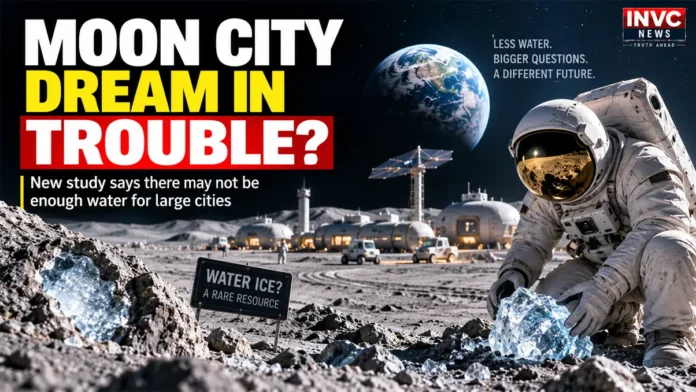
A new peer-reviewed study has cast a serious shadow over dreams of building million-person cities near the Moon’s south pole, warning that even an extremely generous estimate of one billion tons of lunar water ice may support a population of one million for only about a century — even with water recycling as efficient as the International Space Station.
And here comes the uncomfortable part.
Current best estimates of accessible lunar water could be roughly 30 times lower than that generous one-billion-ton scenario.
If those estimates prove accurate, the dream of sprawling lunar megacities starts looking much harder.
Musk Wants a Moon City — Scientists Have Now Asked the Awkward Question
Earlier this year, Elon Musk said SpaceX would prioritise developing a “self-growing city” on the Moon, potentially within about a decade.
Blue Origin, founded by Jeff Bezos, is also developing technologies intended to support permanent lunar settlements and eventually cities using resources extracted directly from lunar soil.
The ambition is enormous.
But astrophysicists Martin Elvis and Jonathan McDowell decided to ask a much less glamorous question:
How much water would all those people actually need?
Their study, published September 14 in Frontiers in Space Technologies, reaches a sobering conclusion.
Power may be manageable.
Water may not be.
One Billion Tons Sounds Huge — Until a Million People Start Drinking It
At first glance, a billion tons of frozen water sounds almost impossible to exhaust.
Put one million people on the Moon, however, and the mathematics changes quickly.
The researchers modeled water requirements that include human consumption as well as the much larger water footprint associated with food production and settlement activity.
Without recycling, a billion-ton supply would last only a few years.
Even using recycling efficiency of 98% — comparable with the International Space Station’s modern life-support system — a million-person lunar city would exhaust the assumed supply in roughly 100 years.
For a civilization-sized investment, the authors argue, one century hardly qualifies as permanent settlement.
And the Real Water Supply May Be Much Smaller
This is where the Moon-city dream gets uncomfortable.
The one-billion-ton number is deliberately generous.
According to Frontiers’ summary of the research, today’s best estimates for lunar water availability are around 30 times lower.
Reduce the water supply by that factor and the settlement’s lifetime shrinks dramatically too.
Suddenly, the problem is not:
Can humans build a city on the Moon?
It becomes:
Can they keep that city alive?
The Moon Has Water — But It Is Hiding in the Dark
Scientists have strong evidence that water ice exists around the lunar poles, especially inside permanently shadowed regions, or PSRs.
These are craters and depressions where sunlight may not have reached for billions of years.
Temperatures there can remain low enough for ice to survive.
That is one reason the lunar south pole has become the prize location for future exploration.
NASA’s Moon Base plans are also focused on establishing sustained operations near the south pole.
But knowing that water exists and knowing how much can practically be extracted are two completely different things.
Electricity? Surprisingly, That May Be the Easy Part
Here comes the strange twist.
Researchers do not consider energy to be the main population limit.
Near the lunar poles are highly illuminated elevated areas where solar installations could receive sunlight for long periods.
The study estimates that kilometre-scale solar structures could potentially provide around 3 gigawatts of mean electrical power for roughly 90% of the time in favourable south-polar locations.
There is also plenty of silicon in lunar soil.
Companies including Blue Origin are already working on concepts for extracting materials from lunar regolith and manufacturing solar technology locally instead of shipping everything from Earth.
So the Moon could potentially have electricity.
Lots of it.
The irony is brutal:
humans could build a brilliantly illuminated lunar city that does not have enough water to sustain its population.
Forget a Million-Person Metropolis — Think Moon Village
The study points toward a much smaller model.
A Moon village of around 1,000 people could use lunar resources much more comfortably.
Even a settlement of around 10,000 people could potentially remain viable for centuries under some scenarios.
Once populations approach 100,000, however, water management becomes far more serious.
And at one million residents, sustainability becomes extremely difficult without dramatically improved recycling or additional water sources.
That could completely change the architecture of future lunar colonisation.
Instead of one enormous metropolis, humanity may initially build a network of small research, industrial and mining settlements.
Less “New York on the Moon.”
More “Antarctic research town with rockets.”
Can We Simply Recycle More Water?
Possibly.
The ISS already recycles approximately 98% of some water streams through sophisticated life-support systems.
But losing even 2% repeatedly becomes enormous when multiplied across a population of one million.
The researchers suggest recycling efficiency would need major improvement — potentially by several times in terms of reducing losses — to make truly large settlements sustainable.
Future lunar agriculture would also need to become extremely water-efficient.
Vertical farming, carefully controlled food production and diets with smaller water footprints could help.
But technology cannot recycle what has permanently escaped the system.
Why Not Ship Water From Asteroids?
That possibility is also on the table.
Asteroids contain water and other valuable resources, so a future space economy could theoretically import ice to the Moon.
But the numbers are staggering.
With a million residents and ISS-level recycling, the study estimates such a city could require roughly 10 million tons of replacement water each year.
Assuming futuristic spacecraft capable of landing 1,000 tons at a time, that would still require roughly 27 water deliveries every day.
Possible one day?
Perhaps.
Simple?
Absolutely not.
The Biggest Hope May Be Under the Surface
There is one reason lunar-city believers should not surrender yet.
Scientists may simply not know how much water is really there.
Many current remote-sensing techniques probe only the upper metres of lunar material.
The Moon’s fragmented regolith can extend tens of metres deep, and undiscovered deposits could exist below the layers we can currently measure effectively.
The authors argue that deeper drilling may ultimately provide the decisive answer.
If large hidden reservoirs exist, the equation changes.
If they do not, future settlers will have to learn to live with extreme scarcity.
The Moon Can Give Us Power, Oxygen and Buildings — Water May Set the Population Limit
This study does not say humans cannot live permanently on the Moon.
Quite the opposite.
Small settlements appear technically much easier to imagine.
NASA is already developing infrastructure aimed at sustained south-polar operations, while private companies are working on landers, resource extraction, oxygen production and local manufacturing.
What the new research challenges is the leap from base to city.
A thousand people?
Possible to imagine.
Ten thousand?
Potentially manageable.
One hundred thousand?
Water begins dictating the rules.
One million?
Now every lost litre matters.
Humanity may eventually learn how to build towers, factories, solar farms and even AI data centres on the Moon.
But before anyone sells apartments in the first lunar metropolis, scientists need an answer to one extremely old-fashioned question:
Where is everyone going to get enough water?
Because on the Moon, the most valuable real estate may not be where the Sun shines.
It may be wherever the ice is hiding.