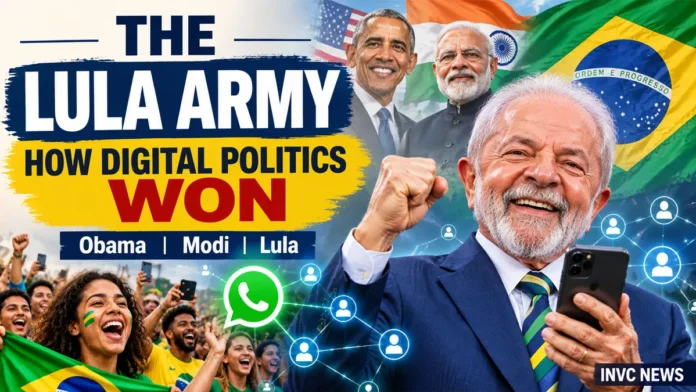
Brasília, November 1, 2026: Brazil’s President Luiz Inácio Lula da Silva has demonstrated how a well-organised digital campaign can reshape political communication in a closely contested election. After finishing behind right-wing challenger Flávio Bolsonaro in the first round, Lula returned to the campaign trail with a different approach: shorter videos, direct appeals to voters and a large network of supporters mobilised through WhatsApp and social media.
The strategy became widely known as “Lula’s Army”. Led by Congressman André Janones, the network reportedly expanded from around 60,000 members or followers after the first round to nearly 11 million. Supporters were encouraged to share campaign videos, promote messages, engage undecided voters and create a visible online presence for Lula.
The mobilisation became a defining feature of Lula’s comeback. On October 25, he defeated Flávio Bolsonaro in the presidential runoff, securing 51.79% of valid votes against his rival’s 48.21%. The result gave Lula a fourth presidential term and turned Brazil’s election into another important example of the growing influence of digital campaigning.
But the Brazilian experience did not emerge in isolation. From Barack Obama’s 2008 campaign in the United States to Narendra Modi’s 2014 election campaign in India, political parties have increasingly used digital platforms not merely to broadcast messages but to organise supporters and encourage direct participation.
What Was the ‘Lula Army’?
The most distinctive feature of Lula’s digital campaign was its effort to turn ordinary supporters into active participants in political communication.
Congressman André Janones played a central role in organising the WhatsApp-based network. Instead of relying only on official campaign accounts, the initiative encouraged supporters to carry campaign messages into their own social circles.
Participants were given regular digital campaign tasks. These included sharing short videos supporting Lula, circulating campaign messages, using social media hashtags, reaching out to other voters and encouraging people to participate in the campaign.
The idea was to multiply the reach of the campaign through thousands of individual accounts and personal networks.
The scale of the initiative attracted considerable attention. Reports put the network’s growth at approximately 60,000 before the decisive campaign push and nearly 10.8 million followers or participants by the runoff period.
This was more than a conventional online publicity drive. It attempted to build a sense of collective identity among supporters, giving them a shared role in the campaign.
How the Brazilian Football Jersey Became a Campaign Symbol
One of the most interesting elements of the campaign involved Brazil’s national football jersey.
The yellow-and-green national team shirt is one of the country’s most recognisable symbols. However, in recent years, it had increasingly been associated with supporters of former president Jair Bolsonaro and the political right.
Lula’s supporters were encouraged to wear the national jersey and share photographs on social media. The campaign sought to reclaim the national colours as a symbol that could represent Brazil more broadly rather than one political camp.
The tactic had both a visual and a political purpose. It created recognisable online content while attempting to connect Lula’s campaign with national identity and shared cultural symbols.
It also gave supporters an easy way to participate. A photograph, a short message or a shared video could become part of a much larger campaign narrative.
Lula’s First Smartphone and the Power of Selfie Videos
Lula’s own communication style also underwent a visible change.
For years, the veteran politician had relied heavily on public meetings, speeches, traditional media and the communication teams around him. He was not known for personally producing informal social media videos.
After the first-round result, however, his campaign began experimenting with a more direct style of digital communication.
Lula started recording selfie-style videos in which he spoke directly to voters. These short recordings were designed to feel more personal and less formal than conventional campaign speeches.
The change was particularly significant because Lula had not been a regular smartphone user. Reports published during the campaign said he acquired his first smartphone shortly before the runoff period and began using it to communicate more directly with supporters.
The videos helped present a more informal side of the president and offered a way to reach younger voters who increasingly consume political content through short-form video platforms.
The campaign’s shift demonstrated that digital political communication is not simply about having an account on a popular platform. It also requires adapting the candidate’s style to the habits of the audience.
The Obama Model: How Digital Politics Changed in the United States
The roots of this transformation can be traced to the 2008 US presidential election.
Barack Obama used the internet as a major campaign tool during his contest against Republican candidate John McCain. His campaign combined online communication, fundraising, volunteer coordination and local supporter networks.
The campaign’s My.BarackObama.com platform allowed supporters to connect with one another, organise local activities and participate in campaign efforts. Social networking sites, online videos, email and text messaging helped the campaign reach voters beyond traditional rallies and television advertisements.
The wider political shift was reflected in a Pew Research Center report published in April 2009. It found that 55% of American adults had used the internet during the 2008 election to obtain political news, communicate about the campaign or participate in online political activity.
Among internet users, 74% had gone online for election-related information or political engagement.
Obama’s campaign showed that supporters could become an organised political resource rather than remain passive recipients of campaign messages. The model helped establish digital mobilisation as an important part of modern election strategy.
India 2014: Social Media Becomes a Major Election Campaign Tool
India witnessed another significant phase in the growth of digital election campaigning during the 2014 Lok Sabha elections.
Under the leadership of Narendra Modi, the Bharatiya Janata Party (BJP) made social media and internet-based communication important parts of its campaign strategy.
Platforms such as Facebook, Twitter and YouTube were used to circulate speeches, videos, campaign messages and updates. Digital volunteers and online supporter groups helped extend the campaign’s reach, particularly among young voters and first-time electors.
The campaign also reflected a wider change in how political communication was organised. Online messages could be circulated rapidly, discussed by supporters and carried into local communities.
A research study examining Twitter activity during the 2014 Indian general election analysed 98,363 tweets posted by 11 political parties during the two months before voting.
The study found that the use of Twitter for voter engagement was associated with the electoral success of the winning party. It also examined the relationship between internet access, first-time voters and electoral outcomes.
However, the researchers did not establish that social media alone determined the election result. Digital communication operated alongside ground-level campaigning, political organisation, leadership, public issues and other factors.
What Makes Lula’s Digital Campaign Different?
Obama’s 2008 campaign helped demonstrate the potential of online supporter networks. India’s 2014 election showed how social media could become a central component of a large national campaign. Brazil’s 2026 election added another dimension: the rapid mobilisation of a huge supporter network around a closely contested runoff.
The Lula Army model placed particular emphasis on giving supporters small, repeatable tasks. Rather than expecting the central campaign team to produce and distribute every message, it encouraged individuals to participate in content sharing and voter outreach.
It also combined organised digital activity with a more personal communication style from the candidate himself.
This combination helped the campaign respond quickly after the first-round setback. It gave supporters a visible sense of participation and allowed campaign messages to circulate through personal networks.
Yet the scale of the network should not be confused with proof that every follower changed a vote. Political analysts have cautioned that it is difficult to measure precisely how many votes a particular WhatsApp network or social media campaign delivers.
Lula’s final victory also took place amid street mobilisation, political alliances, public policy debates and voter concerns about the competing candidates.
The New Reality of Digital Election Campaigning
The experiences of the United States, India and Brazil point to a broader transformation in democratic politics.
Social media has changed the relationship between candidates, parties and voters. Campaign communication is no longer limited to speeches, newspaper advertisements, television interviews and public rallies. It now includes short videos, messaging groups, digital volunteers, online communities and direct interaction between candidates and supporters.
The next challenge is ensuring that this expanded digital participation remains transparent and responsible. The same platforms that help voters access political information can also spread misleading claims, manipulated content and polarising messages.
For political campaigns, the task is therefore not simply to build the largest online network. It is to establish credible communication, encourage meaningful participation and maintain public trust.
The Bottom Line: Barack Obama helped popularise large-scale digital mobilisation in the United States, India’s 2014 election demonstrated the growing political importance of social media, and Lula’s 2026 comeback has highlighted the power of organised supporter networks. The rise of the Lula Army suggests that the future of election campaigning may depend as much on mobilising ordinary supporters as on the messages delivered by political leaders themselves.