Dubai / New Delhi | October 25, 2026 – Iran has reportedly drawn up plans to target major undersea internet cables in the Persian Gulf if the United States and Israel launch fresh military strikes against the country. The threat raises concerns about the security of the digital infrastructure that connects Gulf economies to international financial networks, cloud platforms and internet services.
According to a Reuters report published on October 23, two senior Iranian security officials said Tehran had developed plans to attack undersea communications cables and could attempt to prevent repairs to prolong any disruption. Iranian Revolutionary Guard official Yadollah Javani had also warned that seven major internet cables beneath the Strait of Hormuz could become targets if Iranian infrastructure came under attack.
The threat does not mean the global internet would automatically shut down. Telecommunications research firm TeleGeography estimates that less than 1% of international bandwidth worldwide passes through the Strait of Hormuz. However, simultaneous damage to several cables could disrupt connectivity across Gulf countries, affect financial transactions and cloud services, and complicate communications between regional data centres and the rest of the world.
For India, the key question is whether damage to these routes would cause congestion, slower connections or interruptions to services that rely on international data traffic.
What Exactly Is Iran Threatening to Target?
Iranian officials have warned that undersea communications cables could be targeted if Washington and Israel resume attacks. The officials cited by Reuters provided few operational details and did not identify precisely how or where any attack would take place.
One official said Iran could also seek to prevent damaged cables from being repaired, potentially extending disruption to internet and telecommunications services.
The warning follows comments by Yadollah Javani, deputy head of political affairs for Iran’s Islamic Revolutionary Guard Corps, who identified seven major internet cables beneath the Strait of Hormuz as potential targets if Iranian infrastructure came under attack.
Iranian officials have also warned that US-linked digital infrastructure in Gulf countries, including data centres and artificial intelligence facilities, could face retaliation. These statements describe potential targets in a future escalation; they do not establish that an attack on the cables has taken place.
The broader concern is that a conflict already threatening energy shipments and maritime security could expand to communications infrastructure that supports modern economies.
What Are Undersea Internet Cables?
Undersea cables are fibre-optic systems laid across the seabed to carry digital information between countries and continents. They transmit data for internet browsing, video calls, banking, cloud computing, business communications and many other online services.
The cables connect coastal landing stations, where international networks link to terrestrial telecommunications infrastructure. From there, internet service providers and data networks distribute information to businesses, homes, government agencies and data centres.
Although satellites receive considerable attention, undersea fibre-optic cables carry the vast majority of international internet traffic. The International Telecommunication Union has cited an estimate that submarine cables carry around 99% of international data traffic.
These systems are essential because they provide high-capacity connections for moving enormous volumes of data across long distances. A cable fault can affect connectivity, but the extent of the disruption depends on where the fault occurs, how much capacity is lost and whether operators can reroute traffic through other networks.
Which Major Cables Cross the Strait of Hormuz?
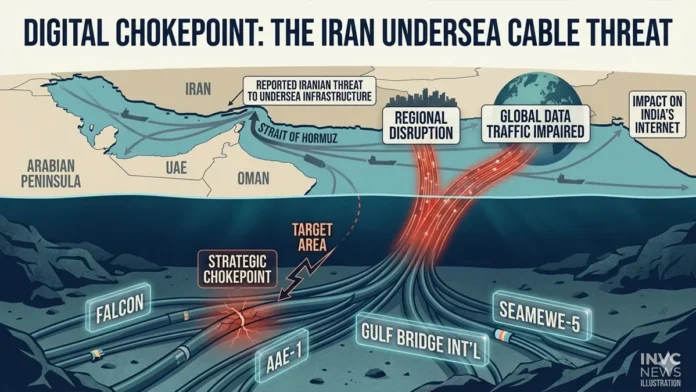
Several submarine cable systems pass through the Gulf region, connecting countries in the Middle East with South Asia, Europe and other international networks.
Three examples illustrate the importance of this infrastructure:
- FALCON: A regional cable system connecting countries including India and Sri Lanka with Gulf locations and other destinations.
- Asia-Africa-Europe 1 (AAE-1): An international cable system linking parts of Asia with the Middle East, Africa and Europe.
- Gulf Bridge International: A cable network designed to connect Gulf countries, including through regional landing points.
These are examples, not a complete list of the seven systems mentioned by Iranian officials. The precise routes and landing points vary by cable, and not every system follows the same path.
The Strait of Hormuz is particularly sensitive because it is a narrow maritime passage connecting the Persian Gulf with the Gulf of Oman and the Arabian Sea. Its importance to energy shipping is well known, but it also serves as a regional corridor for digital connectivity.
Would Cutting the Cables Shut Down the Global Internet?
No. Damage to cables in the Strait of Hormuz would not, by itself, be expected to shut down the global internet.
TeleGeography has estimated that less than 1% of international bandwidth worldwide passes through the strait. This limits the likely direct effect on global connectivity compared with damage to larger international corridors.
Modern telecommunications networks are also designed with redundancy. If one cable fails, network operators can often redirect traffic through alternative submarine cables or terrestrial routes.
However, redundancy does not mean that all disruptions can be avoided. If several cables fail at the same time, the remaining routes may have insufficient capacity to handle all the displaced traffic. Some connections could become slower, congested or temporarily unavailable.
The impact would depend on several factors:
- How many cables were damaged and whether the damage occurred at the same time.
- Which countries and landing stations lost connectivity.
- How much spare capacity alternative routes could provide.
- Whether network operators could reroute traffic quickly.
- How long repairs were delayed by military activity or restrictions on access to affected waters.
The most serious risk would therefore be a prolonged regional disruption rather than an immediate worldwide internet blackout.
How Could Gulf Countries Be Affected?
Gulf economies depend on international digital networks for banking, financial trading, e-commerce, cloud computing, government services and business communications.
A major cable disruption could increase latency, reduce available bandwidth and interrupt some international connections. Businesses that depend on cloud services hosted outside the region could experience delays or service degradation.
Banks and payment providers might need to reroute transactions through alternative networks. Data centres could face connectivity constraints when communicating with overseas facilities. Companies with multiple network providers and geographically distributed infrastructure would generally have more options than organisations relying on a single route.
The duration of the disruption would also matter. A short outage could be manageable, while several simultaneous cable cuts combined with delayed repairs could create longer-lasting problems.
The International Cable Protection Committee has cautioned that the potential consequences of cable damage in the Strait of Hormuz should be understood primarily as a regional connectivity risk, rather than as evidence that the global internet depends on this single passage.
What Could Happen to India’s Internet?
India has extensive international connectivity through submarine cables landing at coastal locations, including Mumbai and Chennai. These systems connect Indian networks with destinations across the Middle East, Southeast Asia, Europe and other regions.
Some cable routes link India to international networks through Gulf countries, making the security of regional infrastructure relevant to Indian telecommunications operators and businesses.
If several cables in the Strait of Hormuz were damaged, the effect on India would depend on which routes were affected and how much traffic could be moved to alternative systems.
Potential consequences could include:
- Slower connections: Some routes could experience higher latency or congestion as traffic moves to alternative paths.
- Business disruption: Companies that depend on international cloud platforms, overseas data centres or regional offices could experience delays.
- Financial services: Cross-border financial and business communications could face interruptions if their usual network paths were affected.
- Uneven impact: Some Indian users and services might notice little change, while organisations heavily dependent on particular routes could face greater disruption.
India would not necessarily lose international internet access. Alternative submarine cables and other network routes could help maintain connectivity, although available capacity and routing arrangements would determine how effectively they could absorb displaced traffic.
The practical impact would depend on the scale of damage and the ability of telecommunications operators to reroute data.
Why Preventing Repairs Could Be More Serious Than the Initial Attack
Undersea cable repairs require specialised vessels, trained crews and suitable weather and sea conditions. Repair teams also need access to the affected area and the necessary permissions to operate in territorial waters.
During a military conflict, these requirements can become harder to meet. Security risks, higher insurance costs, restrictions on vessel movements and delays in obtaining approvals could all slow repairs.
That is why the reported Iranian threat to obstruct repair efforts is significant. If multiple cables were damaged and repairs were delayed, operators could be forced to rely on alternative routes for longer periods.
The longer a major cable remains out of service, the greater the possibility of persistent congestion and service degradation, particularly if other cables in the region are also disrupted.
However, the actual duration of any outage would depend on the location and severity of the damage, the availability of repair ships and the condition of alternative networks.
Could the Threat Affect Global Technology Companies?
The Gulf has become an increasingly important location for cloud computing, data centres and artificial intelligence infrastructure. Major international technology companies have invested in regional facilities to serve businesses and customers across the Middle East.
Damage to undersea cables could affect the connections linking these facilities with customers, corporate networks and computing resources in other regions. That could disrupt some services even if the data centres themselves remained operational.
The effect would not be uniform. A company with several independent network routes and facilities in different countries would generally have more options for maintaining service than one dependent on a limited number of connections.
Iran’s wider warnings about US-linked data centres and AI infrastructure also highlight the growing overlap between military conflict and digital infrastructure. But a threat to infrastructure should not be confused with a confirmed attack or a verified service outage.
The Bigger Picture: A Digital Chokepoint in a Wider Conflict
The Strait of Hormuz is already a critical passage for global energy shipments. The prospect of attacks on communications cables adds a second dimension to the risks facing the region.
Damage to energy infrastructure can affect oil supplies and prices, while disruption to digital infrastructure can affect communications, financial services and business operations. If both were threatened during the same escalation, the economic consequences could extend beyond the immediate conflict zone.
Yet the cable threat should be assessed carefully. The strait carries less than 1% of global international bandwidth, and international networks have alternative routes. The greatest risk lies in concentrated regional disruption, particularly if several cables are damaged and repairs are delayed.
For India and other countries connected to Gulf networks, monitoring cable routes, maintaining redundant connections and preparing contingency plans will be important to limiting the effects of any disruption.
Bottom Line
Iran’s reported plan to target undersea internet cables if the United States and Israel launch fresh attacks highlights a vulnerability in the digital infrastructure underpinning modern economies.
The threat does not mean the world’s internet would suddenly go dark. But multiple cable cuts could disrupt Gulf connectivity, slow some international data routes and affect businesses, financial services and cloud computing.
For India, the impact would depend on which systems were damaged and how effectively operators rerouted traffic. The biggest concern is not a global internet blackout, but a potentially prolonged regional communications disruption during a wider military conflict.