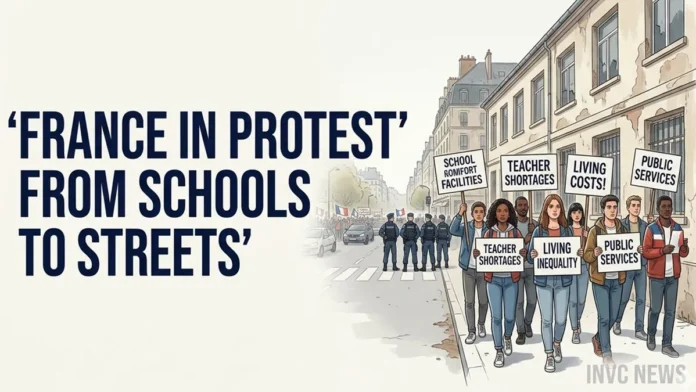
Paris, October 25, 2026: What began as a student protest over poor school conditions in France has grown into a nationwide movement challenging the government over education funding, the cost of living, inequality and public services. More than a month after the first demonstrations, the unrest continues, with mass rallies, school blockades, arrests and clashes between protesters and police.
The latest demonstrations on October 24 drew an estimated 410,000 people nationwide, according to France’s Interior Ministry. The CGT trade union put participation at nearly 800,000. The difference between the two estimates reflects the difficulty of counting large crowds, but both figures point to a major mobilisation across the country. Most of the Paris march was peaceful before confrontations broke out near its endpoint. Similar incidents were reported in other cities.
The movement began with complaints about a lack of teachers, deteriorating school buildings, overcrowded classrooms and inadequate facilities. It has since expanded as students, parents, teachers, workers and trade unions have connected these concerns with wider economic pressures and dissatisfaction with government policies.
Here is how the protests developed, what has happened so far and why the unrest has become a serious challenge for President Emmanuel Macron’s government.
September 21: A School Protest Starts in Créteil
The immediate trigger came at Saint-Exupéry High School in Créteil, a suburb southeast of Paris, where several teaching positions were unfilled. Students began protesting over staffing shortages and the effect they were having on education.
The grievances extended beyond the absence of teachers. Students and their representatives highlighted deteriorating school buildings, inadequate facilities, crowded classrooms, demanding timetables and pressure surrounding Parcoursup, France’s university admissions platform.
Some schools also faced complaints about water access, poor ventilation and uncomfortable classroom temperatures during hot weather. Reports of rodents and other maintenance problems became symbols of what students saw as years of neglect.
The central demand was straightforward: students wanted safe, adequately equipped schools with enough teachers to deliver a proper education.
The movement initially spread through the Paris region before reaching other parts of France. Student organisations encouraged pupils to organise demonstrations and blockades at their schools. By September 28, around 180 schools had reportedly been affected.
September 29–October 1: The Movement Spreads and Tensions Rise
The protests expanded rapidly during the final days of September. By October 1, more than 1,020 high schools had been affected by strikes or demonstrations, including 222 where blockades were reported, according to figures published by French media citing education authorities.
The scale of the disruption increased pressure on the government, but the demonstrations also became more confrontational in some locations.
Reports emerged of burning rubbish bins, damage to school premises and clashes between demonstrators and police. In Nantes, part of the entrance area of Nelson-Mandela High School was set on fire. Public transport was temporarily disrupted in several cities as authorities responded to unrest.
Authorities announced 1,949 arrests on October 1. This was a single-day figure, not the cumulative total for the entire movement. The government argued that violent groups were exploiting a student movement that had begun with concerns about education.
Some school leaders and education officials also reported damage to school property and incidents involving staff.
October 5–6: Police Tactics Become a Major Flashpoint
As the demonstrations intensified, videos of forceful police interventions and injured teenagers circulated widely on social media. The images brought additional attention to how authorities were handling the protests and helped draw more young people and adults into the movement.
French media reported that between September 28 and October 5, law enforcement recorded more than 6,000 arrests, with thousands of people taken into police custody. These figures cover a specific period and should not be confused with the number arrested on October 1 alone.
A particularly serious incident occurred in Lens on October 5, when a 15-year-old student suffered a devastating hand injury involving a stun grenade. Authorities subsequently suspended the use of that grenade model while the incident was examined. The case intensified criticism of police tactics.
On October 6, the movement reached another major turning point. More than 250,000 people participated in demonstrations nationwide according to the Interior Ministry, while organisers estimated turnout at approximately 450,000. Students were joined by teachers, parents and other supporters.
The protests were no longer simply about conditions inside schools. Policing, public spending and the government’s response had become central points of dispute.
October 8: Tens of Thousands Return to the Streets
Demonstrations continued on October 8, drawing around 71,500 people nationwide, including approximately 24,500 in Paris, according to figures reported at the time.
The protests were largely peaceful in the capital, although clashes occurred at some locations and reports of violence emerged elsewhere.
The demands included more teachers, improved school buildings, smaller classes and changes to the university admissions system.
The government also faced pressure to respond to the movement’s underlying concerns. Education Minister Édouard Geffray promised additional teachers and reviews of school timetables, while Prime Minister Sébastien Lecornu pledged that fully funded measures would be set out by late October. Student representatives argued that promises alone would not resolve the problems.
By this stage, the protests had become a test of whether the government could address education concerns while maintaining public order and managing pressure on public finances.
October 17: Protests Expand Into a Wider Social Movement
The unrest broadened further during the following weeks, drawing in workers, trade unions and people concerned about living costs, inequality and public services.
The October 17 demonstrations attracted approximately 550,000 participants, according to figures reported by French media. The protests were accompanied by clashes and property damage in some locations, while many demonstrators continued to participate peacefully.
The broader movement reflects several overlapping concerns:
- Education: More teachers, improved buildings and better classroom conditions.
- Cost of living: Frustration over the cost of everyday necessities and household expenses.
- Public services: Concerns about staffing, funding and access to essential services.
- Inequality: A sense among some protesters that economic pressures and opportunities are distributed unfairly.
- Policing and civil liberties: Anger over arrests, the use of force and restrictions on demonstrations.
These issues do not mean that every participant has the same demands. Students seeking better classrooms, workers protesting economic policies and people opposing police tactics may share a march while having different priorities.
October 24: More Than 400,000 Protest Nationwide
The latest major round of demonstrations took place on Saturday, October 24, under a substantial security operation.
The Interior Ministry estimated nationwide participation at 410,000, including approximately 110,000 people in Paris. The CGT union put the national turnout at nearly 800,000. The figures differ considerably, so both estimates should be attributed rather than presented as a single agreed total.
The Paris march began peacefully, but confrontations developed near Porte de Vincennes as the demonstration ended. Police used tear gas and water cannon against groups of masked protesters who threw objects and fireworks. Clashes and vandalism were also reported in Marseille and several other cities.
Authorities deployed around 70,000 police officers for the nationwide mobilisation, seeking to prevent a repeat of the widespread rioting and looting reported the previous weekend. Police reported nearly 1,000 arrests in connection with the latest protests, although the total remained subject to updates.
The violence remains an important part of the story, but it does not describe every demonstration or every participant. Reports from October 24 indicate that many marches remained peaceful before isolated confrontations broke out.
France’s Political Crisis Adds to the Pressure
The protests are unfolding against a difficult political backdrop. President Emmanuel Macron’s decision to call snap parliamentary elections in 2024 left France with a fragmented National Assembly, making it harder for governments to secure agreement on major legislation and budgets.
The dispute over education funding is therefore connected to a broader question: how can the government respond to demands for better public services while trying to control the deficit and public debt?
The government has limited room to increase spending without addressing how the additional expenditure will be financed. At the same time, cuts or inadequate funding can intensify public dissatisfaction when schools and other services are already struggling.
The pension reform that raised France’s statutory retirement age from 62 to 64 also remains a source of political tension. It has become part of a wider debate over government spending, social protection and the distribution of economic burdens.
The Economic Numbers Behind the Dispute
France’s fiscal position helps explain why the debate over public spending has become so difficult.
According to the European Commission’s May 2026 economic forecast, France’s government budget deficit fell to 5.1% of gross domestic product in 2025, from 5.8% in 2024. Public debt stood at 115.6% of GDP in 2025. The Commission forecast the deficit would remain at 5.1% in 2026, while debt would continue to rise.
In simple terms, the deficit measures how much more the government spends than it receives over a period. Public debt is the accumulated amount the government owes.
Investors have also become more sensitive to France’s fiscal outlook. Reports in early October indicated that the yield on French 10-year government bonds briefly exceeded 5%, reaching a level not seen in roughly 24 years. Higher borrowing costs can increase the expense of servicing government debt and further constrain budget decisions.
Foreign investors’ decisions have added to those concerns. Reports have indicated that a Japanese investment fund decided to sell its French government bond holdings amid concerns about the country’s fiscal position and more attractive investment opportunities elsewhere. This does not mean that all Japanese lenders have stopped financing France.
The fiscal challenge creates a difficult balance: the government faces pressure to improve education and public services, while financial markets expect credible plans to manage borrowing and debt.
What Happens Next?
The next phase will depend on whether the government can turn its promises into measures that students, families and teachers regard as meaningful.
Education authorities will need to address staffing shortages, school maintenance and classroom conditions. The government must also manage demonstrations without allowing violence to overshadow the grievances that brought many participants onto the streets.
The movement faces its own challenge. Its growing coalition includes groups with different priorities, and violent incidents risk shifting public attention away from the original education demands. Meanwhile, restrictions on demonstrations and concerns about police conduct could deepen distrust if they are not addressed transparently.
Trade unions have also called for further mobilisation, including a nationwide strike planned for November 5 over living costs and proposed budget cuts. That could extend the dispute beyond schools and into a wider confrontation over economic policy.
The Bottom Line
France’s protests began with a familiar set of school complaints: missing teachers, deteriorating buildings, overcrowded classrooms and inadequate facilities. Within weeks, those concerns had become part of a much larger debate over living costs, public services, inequality, police conduct and the country’s financial constraints.
The latest demonstrations on October 24 drew hundreds of thousands of people by official and union estimates, while clashes in several cities showed that tensions remain high. The government now faces two linked challenges: responding to concerns about public services and preventing further violence without deepening the divisions that have fuelled the movement.
The central question is no longer just how to repair France’s schools. It is whether the government can respond to broader social grievances while navigating political fragmentation and mounting pressure on public finances.