By Team INVC | INVC NEWS
Published: August 31, 2026 |05 : 04 PM IST
NEW DELHI, India | August 31, 2026 —
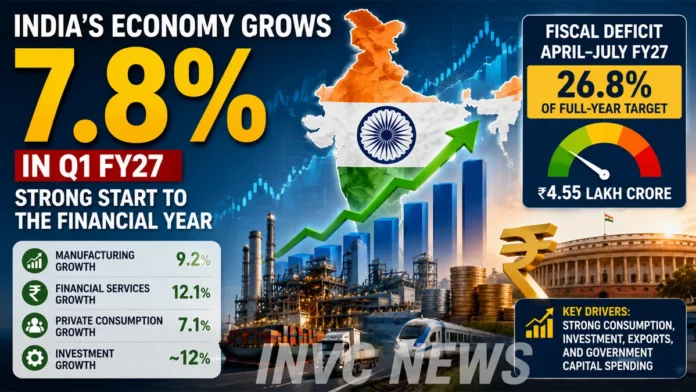
India GDP growth Q1 FY27 came in at a stronger-than-expected 7.8% in the April–June quarter, underscoring the resilience of the world’s fastest-growing major economy despite expensive crude oil, geopolitical tensions and disruptions linked to the US-Iran conflict.
The latest growth rate comfortably exceeded the Reserve Bank of India’s 7% projection and the 7.1% median forecast in a Reuters poll of economists.
Compared with the revised 6.9% growth recorded in the same quarter a year earlier, the latest data show a clear acceleration in economic momentum.
Separate government data released on Monday also showed an improvement in the Centre’s fiscal position, with the April–July fiscal deficit narrowing to ₹4.55 lakh crore, equivalent to 26.8% of the full-year target.
Together, the figures provide a strong opening snapshot for India’s 2026-27 financial year.
India GDP Growth at 7.8% Beats Expectations
India’s real gross domestic product expanded by 7.8% year-on-year during April–June 2026.
The performance was stronger than economists had expected even as the economy faced multiple external pressures, including elevated global energy prices and uncertainty surrounding the conflict in West Asia.
The RBI had projected Q1 FY27 GDP growth of 7%.
The actual number exceeded that estimate by 80 basis points.
It also beat the 7.1% forecast in a Reuters survey, highlighting stronger domestic economic activity than financial markets had anticipated.
Manufacturing Grows 9.2%
Manufacturing emerged as one of the strongest contributors to the quarter.
The sector expanded by 9.2%, compared with 8.3% in the corresponding period a year earlier.
This suggests that industrial activity remained resilient despite high commodity prices and disruptions to global trade routes.
Manufacturing growth is particularly important for India because stronger factory activity can support employment, exports, investment and demand across several associated industries.
Financial Services Surge 12.1%
Financial, real estate and related services also recorded strong growth.
The financial services segment expanded by 12.1%, compared with 8.8% in the same period last year.
Strong bank lending provided an important boost.
Credit growth across agriculture, industry and services reached around 18.3% year-on-year at the end of the June quarter, its fastest pace in more than a decade.
This indicates that borrowing demand remained healthy even amid global uncertainty.
GVA Growth Stronger Than GDP at 8.2%
Gross Value Added, or GVA, grew by 8.2% during the first quarter.
GVA measures the value created by different sectors of the economy and removes the impact of indirect taxes and subsidies.
It is therefore often considered a useful indicator of underlying economic activity.
The fact that GVA growth exceeded headline GDP growth points to broad strength across productive sectors of the economy.
Consumption Growth Remains Healthy
Household consumption continued to provide an important foundation for economic expansion.
Private consumption increased by around 7.1% during the quarter.
Tax relief and improving household purchasing power helped maintain demand even as higher global commodity prices created pressure in some categories.
Strong consumer demand is critical for India because domestic consumption accounts for a large share of the economy.
This domestic base can also provide some protection when global trade conditions weaken.
Investment Jumps Nearly 12%
Investment was another major positive.
Gross fixed capital formation, a key measure of investment in assets and infrastructure, increased by nearly 12%.
Government capital expenditure played an important role in supporting this expansion.
Large public investments in roads, railways, infrastructure and other capital projects can have a multiplier effect by generating demand for steel, cement, machinery, logistics and labour.
Also Read – : India GDP Growth Hits 7.7%, Rajnath Singh Hails Economic Strength Amid Global Uncertainty
US-Iran War Failed to Derail Q1 Growth
The April–June quarter coincided with significant geopolitical disruption.
The US-Iran conflict created uncertainty across global energy and shipping markets, while crude-oil prices and several commodities moved sharply higher.
India is particularly exposed to oil-price shocks because it imports most of the crude it consumes.
However, stronger domestic consumption, exports, investment and government spending helped offset much of that external pressure during the quarter.
That resilience is one of the most significant signals in the latest GDP release.
Fiscal Deficit Falls to ₹4.55 Lakh Crore
Monday brought another encouraging macroeconomic number.
India’s fiscal deficit during April–July 2026 stood at ₹4.55 lakh crore.
That was equivalent to 26.8% of the government’s full-year fiscal deficit target.
During the same period last year, the deficit stood at approximately ₹4.70 lakh crore.
The government has budgeted a fiscal deficit of around ₹16.96 lakh crore for FY27, equivalent to 4.3% of GDP.
A fiscal deficit occurs when government expenditure exceeds non-borrowed receipts.
Tax Revenue Jumps Sharply
Improving government revenues contributed to the better fiscal picture.
Net tax receipts stood at approximately:
₹8.5 lakh crore
That compares with:
₹6.6 lakh crore a year earlier
The significant increase provides the government with greater fiscal space while it continues spending on infrastructure and welfare programmes.
Non-tax revenue also increased to approximately ₹4.2 lakh crore, compared with ₹4 lakh crore in the corresponding period last year.
Government Spending Reaches ₹17.6 Lakh Crore
Total government expenditure during April–July stood at approximately:
₹17.6 lakh crore
That was higher than the ₹15.6 lakh crore spent during the same four months last year.
Importantly, the increase was not driven only by routine expenditure.
Capital expenditure continued to rise sharply.
Capital Expenditure Rises to ₹4.5 Lakh Crore
Government capital expenditure reached approximately:
₹4.5 lakh crore
during April–July.
That compares with around:
₹3.5 lakh crore
during the corresponding period a year earlier.
Capital expenditure typically includes investment in physical assets such as highways, railways, public infrastructure and other long-term projects.
The combination of rising capital spending and a lower fiscal deficit is particularly important because it suggests the government has so far been able to maintain investment without a proportionate deterioration in its finances.
Why 7.8% GDP Growth Matters for RBI
The stronger-than-expected GDP figure also creates an interesting policy equation for the Reserve Bank of India.
Normally, strong growth gives a central bank greater flexibility to focus on inflation.
However, India’s current situation is complicated by crude oil trading above $90 and renewed geopolitical uncertainty.
Higher oil prices can increase:
- Import costs
- Transport expenses
- Inflation
- Pressure on the rupee
- Government subsidy requirements
Therefore, RBI policymakers will now have to balance strong domestic growth against external inflation risks.
Can India Maintain Above-7% Growth?
The first-quarter number provides a strong start, but sustaining 7.8% growth throughout the year will be difficult.
Key risks include:
- Persistently high crude prices
- US-Iran military escalation
- Global interest rates
- Rupee weakness
- Slower international demand
- Commodity-price inflation
- Weakness in selected consumer-facing sectors
The Economic Survey had projected FY27 real GDP growth of 6.8% to 7.2%.
The stronger first-quarter result could now prompt some economists to revise full-year forecasts upward.
India Starts FY27 on a Stronger Footing
Taken together, Monday’s GDP and government-finance data present a favourable macroeconomic picture.
India delivered:
7.8% GDP growth
8.2% GVA growth
9.2% manufacturing growth
12.1% financial-services growth
Nearly 12% investment growth
and an April–July fiscal deficit equal to only 26.8% of the annual target.
The numbers do not remove the risks created by expensive oil and geopolitical instability.
But they show that domestic demand, investment, manufacturing and government capital expenditure have so far provided India with a substantial economic buffer.
For investors and policymakers, the next question is no longer whether India entered FY27 with momentum.
It is whether that momentum can survive another year of unusually volatile global conditions.