By Team INVC | INVC NEWS
Published: August 31, 2026 | 10 : 41 AM IST
HYDERABAD, India | August 31, 2026 —
An insurance claim rejected by an insurer does not always mean the matter is over.
Whether the dispute involves health insurance, life insurance, motor insurance or another eligible personal insurance policy, policyholders have a structured grievance process available through the insurer, the Insurance Regulatory and Development Authority of India’s Bima Bharosa platform and, where applicable, the Insurance Ombudsman.
The most important first step is simple: do not accept a verbal rejection.
Ask the insurer for a written claim-rejection or repudiation letter explaining the exact policy clause and reason used to deny or partially settle the claim.
That document becomes the foundation of any further complaint.
Why Insurance Claims Get Rejected
Insurance claims can be denied for several reasons.
Common grounds include:
- Non-disclosure of material information
- Policy exclusion
- Waiting period
- Pre-existing disease clause
- Lapsed policy
- Late intimation
- Missing documents
- Treatment or expense not covered
- Incorrect information in the proposal form
- Claim exceeding policy limits
- Fraud or suspected misrepresentation
- Dispute over interpretation of policy terms
A rejection is not automatically unfair simply because the policyholder disagrees with it.
The real question is whether the insurer has applied the policy terms and regulatory requirements correctly.
Step 1: Get the Rejection in Writing
Do not rely only on a phone call from the insurer, hospital desk, TPA or agent.
Ask for the formal:
- Repudiation letter
- Rejection letter
- Partial settlement letter
- Claim assessment
- Clause relied upon by the insurer
Read the policy wording alongside the rejection.
Check whether the insurer has clearly explained:
- Why the claim was rejected
- Which policy clause applies
- Which document or medical record supports its decision
- Whether only part of the claim has been denied
- Whether additional documents can still be submitted
Keep the original email or letter safely.
Step 2: Collect Your Evidence
A strong complaint needs documents.
Depending on the type of insurance, keep copies of:
- Complete insurance policy
- Policy schedule
- Proposal form, if available
- Premium receipts
- Claim form
- Claim acknowledgement
- Hospital records
- Discharge summary
- Diagnostic reports
- Bills and invoices
- Prescriptions
- Death certificate, where applicable
- Surveyor report, where available
- FIR or police report for applicable motor/property claims
- Rejection or repudiation letter
- Emails exchanged with insurer or TPA
If the dispute concerns a pre-existing disease or waiting period, older insurance policies and medical records may also become relevant.
Step 3: Complain to the Insurance Company First
Before escalating to IRDAI or the Insurance Ombudsman, complain formally to the insurer’s Grievance Redressal Officer.
Do not send the complaint only to your insurance agent.
Your complaint should state:
- Policy number
- Claim number
- Date of claim
- Amount claimed
- Amount paid, if partially settled
- Exact reason for rejection
- Why you believe the decision is incorrect
- Resolution you want
Attach supporting documents.
Ask for a written acknowledgement and grievance reference number.
IRDAI provides insurer-wise Grievance Redressal Officer details through its official website:
https://irdai.gov.in/list-of-gros
How Long Does the Insurer Get?
IRDAI’s grievance framework requires insurance complaints to be addressed within the prescribed grievance turnaround time.
The Bima Bharosa system advises policyholders to escalate if the complaint remains unresolved within the applicable period or the insurer’s response is unsatisfactory.
Do not repeatedly restart the complaint through different channels without keeping track of the original filing date.
Preserve the first complaint acknowledgement.
Step 4: Escalate Through Bima Bharosa
If the insurer does not resolve the complaint satisfactorily, the policyholder can escalate the matter through IRDAI’s Bima Bharosa portal.
Official portal:
https://bimabharosa.irdai.gov.in/
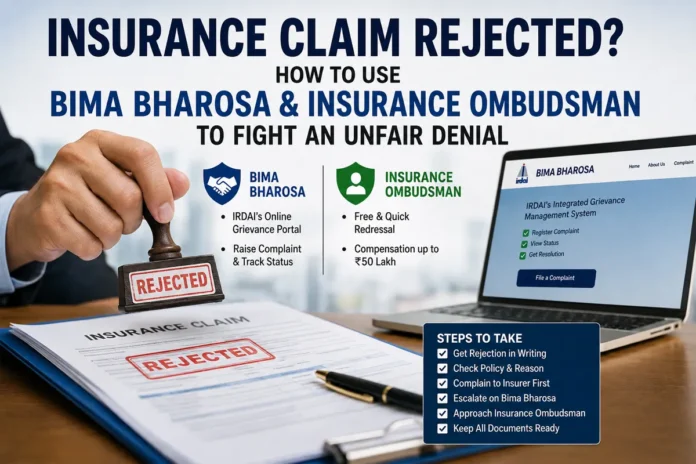
Bima Bharosa is IRDAI’s integrated grievance-management system.
Once a complaint is successfully registered, a Token Number is generated.
The complaint flows into the insurer’s grievance system as well as the IRDAI repository.
The policyholder can then use the token number to track progress online.
Information You May Need for Bima Bharosa
Keep the following details ready:
- Policyholder name
- Mobile number
- Email address
- Insurance company
- Policy number
- Claim number
- Complaint details
- Grievance reference number
- Supporting documents
Write the complaint chronologically.
A simple timeline is often more useful than a long emotional explanation.
For example:
January 10: Hospitalisation
January 15: Claim filed
January 30: Claim rejected
February 2: Complaint filed with insurer
February 12: Insurer upheld rejection
Then explain why you believe the rejection is incorrect.
Bima Bharosa Does Not Charge a Complaint Fee
IRDAI specifically warns policyholders that the Bima Bharosa portal does not ask for payments of any kind for registering or resolving grievances.
Do not scan a QR code sent by an unknown person claiming that money will be released after payment.
Never share:
- OTP
- UPI PIN
- Debit-card PIN
- CVV
- Internet-banking password
Use only:
https://bimabharosa.irdai.gov.in/
IRDAI also provides grievance assistance through:
Toll-Free: 155255
Alternative Number: 1800 4254 732
Email: complaints@irdai.gov.in
What Bima Bharosa Can and Cannot Do
Bima Bharosa is an important escalation and monitoring channel.
It allows IRDAI to monitor complaints and facilitates reconsideration by the insurer.
However, policyholders should not assume that simply registering a Bima Bharosa complaint guarantees payment of the insurance claim.
The underlying dispute still depends on:
- Policy wording
- Facts of the case
- Documents
- Regulatory requirements
- Whether the rejection was justified
Where the dispute remains unresolved, the Insurance Ombudsman may offer another route.
Step 5: Approach the Insurance Ombudsman
The Insurance Ombudsman provides an alternative grievance-redress mechanism for eligible insurance disputes.
It covers complaints involving matters such as:
- Delay in claim settlement
- Full claim rejection
- Partial claim rejection
- Policy servicing disputes
- Premium disputes
- Misrepresentation of policy terms
- Disputes over interpretation of policy terms connected with a claim
- Certain health, life and general insurance disputes
- Non-compliance with policyholder-protection rules
The service is designed to be cost-effective and accessible to policyholders.
Official website:
Who Can File an Ombudsman Complaint?
Depending on the case, the complaint may be filed by:
- Policyholder
- Claimant
- Legal heir
- Nominee
- Assignee
The scheme applies to eligible personal-line insurance and certain group, sole-proprietorship and micro-enterprise policies.
You Must Complain to the Insurer First
You cannot normally bypass the insurer and immediately approach the Insurance Ombudsman.
You must first make a written complaint to the insurance company or insurance broker.
You can then approach the Ombudsman if:
- The insurer rejects the complaint
- You are dissatisfied with the insurer’s response
- The insurer fails to reply within one month
This earlier complaint is therefore one of the most important documents in the Ombudsman process.
Insurance Ombudsman ₹50 Lakh Limit
The Insurance Ombudsman can entertain eligible complaints where the compensation sought or awarded falls within its prescribed financial jurisdiction.
The current maximum compensation that may be awarded is:
₹50 lakh
This includes relevant expenses where applicable.
The Ombudsman cannot award compensation exceeding the actual direct loss suffered merely because the complainant requests a larger amount.
One-Year Deadline to Approach Ombudsman
Do not leave an insurance dispute unresolved indefinitely.
A complaint generally needs to be made to the Insurance Ombudsman within one year from the relevant event, such as:
- Receipt of the insurer’s rejection
- Receipt of an unsatisfactory decision
- Expiry of one month after making the complaint where the insurer does not reply
The Ombudsman has powers to consider delay in appropriate circumstances, but policyholders should not rely on that exception.
File within time.
Documents Needed for Insurance Ombudsman
The Council for Insurance Ombudsmen lists documents such as:
- Copy of complaint made to the insurer
- Insurer’s rejection or repudiation letter
- Insurance policy
- KYC documents
- Claim documents
- Correspondence with insurer
- TPA correspondence, where relevant
- Supporting medical or financial documents
If the claim was denied because of a pre-existing disease or waiting period, previous insurance policies covering the earlier years may also be useful.
Can You File the Ombudsman Complaint Online?
Yes.
The Council for Insurance Ombudsmen provides an online complaint facility at:
The complaint can also be submitted through eligible offline channels to the relevant Ombudsman office.
Jurisdiction can depend on the insurer’s office or the complainant’s residential location.
Do You Need a Lawyer?
The Insurance Ombudsman mechanism is intended to be accessible without requiring a lawyer.
The Council for Insurance Ombudsmen states that the Ombudsman Rules do not provide for engaging a lawyer in the complaint process.
That makes the quality of your documentation particularly important.
Present:
- Facts
- Dates
- Policy clause
- Insurer’s reason
- Your counterargument
- Evidence
- Exact relief sought
Keep it simple.
Can You Go to Ombudsman After Filing a Court Case?
Generally, no.
The same subject matter should not already be pending before or have been disposed of by a court, consumer forum or arbitrator if you want to use the Insurance Ombudsman route.
Therefore, choose your escalation path carefully.
For high-value or legally complex disputes, consider obtaining independent professional advice before starting parallel proceedings.
How Long Can Ombudsman Take?
Where mediation succeeds, a recommendation may be issued under the applicable procedure.
Where the dispute is not resolved through mediation, the Ombudsman is required to pass an award within the prescribed period after receiving all required information.
The current rules provide for an award within three months after receipt of all requirements from the complainant.
Insurers are required to comply with an Ombudsman award within the prescribed period.
Health Insurance Claim Rejected: What to Check
For health insurance, closely examine whether the insurer has relied on:
- Pre-existing disease
- Waiting period
- Exclusion
- Non-medical expense
- Room-rent restriction
- Sub-limit
- Non-disclosure
- Treatment not considered medically necessary
- Policy lapse
- Cashless rejection versus final reimbursement rejection
A cashless authorisation being denied is not always the same as final rejection of the insurance claim.
In some cases, a policyholder may still submit a reimbursement claim after paying the hospital directly.
Check your policy and insurer instructions.
Life Insurance Claim Rejected: What to Check
For life insurance disputes, relevant issues may include:
- Proposal-form disclosures
- Medical history
- Nominee documents
- Cause of death
- Policy status
- Premium payment
- Insurer’s investigation
- Material misrepresentation allegations
The nominee should request the written repudiation letter and review the specific reason against the policy documents and application disclosures.
Motor Insurance Claim Rejected: What to Check
Motor claims can involve disputes over:
- Driving licence
- Policy coverage
- Delay in reporting accident
- Commercial use
- Drunk driving
- Vehicle modifications
- Survey assessment
- Repair estimate
- Consequential damage
- Depreciation
- Add-on cover
Do not begin major repairs before the insurer or surveyor completes required inspection unless emergency circumstances require immediate action.
Document the damage with photographs and retain repair bills.
What If Only Part of the Claim Is Paid?
A partial settlement can also be disputed.
Ask the insurer for a detailed settlement sheet showing:
- Claimed amount
- Approved amount
- Deduction
- Reason for each deduction
- Policy clause supporting each deduction
Sometimes the disagreement is not over whether the claim is payable, but over how much is payable.
Such disputes may still qualify for grievance escalation.
A Strong Complaint Is Factual, Not Emotional
Avoid writing:
“My insurer cheated me and must pay immediately.”
Instead write:
“My claim of ₹3,25,000 was rejected on May 10 under Clause X. The insurer stated that the condition was pre-existing. However, my policy has been continuously renewed since 2021 and the attached records show the diagnosis occurred after the applicable waiting period. I request reconsideration of the repudiation.”
Specific evidence is more persuasive than anger.
Insurance Claim Rejected: Complaint Checklist
Before escalation, confirm that you have:
- Policy copy
- Claim number
- Claim form
- Repudiation letter
- Relevant bills and records
- Complaint filed with insurer
- Complaint acknowledgement
- Insurer response
- Bima Bharosa token number, if used
- Copies of all correspondence
Keep digital backups.
Frequently Asked Questions
What should I do first if my insurance claim is rejected?
Ask the insurer for the written rejection or repudiation letter and identify the policy clause used to deny the claim. Then file a formal grievance with the insurer.
Can I complain directly to IRDAI?
IRDAI advises policyholders to first complain to the concerned insurance company. If the complaint remains unresolved or the response is unsatisfactory, it can be escalated through Bima Bharosa or IRDAI’s grievance channels.
Is Bima Bharosa free?
Yes. IRDAI warns that Bima Bharosa does not ask policyholders to make payments to register or resolve complaints.
How do I track a Bima Bharosa complaint?
A Token Number is generated after successful registration. The complainant can use the portal to track the grievance.
What is the Insurance Ombudsman claim limit?
The maximum compensation that can currently be awarded by the Insurance Ombudsman is ₹50 lakh, subject to the applicable rules and actual loss.
How long do I have to approach the Ombudsman?
Eligible complaints generally need to be filed within one year of the insurer’s rejection, unsatisfactory response or expiry of one month without a reply.
Can the Ombudsman handle a health-insurance claim rejection?
Yes, eligible health-insurance disputes, including partial or total claim repudiation, can fall within the Ombudsman’s jurisdiction.
Can I approach both the Ombudsman and consumer court for the same matter?
The Ombudsman generally cannot entertain the same subject matter if proceedings are already pending before or have been disposed of by a court, consumer forum or arbitrator.
The Bottom Line
An insurance claim rejection should be examined, not automatically accepted.
Start with the policy wording and written repudiation letter.
Complain formally to the insurer and keep a complete record of the grievance.
If the issue remains unresolved, use IRDAI’s Bima Bharosa system for escalation and tracking.
Eligible disputes can also be taken to the Insurance Ombudsman, which provides a cost-effective grievance mechanism with compensation jurisdiction up to ₹50 lakh.
The stronger your documents and timeline, the stronger your complaint.