By Team INVC | INVC NEWS
Published: August 31, 2026 | 10 : 32 AM IST
MUMBAI, India | August 31, 2026 —
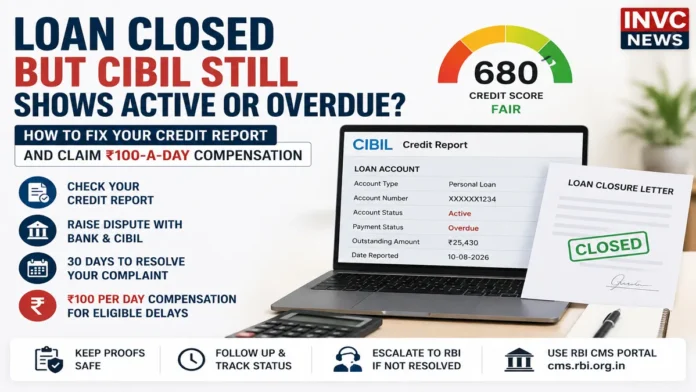
You have repaid your loan, collected the closure letter and moved on — but your credit report still shows the account as active, overdue or incorrectly settled.
This is more than a cosmetic error.
A wrong CIBIL credit report after loan closure can affect future home loans, personal loans, credit cards and even the interest rate offered by a lender.
The good news is that borrowers have a formal correction process.
Under Reserve Bank of India rules, credit institutions and credit information companies are expected to resolve credit-information correction complaints within 30 calendar days. If an eligible complaint remains unresolved beyond that period, the customer may become entitled to ₹100 for every calendar day of delay.
Here is what borrowers should do.
First Check Whether There Is Actually an Error
A closed loan may continue to remain visible in your credit report.
That by itself is not necessarily wrong.
Your credit history contains past as well as current accounts, and a properly repaid loan can continue to appear with the status “Closed.”
The problem begins when a fully repaid loan is still shown as:
- Active or Open
- Overdue
- Past Due
- Settled
- Written-Off
- Carrying an incorrect outstanding balance
- Showing wrong payment history
Therefore, do not raise a dispute merely because an old loan still appears in the report.
Check the account status, outstanding balance, payment history and date reported.
Closed and Settled Do Not Mean the Same Thing
This distinction is extremely important.
If you repaid the full amount owed under the loan agreement, the account should normally be reported as Closed.
A Settled status generally means the lender accepted less than the total amount it considered payable.
That can negatively influence future lending decisions because lenders may interpret it as evidence that the original repayment obligation was not fully met.
If you genuinely repaid the entire dues but the account is incorrectly shown as “Settled,” you should challenge the entry with documentary proof.
If the account was actually settled for a reduced amount, the borrower may need to clear the remaining amount with the lender before requesting that the status be changed.
How Soon Should a Loan Closure Reflect in Your Credit Report?
Credit information is now required to be updated more frequently than in the past.
RBI rules require credit institutions and credit information companies to keep credit information updated on a fortnightly basis, using data as of the 15th and last day of each month or at shorter agreed intervals.
The lender must submit the relevant data within the prescribed reporting timeline.
However, an update may still not appear instantly on the day you make the final payment.
TransUnion CIBIL advises that recent payment information can typically take some time to reflect.
If sufficient time has passed and the account status remains incorrect, the borrower should begin the dispute process.
Documents You Should Keep Ready
Before raising a dispute, collect evidence.
Useful documents may include:
- Loan closure letter
- No Objection Certificate or NOC
- No Dues Certificate
- Final repayment receipt
- Bank statement showing the final payment
- Loan account statement
- Foreclosure statement, if applicable
- Email confirming closure
- Any communication from the lender confirming zero outstanding balance
Keep copies rather than surrendering original documents unnecessarily.
Step 1: Download Your Latest Credit Report
Start by checking the exact error.
Obtain your latest credit report and identify:
- Lender name
- Loan account
- Account status
- Current balance
- Overdue amount
- Date of last payment
- Date reported
- Payment history
TransUnion CIBIL provides access to credit-report services through:
Do not rely only on a score displayed inside an unrelated financial application.
The detailed report is what shows which lender and which account is causing the problem.
Step 2: Raise a Complaint With the Lender
The lender is the source of most loan-account data appearing in a credit report.
Therefore, contact the bank, NBFC or other credit institution that reported the incorrect information.
State clearly:
- The loan has been fully repaid
- The date of final payment
- The incorrect entry appearing in the report
- The correction you require
Attach the supporting closure documents.
Ask for a complaint or service-request number.
This number is important because it proves when you first raised the issue.
Step 3: Raise a CIBIL Dispute
You can also raise a dispute through CIBIL.
Log in to your CIBIL account and use the dispute centre to identify the incorrect account or field.
Official portal:
CIBIL can coordinate the dispute with the lender.
However, there is an important limitation:
CIBIL cannot independently rewrite lender-supplied account information merely because the borrower requests it.
The relevant credit institution normally has to confirm the correction.
That is why submitting accurate evidence to the lender is crucial.
What Happens After You Raise the Dispute?
The dispute is sent to the concerned credit institution for verification.
The lender checks its records and confirms whether the information should be corrected.
If the lender accepts the correction, updated information is sent to the credit information company and the report is revised.
While a dispute is being processed, the relevant item may be marked as being under dispute.
RBI Gives 30 Days for Resolution
The RBI compensation framework sets an overall period of 30 calendar days for resolving eligible credit-information complaints.
Within this framework:
- The credit institution effectively gets 21 calendar days
- The credit information company gets the remaining 9 calendar days
The 30-day period runs from the initial filing of the complaint with the credit institution or credit information company.
₹100 Per Day Compensation for Delay
This is one of the strongest consumer protections in the framework.
If an eligible credit-information correction complaint is not resolved within 30 calendar days, the complainant may be entitled to compensation of:
₹100 per calendar day of delay
The entity responsible for the delay — the lender, credit information company, or both as applicable — is responsible for paying the compensation.
The compensation framework has been effective since April 26, 2024.
Borrowers should provide accurate bank-account details when required so any compensation due can be credited.
Example: How the ₹100-a-Day Rule Works
Suppose you file an eligible complaint on June 1.
The 30-day resolution period expires at the end of June 30.
If the complaint is ultimately resolved on July 10 and the delay is attributable under the RBI framework, compensation may potentially apply for the delayed calendar days beyond the permitted period.
The exact liability depends on which entity caused the delay and whether the complaint meets the applicable RBI conditions.
What If the Bank Rejects Your Correction Request?
Do not stop at a verbal rejection.
Ask the lender to provide the reason in writing.
RBI’s credit-information framework requires regulated institutions to communicate reasons when data-correction requests are rejected.
Review the reason carefully.
Common possibilities include:
- The lender’s records still show unpaid dues
- The final payment has not been allocated correctly
- Charges remain outstanding
- The borrower actually entered into a settlement
- The wrong loan account was disputed
- The lender has not yet processed the closure internally
If the rejection is factually wrong, reply with supporting evidence.
What If the Lender Says “Contact CIBIL”?
This is a common source of frustration.
Remember that a credit bureau generally cannot change lender-reported information without confirmation from the lender.
If the lender itself supplied the wrong status, it cannot simply avoid responsibility by telling the customer to contact CIBIL.
Raise the complaint formally with both sides where necessary and preserve acknowledgements.
Can a Wrong CIBIL Entry Reduce Your Score?
Yes, depending on the type of error.
An incorrect overdue balance, missed-payment history, settlement status or written-off status can affect how lenders assess your creditworthiness.
The exact numerical impact on a credit score varies.
A credit-information error can also affect a loan application even if the score itself remains relatively high, because lenders examine individual account details in addition to the score.
What If Your Loan Application Is Rejected Because of the Error?
Ask the lender processing your new application whether the credit-report entry contributed to the decision.
Keep evidence of:
- Loan rejection communication
- Incorrect credit-report entry
- Earlier dispute
- Loan closure documents
Correcting the source record remains the first priority.
A credit bureau does not decide whether a bank must approve your loan; the final lending decision belongs to the lender.
How to Escalate the Complaint to RBI
If your complaint against the bank, NBFC or credit information company remains unresolved or the response is unsatisfactory, you may be able to approach the Reserve Bank’s grievance redress system.
From July 1, 2026, RBI’s Integrated Ombudsman Scheme, 2026 is the current framework for eligible complaints involving deficiency in service.
The customer should first complain to the regulated entity.
If the complaint is rejected wholly or partly, the customer is dissatisfied with the response, or no reply is received within the applicable 30-day period, an eligible complaint can be escalated through RBI’s Complaint Management System.
Official RBI complaint portal:
The RBI Ombudsman mechanism is cost-free.
Keep a Proper Paper Trail
For any credit-report dispute, maintain one folder containing:
- Original credit report
- Corrected credit report
- Loan closure letter
- NOC
- Final payment proof
- Complaint acknowledgement
- CIBIL dispute ID
- Lender complaint ID
- Emails
- SMS messages
- Dates of phone calls
- Final resolution communication
This documentation can be extremely useful if the matter has to be escalated.
Do Not Pay a “CIBIL Repair Agent” Blindly
Be cautious of people promising to erase genuine defaults or instantly increase a CIBIL score for a fee.
A genuine error can be disputed.
A genuine history of missed payments cannot simply be legally erased because an agent promises to “clean” the report.
Never share:
- OTP
- UPI PIN
- Internet-banking password
- Debit-card PIN
- CVV
- Remote screen access
Use the lender, recognised credit bureau and RBI grievance channels.
Frequently Asked Questions
My loan is closed but it still appears in CIBIL. Is that wrong?
Not necessarily. A past loan can remain visible in your credit history. The important point is whether its status correctly shows Closed with the appropriate balance and payment history.
How do I change an active loan to closed in CIBIL?
First confirm that all dues have been repaid. Obtain the NOC or closure certificate, complain to the lender and raise a dispute with CIBIL if the report remains incorrect.
Can CIBIL directly change a wrong loan status?
CIBIL generally cannot independently modify lender-supplied information without confirmation from the concerned credit institution.
How long does a CIBIL dispute take?
RBI’s compensation framework provides an overall 30-calendar-day period for resolving eligible credit-information correction complaints.
Can I get ₹100 per day if the correction is delayed?
Eligible complainants can receive ₹100 per calendar day when a qualifying complaint is not resolved within 30 calendar days, subject to the RBI compensation framework.
Is “settled” the same as “closed”?
No. A fully repaid account is generally reported as closed. A settled account typically indicates that less than the full amount considered payable was accepted.
Where can I complain to RBI?
Eligible unresolved complaints can be filed through RBI’s Complaint Management System at:
The Bottom Line
A loan that has been fully repaid should not continue showing an incorrect active balance, overdue amount or wrong settlement status.
Check the detailed credit report, preserve your loan-closure documents and complain formally to the lender and credit bureau.
Most importantly, keep the complaint reference number.
RBI’s framework gives customers an important protection: eligible credit-information correction complaints that remain unresolved beyond 30 calendar days can attract ₹100 per day in compensation.