By Team INVC | INVC NEWS
Published: August 31, 2026 |03 : 47 PM IST
MUMBAI, India | August 31, 2026 —
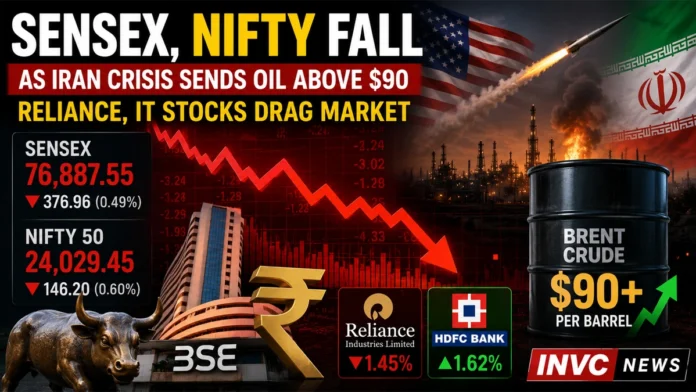
Stock Market Today August 31 2026 ended firmly in the red as renewed US-Iran military tensions pushed crude oil above $90 a barrel, revived inflation fears and triggered broad selling across Indian equities.
The BSE Sensex closed 376.96 points, or 0.49%, lower at 76,887.55, while the NSE Nifty 50 dropped 146.20 points, or 0.60%, to 24,029.45.
Bank Nifty proved relatively resilient but still finished 149.95 points lower at 57,346.35.
Selling was especially visible across metal, technology and other rate-sensitive stocks, while HDFC Bank emerged as a rare large-cap support.
Stock Market Closing Today: Sensex and Nifty at a Glance
The closing snapshot:
- Sensex: 76,887.55 — down 376.96 points or 0.49%
- Nifty 50: 24,029.45 — down 146.20 points or 0.60%
- Bank Nifty: 57,346.35 — down 149.95 points or 0.26%
- Nifty Metal: down around 2.30%
- HDFC Bank: up around 1.62%
- Hindalco: down around 2.77%
The Nifty again came dangerously close to the psychologically important 24,000 level, making that zone important for Tuesday’s session.
Iran Crisis Sends Brent Crude Above $90
The biggest global trigger was crude oil.
Brent moved back above $90 per barrel after fresh military exchanges between the United States and Iran renewed concern about supply disruption around the Strait of Hormuz.
U.S. forces struck Iranian positions on Larak Island, while Iran responded with missile and drone attacks against American military facilities in the region.
For India, expensive crude is a significant macroeconomic negative because the country imports most of its oil requirements.
Higher crude can increase India’s import bill, put pressure on the rupee, raise inflation risks and squeeze margins for businesses dependent on fuel and petrochemical inputs.
Also Read – : Trump-Iran Conflict Escalates Again as Strait of Hormuz Oil Risk Returns
Why Rising Oil Hurts Sensex and Nifty
A sustained rise in crude affects Indian equities through several channels.
Higher oil can:
- Increase India’s current-account burden
- Raise transportation and logistics costs
- Put pressure on the Indian rupee
- Increase inflation expectations
- Reduce corporate profit margins
- Make interest-rate cuts more difficult
- Trigger caution among foreign investors
Oil-sensitive sectors such as aviation, paints, chemicals, tyres and logistics can face additional cost pressure.
Upstream producers such as ONGC and Oil India may benefit from higher crude realisations, although their share prices can still be influenced by broader market sentiment.
Also Read – : Crude Oil Price Impact on Sensex and Nifty: Which Sectors Gain and Lose
Reliance in Focus as MSCI Weight Falls
Reliance Industries remained under pressure during the session as investors prepared for the latest MSCI Global Standard Index rebalancing.
Reliance’s weighting in the MSCI index is being reduced, creating the possibility of passive fund outflows as global index-tracking portfolios adjust their holdings.
The August 31 session was particularly important because MSCI’s changes become effective from September 1.
The reshuffle is adding:
- Laurus Labs
- Lenskart
- Adani Energy Solutions
- Groww
It is removing:
- Balkrishna Industries
- SBI Cards
- Astral
Adani Enterprises is also receiving a higher weighting, while Reliance faces a reduction.
That produced additional stock-specific activity during an already weak market session.
HDFC Bank Bucks the Market Fall
HDFC Bank was one of the strongest heavyweight stocks during Monday’s otherwise weak market.
Shares finished around 1.6% higher, helping prevent a deeper decline in the benchmark indices.
The stock reacted positively after Managing Director and CEO Sashidhar Jagdishan decided not to seek another term when his current tenure ends in October.
Investors appeared to view greater clarity around the leadership transition as reducing uncertainty surrounding India’s biggest private-sector bank by assets.
The bank’s large weighting in both benchmark indices meant its gains provided meaningful support to the Sensex and Nifty.
Metals Among Biggest Losers
Metals were among the hardest-hit segments.
The Nifty Metal index fell around 2.3%, making it one of the weakest sectoral performers.
Hindalco dropped around 2.77%, while other metal counters also remained under pressure during the session.
Technology stocks were weak as well as investors reacted to rising global bond yields and stronger expectations that the U.S. Federal Reserve could raise interest rates.
Higher U.S. rates generally reduce the relative appeal of risk assets and can encourage capital flows toward dollar-denominated investments.
Fed Rate-Hike Fear Adds Another Shock
Fresh comments from U.S. Federal Reserve Chair Kevin Warsh have increased expectations that interest rates could rise again if inflation remains persistent.
The combination of:
higher oil + elevated bond yields + Fed tightening fears + geopolitical risk
created an unfavourable backdrop for Indian equities.
The U.S.-Iran confrontation makes the situation more complicated because higher energy prices themselves can strengthen inflationary pressures, potentially giving central banks another reason to remain hawkish.
Rupee Also Faces Oil Pressure
The Indian rupee also came under pressure during the session as expensive crude increased demand for dollars from importers.
The currency traded around 95.4 against the U.S. dollar, with the Reserve Bank of India reportedly intervening to contain excessive volatility.
A combination of rising crude and a weaker rupee can be particularly challenging for India because oil imports are generally priced in dollars.
Even unchanged international oil prices become more expensive domestically when the rupee depreciates.
New Closing Auction Gets Its Biggest MSCI Test
Monday’s session had another unusual element: India’s new Closing Auction Session, or CAS.
The mechanism was introduced on August 3 and now determines official closing prices for eligible stocks through an auction process.
August 31 represented its first major test during an MSCI rebalance.
Large passive funds tracking MSCI benchmarks typically adjust their portfolios immediately before index changes take effect, creating concentrated buying and selling orders near the close.
This made the final minutes particularly important for Reliance and other stocks affected by changes in MSCI weights.
What Should Investors Watch on September 1?
Tuesday’s market direction may depend heavily on four factors:
- Brent crude oil — whether it remains above $90 or moves toward $95
- US-Iran conflict — any further military retaliation or Hormuz disruption
- Nifty 24,000 level — whether this crucial psychological support holds
- Global interest rates — especially expectations around the U.S. Federal Reserve
The Nifty’s close at 24,029.45 leaves the index almost directly on top of the 24,000 support zone.
A decisive break below that level could increase selling pressure.
Conversely, easing crude prices or signs of de-escalation between Washington and Tehran could provide relief to Indian equities.
For now, the message from Dalal Street is clear: oil has once again become one of the biggest risks facing Indian stocks.