By Team INVC | INVC NEWS
NEW DELHI, India | September 18, 2026 —
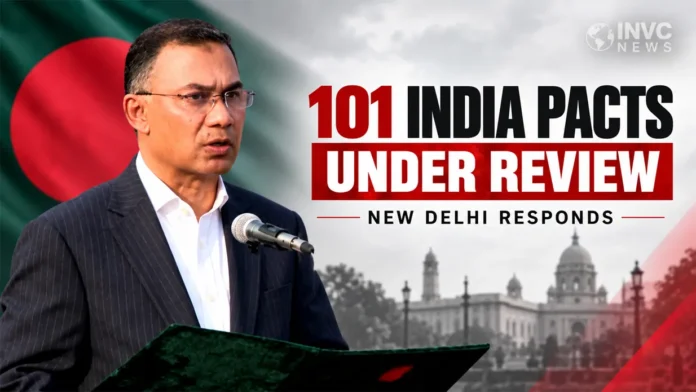
Bangladesh India agreements review has opened a sensitive new chapter in relations between the two neighbours, with Dhaka examining 101 agreements and memorandums of understanding signed during the previous Awami League government and New Delhi saying it will take necessary steps to protect its national interests.
The Bangladesh government has not announced that all 101 agreements will be cancelled.
Instead, officials in Dhaka say the agreements are being examined to determine whether they continue to serve Bangladesh’s national interests.
India, meanwhile, says it has received no formal communication from Bangladesh about proposed changes.
That distinction is critical.
For now, this is a review of existing arrangements, not the cancellation of 101 agreements.
However, because the agreements touch areas such as connectivity, ports, trade and infrastructure, their future could have significant consequences for India-Bangladesh relations.
What Bangladesh Has Actually Announced
Bangladesh Chief Whip Nurul Islam Moni has confirmed that the government is reviewing 101 agreements and MoUs signed with India during the tenure of former Prime Minister Sheikh Hasina’s Awami League government.
Moni said the findings of the exercise would be made known after the review.
Dhaka has presented the process as an assessment of whether previous arrangements sufficiently protected Bangladesh’s national interests.
The government has not yet published a complete list identifying every agreement under examination.
Nor has it announced which agreements may be retained, renegotiated or discontinued.
That means claims that Bangladesh has already decided to scrap 101 agreements would be premature.
India Responds: National Interests Will Be Protected
India reacted publicly on September 18.
Ministry of External Affairs spokesperson Randhir Jaiswal said New Delhi had seen media reports about Bangladesh’s review but had not received an official communication from Dhaka so far.
He made clear that India would take necessary action to protect its interests if developments affected existing bilateral arrangements.
The response is significant because New Delhi has so far avoided assuming that the review automatically means a breakdown in relations.
Instead, India’s position leaves room for formal discussions while signalling that strategic and economic interests linked to the agreements will be defended.
Why 101 Agreements Matter
India and Bangladesh are connected by far more than a conventional diplomatic relationship.
The two countries share a border stretching more than 4,000 kilometres.
Trade, electricity, transport links, inland waterways, ports, road connectivity, security cooperation and river management all form part of the bilateral relationship.
Over the past decade, several projects have also attempted to improve connectivity between India’s northeastern states and Bangladeshi transport infrastructure.
That makes Dhaka’s review important well beyond diplomatic symbolism.
Changes to individual agreements could potentially affect logistics, freight movement, infrastructure projects or access arrangements.
The actual impact will depend entirely on which agreements Bangladesh ultimately chooses to modify.
Chattogram and Mongla Ports Come Into Focus
Port access has emerged as one of the most closely watched elements of the review.
India and Bangladesh have developed arrangements allowing Indian cargo to use the Chattogram and Mongla ports for moving goods.
These routes have particular importance for India’s northeastern region because Bangladesh’s geographic position can provide shorter transport links than routes running entirely through Indian territory.
Bangladesh officials have raised questions about whether some previous port arrangements provided adequate benefits to their country.
Chief Whip Nurul Islam Moni has alleged that vessels from a friendly country received preferential treatment in some circumstances.
The Bangladesh government has not yet released detailed contractual evidence supporting all such claims.
It has also not announced that Indian access to either port has been terminated.
Connectivity Could Become the Biggest Strategic Question
The broader connectivity framework may prove even more important than the immediate political rhetoric.
India has invested heavily in improving regional transport links involving Bangladesh.
Roads, ports, railways and inland waterways can reduce distances between mainland India and northeastern states.
Bangladesh benefits from trade, transit revenue, investment and infrastructure development associated with regional connectivity.
Because both countries have economic interests in these arrangements, renegotiation would not automatically mean their complete abandonment.
Still, any major changes could alter the cost and efficiency of cross-border trade.
That gives the review a clear strategic dimension.
Dhaka Says It Wants a ‘Reset’ With India
The review comes as Bangladesh’s new political leadership seeks to redefine relations with New Delhi.
Bangladesh State Minister for Foreign Affairs Humaiun Kobir has recently spoken about the need for a “reset” in relations with India.
Dhaka says it wants ties based on mutual interests and direct bilateral engagement.
That language marks a shift from the exceptionally close relationship New Delhi maintained with Sheikh Hasina’s government.
Bangladesh’s current leadership has criticised some policies and agreements associated with the previous administration.
Nevertheless, Dhaka has also repeatedly indicated that it wants constructive relations with India.
The emerging policy therefore appears to be one of reassessment rather than diplomatic separation.
Sheikh Hasina Remains an Important Background Issue
Former Prime Minister Sheikh Hasina continues to cast a shadow over India-Bangladesh relations.
She has remained in India since losing power in 2024.
Dhaka has sought action concerning her return, while the issue has become politically sensitive inside Bangladesh.
Prime Minister Tarique Rahman’s government has also sought to distance itself from several policies adopted during the Awami League era.
The review of the 101 agreements therefore cannot be separated entirely from Bangladesh’s domestic political transition.
However, each bilateral agreement will ultimately have to be assessed on its own legal and economic terms.
Are All 101 Agreements at Risk?
No such conclusion can be drawn at this stage.
Bangladesh is reviewing 101 agreements.
That is different from cancelling 101 agreements.
Some could remain unchanged.
Others could face renegotiation.
A smaller number could potentially be discontinued if Dhaka concludes they no longer serve its interests.
Until Bangladesh publishes its final findings, any claim about the fate of individual agreements remains speculative.
This distinction is especially important because connectivity and trade agreements often involve long-term infrastructure, financial commitments and legal obligations that cannot necessarily be altered overnight.
What India Will Watch Most Closely
New Delhi is likely to focus on several areas.
Port access and freight movement will matter because of India’s northeastern connectivity.
Infrastructure projects involving Indian financing will also require attention.
Energy cooperation could become another sensitive area if related agreements enter the review.
Border and security cooperation will remain strategically important to both countries.
India will also watch whether the review becomes a negotiating exercise or evolves into a broader political rollback of agreements associated with the Hasina era.
So far, Bangladesh has not announced such a blanket reversal.
Why This Could Become a Major South Asian Story
India and Bangladesh are among South Asia’s most interconnected neighbours.
A serious disruption in their relationship would affect much more than bilateral diplomacy.
Trade routes could be affected.
Regional connectivity could face uncertainty.
Projects involving India’s Northeast could require reassessment.
China and other regional powers would also closely watch any significant strategic shift in Dhaka’s foreign policy.
That does not mean Bangladesh is automatically moving against India.
It means a review of 101 bilateral agreements is large enough to deserve careful attention.
What Happens Next?
The next decisive development will come when Bangladesh releases the findings of its review.
Until then, three questions will dominate the relationship:
Which agreements does Dhaka want to change?
Will it seek renegotiation or outright cancellation of specific arrangements?
How will India respond if strategically important agreements are affected?
For now, New Delhi has chosen a measured but firm position.
India says no official proposal has yet arrived from Bangladesh.
At the same time, it has made clear that it will protect its national interests if the review leads to changes affecting bilateral arrangements.
That leaves the door open for diplomacy.
It also makes the outcome of Bangladesh’s 101-agreement review one of the most important developments to watch in India-Bangladesh relations.