By Team INVC | INVC NEWS
Published: August 23, 2026 | Updated: August 31, 2026 |03 : 16 PM IST
WASHINGTON, United States | August 31, 2026 —
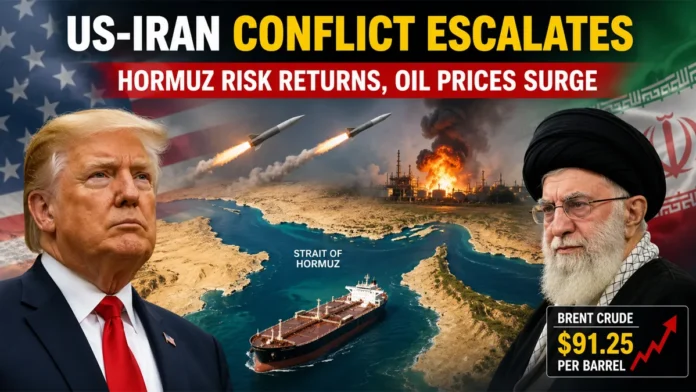
The Trump-Iran conflict has erupted into direct military confrontation again, with U.S. forces striking Iranian missile launchers on Larak Island in the Strait of Hormuz and Iran responding with missile and drone attacks against American military bases in Jordan.
The sudden escalation has immediately shaken global energy markets. Brent crude surged above $91 a barrel, reviving fears that another prolonged military confrontation around the Strait of Hormuz could disrupt oil shipments, raise tanker risks and push energy prices higher worldwide.
At the same time, U.S. President Donald Trump made an explosive claim about Iran’s strategically important Kharg Island, saying the country’s key oil hub was being destroyed.
However, that claim should not be treated as a confirmed military development.
No independently verified attack on Kharg Island had been established by Monday afternoon, while Iranian oil authorities said operations there remained normal.
US Strikes Iranian Positions on Larak Island
The latest confrontation began after U.S. forces struck two Iranian missile launchers on Larak Island, which sits inside the strategically sensitive Strait of Hormuz.
American officials said the targets were linked to Iranian Revolutionary Guard personnel allegedly preparing naval mines.
The operation marks the first direct U.S. strike on Iranian territory since late July and represents a sharp reversal from the relative reduction in military exchanges seen in recent weeks.
Iran condemned the attack and said its forces had the right to retaliate.
Tehran subsequently announced a combined missile and drone operation targeting U.S. military bases in Jordan.
Most of the incoming missiles were reportedly intercepted, and no major damage had been confirmed in the initial assessments.
The renewed fighting has nevertheless raised an uncomfortable question for global markets: is the fragile period of de-escalation between Washington and Tehran now collapsing?
Also Read – : US-Iran Talks: UN Calls for Fresh Negotiations After 60-Day Deal Deadline Expires
Oil Jumps Above $91 as Hormuz Fear Returns
Oil markets reacted almost immediately.
Brent crude climbed more than 3% and traded around $91.25 per barrel, while U.S. West Texas Intermediate also moved sharply higher.
The reaction reflects the importance of the Strait of Hormuz.
Even after months of conflict and disrupted shipping, the narrow waterway remains one of the most important energy corridors in the world.
Any renewed mining campaign, missile exchange or attack on commercial vessels could make tanker operators more reluctant to enter the region.
That would raise insurance and freight costs even before any physical shortage of oil emerges.
The latest confrontation is especially sensitive because tanker movement through Hormuz has still not fully returned to levels seen before the conflict.
Trump’s Kharg Island Claim Raises Fresh Questions
President Donald Trump added another dramatic element to the crisis when he posted a video while claiming that Kharg Island was being “blown to smithereens.”
Kharg is critically important to Iran because it handles a large share of the country’s crude-oil exports.
But there is a major caution.
The video posted alongside the claim was identified as AI-generated, and there was no verified evidence on Monday afternoon establishing that U.S. forces had actually launched a new attack on Kharg Island.
Iranian officials rejected Trump’s assertion and said the island remained stable, with oil operations continuing.
That distinction is crucial.
An actual large-scale attack on Kharg could have far more serious consequences for Iranian exports and global oil prices than the confirmed strike on Larak Island.
For now, therefore, the Kharg Island claim should remain clearly labelled as an unverified claim by President Trump, not a confirmed battlefield fact.
Iran Says It Retaliated Against US Bases
Iran’s Revolutionary Guards said their retaliation targeted two U.S. military installations in Jordan with missiles and drones.
Tehran described the operation as a response to the Larak Island attack.
Iran also said its forces shot down an American MQ-9 drone over the Strait of Hormuz.
The latest military exchange demonstrates how quickly an incident inside the Strait can spill into a wider regional confrontation involving U.S. facilities across the Middle East.
Washington has simultaneously begun increasing economic pressure on Tehran.
The Trump administration is preparing repeated secondary sanctions targeting financial institutions and other entities doing business with Iran, adding another front to the confrontation beyond missiles and drones.
Strait of Hormuz Again Becomes the Biggest Risk
The Trump Strait of Hormuz confrontation had increasingly shifted toward sanctions, shipping restrictions and negotiations in recent weeks.
Monday’s escalation changes that equation.
Physical military action has now returned directly to the waterway.
The biggest immediate risks include:
- Fresh attacks on Iranian military positions
- Iranian missile or drone retaliation
- Naval mines in or near shipping lanes
- Attacks on commercial tankers
- Higher marine insurance costs
- Further restrictions on Hormuz traffic
- Another surge in global crude and LNG prices
An agreement between Iran and Oman had previously raised hopes that commercial shipping could gradually become more predictable.
Those hopes now face another serious test.
Also Read – : Iran-Oman Near Deal on New Hormuz Shipping Route; Strait Not Fully Reopening Yet
Why India Should Watch the New Oil Shock
For India, the renewed confrontation is not a distant geopolitical event.
Higher crude prices can increase the country’s import bill, put pressure on the rupee and eventually feed into transport and inflation costs if elevated prices persist.
India has significantly diversified its crude sourcing during the conflict and now obtains a greater share of its oil from routes outside Hormuz.
However, the waterway remains particularly important for Gulf energy supplies, including LPG.
The government has previously said India imports about 60% of its LPG consumption, with roughly 90% of those imports historically moving through the Strait of Hormuz.
That makes prolonged instability important for households as well as businesses.
India’s energy companies have already been forced to source expensive alternative LNG cargoes as the Iran conflict disrupted normal Gulf supplies.
Also Read – : India Buys Costliest LNG Since 2022 as Iran War Chokes Supplies Through Strait of Hormuz
Will Petrol and Diesel Prices Rise in India?
A one-day jump in Brent does not automatically mean petrol and diesel prices will immediately rise.
Domestic fuel prices depend on several factors, including crude prices, the rupee-dollar exchange rate, refining costs, taxes and oil-marketing company margins.
But a sustained move toward or above $100 would increase pressure on India’s energy economy.
The more important question is therefore not whether Brent briefly crosses $91.
It is whether the latest U.S.-Iran confrontation develops into another prolonged military cycle around Hormuz.
What Happens Next?
Three developments now deserve particularly close attention.
First, whether the United States conducts additional strikes after the Iranian retaliation.
Second, whether Tehran attempts to further restrict shipping or deploy mines around the Strait of Hormuz.
Third, whether Trump’s Kharg Island claim is followed by any independently verifiable military action.
For oil markets, even the threat of escalation matters.
For the wider region, however, another prolonged round of attacks would carry much greater consequences.
The Trump-Iran conflict has moved back from sanctions and diplomatic threats to actual military exchanges—and the world’s most sensitive oil corridor is once again at the centre of it.