By Team INVC | INVC NEWS
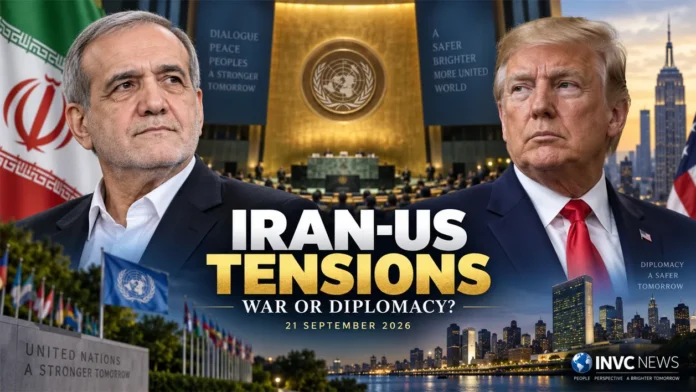
TEHRAN, Iran | September 21, 2026 — Iran-US tensions entered another critical phase on Monday as Tehran warned of sustained retaliation against any fresh American attack, while US President Donald Trump simultaneously left the door open to a possible meeting with Iranian President Masoud Pezeshkian during the United Nations General Assembly in New York.
The contrasting messages — military threats on one side and the possibility of diplomacy on the other — have placed this week’s UN gathering at the centre of efforts to prevent another major escalation in the Middle East.
Iran Warns US Bases and Regional Allies
Iran’s military central command said any new attack on the country would trigger sustained retaliation against US bases and American interests in the region.
Tehran also warned that regional countries supporting an American attack could be treated as parties to the conflict.
Iran said it had received information indicating that another attack might be under preparation. However, it did not publicly provide evidence or additional details supporting that claim.
That distinction matters because Tehran’s assertion about an impending attack remains an Iranian claim rather than independently verified evidence.
Trump Keeps Door Open for Pezeshkian Meeting
At the same time, President Trump has continued to pressure Iran to reach an agreement.
According to Reuters, Trump issued another warning over the consequences of failing to make a deal but also said he would be open to meeting President Masoud Pezeshkian, who is expected in New York for the UN General Assembly.
That combination has created an unusual diplomatic moment.
Washington and Tehran continue exchanging threats, yet both sides will have senior officials in New York at the same time.
The United States has approved access for a core Iranian delegation that includes Pezeshkian and Foreign Minister Abbas Araghchi. The delegation faces travel restrictions while in New York.
Pezeshkian to Address UN on Wednesday
Iranian President Masoud Pezeshkian is scheduled to address the UN General Assembly on Wednesday.
Nearly 130 heads of state and government are gathering in New York this week, with the Middle East conflict expected to dominate a significant part of the diplomatic agenda.
President Trump is also scheduled to address the General Assembly as Washington holds meetings with several international and Gulf leaders.
The presence of both leaders has therefore intensified speculation about whether direct or indirect negotiations could emerge from the gathering.
No Trump-Pezeshkian meeting has been formally confirmed.
Qatar Diplomacy Could Become Crucial
Diplomatic activity has also intensified away from the cameras.
Iran has conveyed conditions to mediators for possible renewed negotiations aimed at ending the conflict, according to information cited by Reuters.
Qatar has played a prominent mediation role in regional disputes and remains one of the countries positioned to facilitate communication between the two sides.
For now, however, diplomatic contacts have not produced a publicly announced settlement.
Strait of Hormuz Traffic Falls Sharply
The military standoff continues to affect one of the world’s most important shipping corridors.
Shipping data cited by Reuters showed that only about 12 tracked commodity vessels transited the Strait of Hormuz over the weekend, down from 35 during the previous weekend.
Before the US-Israel conflict with Iran began on February 28, the strait typically handled roughly 125 large commercial vessels per day, although that broader pre-war measure is not directly comparable with the narrower weekend commodity-vessel count.
The strait carried around one-fifth of global oil and liquefied natural gas flows before the conflict.
Some oil shipments are still moving through the region with vessel transponders switched off, according to Reuters.
Houthi Attacks Add Another Layer of Risk
The crisis has become even more complicated after Yemen’s Iran-aligned Houthi movement launched missile and drone attacks targeting Saudi Arabia.
Reuters reported attacks aimed at sites in Riyadh and an Aramco facility at Yanbu, a major Red Sea oil export hub.
Saudi-led forces said they had intercepted additional attacks, while the US State Department warned of the potential for further regional escalation.
The attacks matter because disruption around both the Strait of Hormuz and the Bab el-Mandeb route can directly affect energy shipments between the Gulf, Asia and Europe.
Oil Markets Are Already Reacting
Despite the military tension, oil prices fell early Monday as traders focused on the possibility of renewed diplomacy.
Brent crude dropped to around $101.71 a barrel, while US West Texas Intermediate fell to approximately $98.15 during early trading, according to Reuters.
Market analysts attributed part of that fall to hopes that diplomatic activity around the UN General Assembly could reduce the risk premium built into oil prices.
However, that optimism remains fragile.
A renewed military escalation, further disruption to shipping lanes or attacks on major energy infrastructure could quickly change the market outlook.
UNGA Could Become the Week’s Decisive Diplomatic Stage
The next few days could therefore prove unusually important.
Washington is maintaining military and economic pressure on Tehran. Iran is signalling that it will respond to any new attack. Gulf countries want to protect energy infrastructure and shipping routes, while international mediators continue exploring a negotiated path.
At the same time, the arrival of both American and Iranian leaders in New York creates a rare opportunity for diplomacy.
Whether that produces formal negotiations, indirect contacts or simply another exchange of public warnings remains uncertain.
What is clear is that the Iran-US conflict will be one of the defining issues hanging over the 2026 UN General Assembly.