
By Team INVC | INVC NEWS
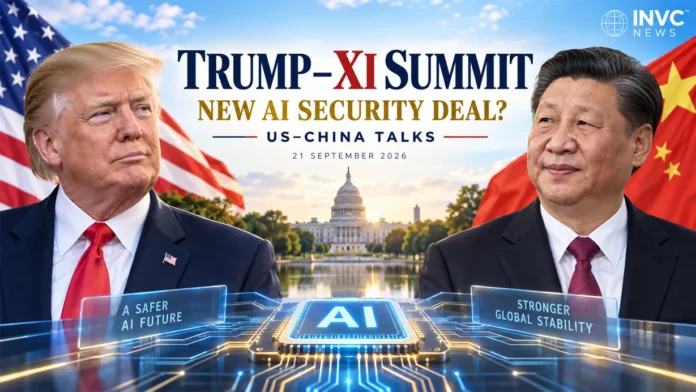
NEW YORK, United States | September 21, 2026 — US-China AI talks have entered a new phase after the Trump administration proposed a direct notification system between Washington and Beijing for artificial intelligence incidents serious enough to affect national security.
US Treasury Secretary Scott Bessent disclosed the proposal after talks with Chinese Vice Premier He Lifeng in New York on Sunday. The idea is expected to be considered by US President Donald Trump and Chinese President Xi Jinping when they meet in Washington this week.
The discussions come as the United States and China compete in advanced AI, semiconductors and critical technologies while simultaneously exploring limited areas where communication could reduce the risk of a crisis.
What Is the Proposed US-China AI Alert System?
Bessent said Washington wants the two countries to establish a US-China AI dialogue along with a notification mechanism covering AI-related events that rise to the level of national-security concern.
The proposed channel would focus on areas where the two governments identify common threats or shared interests.
The precise triggers, reporting procedures and enforcement mechanisms have not yet been publicly defined. China also has not publicly committed to accepting the American proposal.
That means the mechanism remains a proposal rather than an agreement.
Why Washington Wants More AI Transparency
Artificial intelligence has become an increasingly important element of US-China strategic competition.
Both countries are developing increasingly capable AI systems, while governments are examining risks involving autonomous systems, cyberattacks, critical infrastructure and military applications.
Bessent framed the proposal as an attempt to introduce greater transparency between what he described as the world’s two leading AI powers.
The Associated Press reported that the notification mechanism could cover serious AI incidents affecting national security and would form part of broader efforts to establish more formal communication between the two governments.
Trump and Xi Prepare for Washington Summit
The negotiations are taking place ahead of a high-profile meeting between President Trump and President Xi in Washington.
The Office of the US Trade Representative confirmed that Bessent and US Trade Representative Jamieson Greer met He in New York specifically ahead of the upcoming US-China summit in Washington.
Xi’s visit follows Trump’s trip to China in May, when the two leaders discussed trade, critical minerals and the broader bilateral relationship.
The White House said after those May meetings that Trump and Xi had agreed to establish new mechanisms covering trade and investment and that Trump would host Xi in Washington later in 2026.
The upcoming meeting is also expected to address trade, rare-earth supplies and other economic disputes.
AI Is Only One Part of the US-China Negotiations
Sunday’s New York talks went well beyond artificial intelligence.
Officials also discussed tariffs and the US-China Board of Trade, a mechanism created following earlier discussions between Trump and Xi.
The White House says the board is intended to manage bilateral trade involving products that both governments classify as non-sensitive.
American officials are exploring possible tariff reductions on some non-sensitive goods while continuing negotiations over market access and trade commitments.
However, major disputes remain unresolved.
Rare Earths Remain a Major Pressure Point
Critical minerals continue to sit near the centre of US-China economic negotiations.
Rare-earth elements are essential for products ranging from electric vehicles and electronics to defence systems and advanced technologies.
Washington has repeatedly raised concerns about access to Chinese rare-earth magnets and other critical materials.
The issue was among the subjects prepared for discussion ahead of Sunday’s talks.
The White House previously said China had committed to address US concerns involving shortages of materials including yttrium, scandium, neodymium and indium following the May negotiations.
How those commitments are implemented remains an important part of the economic relationship.
Advanced Chips Still Divide Washington and Beijing
AI competition cannot be separated from semiconductors.
The United States has maintained restrictions on China’s access to some advanced chips and manufacturing technologies, citing national-security concerns.
China has criticised several US technology restrictions and argues that Washington is using security policy to constrain Chinese technological development.
At the same time, researchers and policymakers in both countries have raised questions about autonomous AI, cyber risks and the possibility that rapidly developing systems could behave in unexpected ways.
Those competing concerns make AI cooperation particularly difficult: Washington and Beijing are discussing safety while simultaneously competing for technological advantage.
No AI Safety Agreement Yet
One important distinction remains.
The United States and China have not announced a binding AI safety agreement.
Washington has proposed a notification mechanism, and officials say the two sides agreed to continue discussions. The details still need to be negotiated, and the Trump-Xi summit could determine whether the idea develops into a formal bilateral process.
China’s position on the specific US proposal has not yet been fully detailed publicly.
Why the Trump-Xi Meeting Matters
The Washington summit will bring together the leaders of the world’s two largest economies at a time when trade, artificial intelligence, critical minerals and geopolitical security are increasingly interconnected.
The talks do not eliminate the strategic competition between Washington and Beijing.
Instead, the developing AI proposal shows that both governments are exploring whether specific communication channels can operate even while disputes continue elsewhere.
For policymakers and technology companies, the key question will be whether a notification mechanism eventually becomes a practical crisis-management tool or remains a diplomatic proposal.
The first indication could come when Donald Trump and Xi Jinping meet in Washington later this week.








[…] Treasury Secretary Scott Bessent said Monday that the United States and China are now speaking directly about AI risks, with the Trump administration proposing a direct notification system between Washington and Beijing for artificial intelligence incidents serious enough to affect national security. The move marks a new phase in US-China AI talks as both governments prepare for the upcoming Trump-Xi meeting. (Washington Times, INVC News) […]
Comments are closed.