By Team INVC | INVC NEWS
Published: August 31, 2026 |04 : 57 PM IST
NEW DELHI, India | August 31, 2026 —
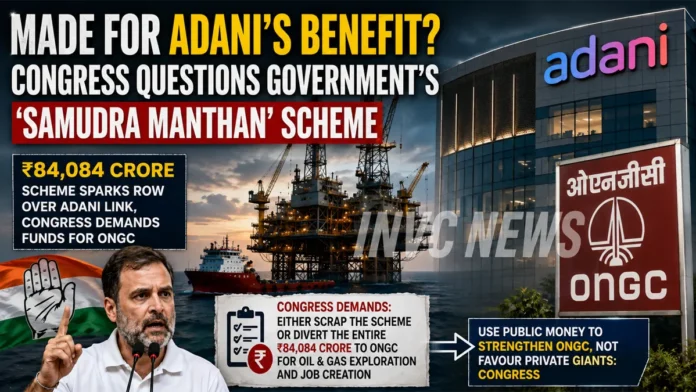
A fresh political battle has erupted over the Centre’s ₹84,084 crore Samudra Manthan scheme, with the Congress alleging that the offshore oil and gas exploration programme could disproportionately benefit the Adani Group while weakening the role of state-owned energy giant ONGC.
Congress spokesperson Shaktisinh Gohil demanded on Monday that the National Offshore Exploration Scheme either be scrapped or that its full public outlay be redirected to ONGC for offshore exploration, domestic energy production and job creation.
The government, however, describes Samudra Manthan as a national energy-security mission designed to reduce exploration risk, increase domestic oil and gas output and cut India’s heavy dependence on energy imports.
As of Monday evening, there was no immediate public response from the government or Adani Group to the Congress allegations.
What Congress Has Alleged
At a press conference in New Delhi, Gohil alleged that the structure of Samudra Manthan could help private exploration companies by allowing the government to absorb a substantial share of high-risk deepwater exploration costs.
He specifically referred to Adani Welspun Exploration Limited, or AWEL, an upstream oil and gas joint venture in which Adani Enterprises holds a 65% stake and Welspun holds 35%.
Congress argued that because AWEL has interests in offshore exploration blocks, it could benefit from government-backed risk sharing when it undertakes eligible exploration activity.
The party claimed this creates an unfair situation in which taxpayers absorb part of the exploration risk while private companies retain the commercial upside from successful discoveries.
That is an allegation by the Congress and has not been established as a finding by any regulator, court or government audit.
Congress Wants ₹84,084 Crore Routed to ONGC
Gohil questioned why the government was using public money to de-risk private-sector exploration instead of strengthening ONGC, which has decades of experience in India’s offshore oil and gas sector.
The Congress demanded that the scheme either be withdrawn or that the government use the entire allocation to expand ONGC’s exploration programme.
The party also linked its argument to employment, saying a larger public-sector exploration drive could create jobs while strengthening domestic energy production.
What Samudra Manthan Actually Provides
The Union Cabinet approved Samudra Manthan — National Offshore Exploration Scheme on July 31 with an outlay of ₹84,084 crore up to FY2030-31.
The scheme is broader than direct funding for individual oil companies.
Its official allocation includes:
- ₹28,534 crore for offshore seismic data acquisition and processing
- ₹43,200 crore for accelerated offshore exploration
- ₹10,000 crore for shared offshore infrastructure
- ₹2,000 crore for oil and gas manufacturing and services zones
- ₹350 crore for monitoring, digital systems, capacity building and support
A major component involves drilling 60 deepwater exploration wells.
For eligible deepwater wells, the government can provide support of up to 50% of the drilling cost or ₹675 crore per well, whichever is lower.
That risk-sharing structure is at the centre of the Congress criticism.
Why Government Says Public Support Is Needed
Deepwater oil and gas exploration is extremely expensive and carries a high probability of failure.
The government estimates that a single deepwater exploration well can cost approximately $125 million to $150 million.
A company may therefore spend hundreds or thousands of crores without making a commercially viable discovery.
The Petroleum Ministry argues that sharing part of this exploration risk can encourage companies to drill in frontier offshore basins that might otherwise remain unexplored.
India’s major future offshore opportunities include the:
- Krishna-Godavari Basin
- Cauvery Basin
- Mahanadi Basin
- Andaman region
- Western offshore areas
The government says nearly all of India’s previously restricted offshore acreage has now been opened for exploration.
Why India Is Pushing Offshore Oil Exploration
India remains one of the world’s largest crude-oil consumers and depends heavily on imports.
The government has estimated the country’s annual crude import bill at roughly $144 billion, or around ₹13 lakh crore.
Under Samudra Manthan, the Centre wants domestic oil and gas production to rise from around 62 MMTOE to 80 MMTOE annually, subject to successful discoveries.
The programme also aims to add more than 600 MMTOE of hydrocarbon reserves.
If those targets are achieved, the government believes additional domestic production could reduce crude-oil imports by nearly ₹1 lakh crore per year.
Also Read – : India LNG Prices Surge Above $23 as Iran War Disrupts Supplies
Why Adani Welspun Is in the Political Spotlight
Adani Welspun Exploration is involved in upstream oil and gas exploration and holds interests in offshore areas in western India.
Adani Enterprises owns 65% of the joint venture, while Welspun owns the remaining 35%.
Because Samudra Manthan allows eligible operators to receive government-backed exploration support, Congress has argued that AWEL could become one of its beneficiaries.
However, the official Samudra Manthan framework is not restricted to AWEL.
The scheme is designed for a wider offshore exploration ecosystem involving national oil companies, private operators, technology companies, seismic-service providers and other participants.
That makes the political question more complicated than simply asking whether one company may benefit.
The larger debate is whether the government should use public funds to reduce exploration risk for private operators at all—or whether that capital should be concentrated in public-sector companies such as ONGC and Oil India.
ONGC Remains Central to India’s Offshore Strategy
ONGC remains India’s most important offshore oil and gas producer.
The government has itself said that performance parameters for ONGC and Oil India have been reoriented to place greater emphasis on exploration.
That means Samudra Manthan does not formally exclude public-sector companies.
The key policy debate is instead about how much public money should be used to incentivise private exploration alongside state-owned operators.
Government and Adani Response Awaited
The Congress allegations have injected a major political dimension into what had previously been presented primarily as an energy-security and exploration policy.
As of Monday evening, neither the Petroleum Ministry nor Adani Group had issued an immediate detailed response to Gohil’s allegations.
Any future response will be important because the dispute centres on two competing narratives.
Congress argues that taxpayer-funded risk sharing could favour private corporate interests.
The government argues that deepwater exploration is so expensive and risky that public support is necessary to unlock resources, attract investment and reduce India’s dependence on imported oil.
That debate is now likely to intensify as implementation of the ₹84,084 crore Samudra Manthan programme moves forward.