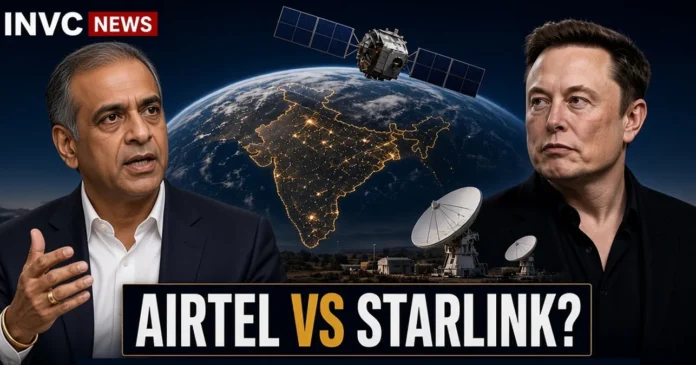
The Bharti Enterprises chairman says his group applied five years ago and has had its ground infrastructure ready for three years, as the government continues security and regulatory checks on satellite broadband operators.
NEW DELHI | October 15, 2026 – Bharti Enterprises Chairman Sunil Bharti Mittal has pushed back against Elon Musk’s allegations that powerful Indian business interests are obstructing Starlink’s entry into the country, saying his group’s satellite broadband venture is already ahead of the US billionaire’s company in the regulatory approval queue.
Speaking at the Bloomberg New Economy Forum in New Delhi on Wednesday, October 14, Mittal said Eutelsat OneWeb had applied for permission to provide satellite communications services in India five years ago. He added that the company’s ground infrastructure had been ready for three years, while its satellites had been positioned to serve the Indian market for about five years.
“We are all awaiting our approvals. I believe we are significantly ahead of him in the queue because we applied five years ago,” Mittal said, referring to Musk’s Starlink. He added that the company would be pleased to receive approval even a few days before its rival.
The remarks come amid a growing dispute over the pace of regulatory clearances for satellite internet services in India. Musk has repeatedly questioned the delay in Starlink’s commercial launch, suggesting that influential Indian business groups are using their position to protect their market share. Indian telecom companies have rejected those allegations, while the government has said operators must meet the country’s regulatory and national security requirements.
What Sunil Bharti Mittal Said About Starlink
Mittal’s central argument was that Bharti-backed OneWeb should not be portrayed as a competitor seeking preferential treatment. Instead, he said, the company had been waiting for approvals for years and had already invested in the infrastructure needed to deliver satellite connectivity.
His comments also highlighted a distinction between preparing a satellite network and receiving permission to begin commercial services. Although OneWeb has satellites and ground infrastructure in place, final clearances remain necessary before it can roll out its services to customers in India.
The company’s position is particularly relevant because satellite broadband could expand internet access in remote and underserved areas, where conventional terrestrial networks can be expensive or difficult to deploy.
For Airtel and its partners, satellite connectivity could complement existing mobile and broadband networks. It could also create new opportunities in enterprise communications, remote infrastructure and connectivity for locations where traditional networks have limited reach.
However, the timing of a commercial launch depends on regulatory approvals and other operational requirements, not simply on the readiness of satellites and ground equipment.
Why Elon Musk Has Criticized India’s Approval Process
Musk has used his social media platform, X, to complain about the delay in granting Starlink final permission to launch commercial satellite internet services in India.
He has suggested that powerful business interests, including those associated with Reliance Industries Chairman Mukesh Ambani, are attempting to prevent Starlink from entering the market to protect established telecom operators. Musk has also questioned whether political influence is affecting the regulatory process.
Those allegations have not been established by the evidence cited in the public debate. Indian telecom operators have rejected claims that they are blocking Starlink, and the government has denied that the company is being treated unfairly.
The dispute reflects the commercial stakes involved. India is a large potential market for satellite broadband, particularly in areas where terrestrial internet coverage remains limited. Starlink’s entry would introduce another major player into a market in which domestic telecom groups already have substantial networks and customer relationships.
For Musk, securing approval would create an opportunity to expand Starlink’s international footprint. For Indian operators, the arrival of another satellite broadband provider would increase competition in a segment that could become increasingly important to digital infrastructure.
What Is Eutelsat OneWeb, and How Is Airtel Connected?
Eutelsat OneWeb is a low-Earth-orbit satellite communications company backed in part by Bharti Enterprises. It operates a constellation designed to provide connectivity through satellites orbiting much closer to Earth than traditional geostationary satellites.
Bharti’s investment gives the group a direct interest in the development of satellite communications, alongside its established telecommunications business through Airtel.
OneWeb’s planned services could complement conventional broadband by providing connectivity in areas where fibre and mobile networks are difficult to extend. The technology can also support enterprise customers, government operations and communications infrastructure in remote locations.
The company has argued that its preparations are already advanced. Mittal’s latest remarks were intended to underline that the group’s long wait for final approval began well before the current dispute over Starlink’s entry into India.
Nevertheless, an earlier application does not automatically establish that a company must receive permission first. The final sequence of approvals depends on the applicable regulatory process and the completion of required checks.
Government Says Security Clearances Are Still Required
The Indian government has said the delay in Starlink’s commercial launch is linked to regulatory and national security requirements, rather than an effort to protect domestic telecom operators.
Communications Minister Jyotiraditya Scindia previously rejected Musk’s monopoly-related allegations and said India does not permit monopolies in any sector. The government has also said that Starlink, Jio Satellite Communications and Bharti-backed OneWeb have been subject to the relevant regulatory process.
The companies have obtained certain satellite communications authorizations, but permission to provide commercial services involves additional requirements, including security-related clearances and arrangements for spectrum use.
These stages are important because satellite communications networks operate across large geographical areas and involve equipment, data flows and infrastructure that regulators may need to assess before commercial deployment.
The government’s position is that all providers must comply with the same applicable rules. The precise timing of commercial launches will depend on the completion of those requirements.
Akash Ambani Also Rejects Monopoly Allegations
Reliance Jio Platforms Managing Director Akash Ambani has also pushed back against Musk’s claims that Indian telecom companies are attempting to create a monopoly.
Ambani has maintained that Jio operates within India’s regulatory framework and must comply with the same rules that apply to other satellite communications providers.
The disagreement highlights a broader policy question: how India should balance competition, investment and rapid deployment of new communications technology with national security and regulatory oversight.
Starlink’s supporters argue that satellite internet could expand connectivity options, particularly for customers in remote regions. Domestic operators, meanwhile, point to their existing investments and the need for a consistent regulatory framework across providers.
The outcome will depend on the government’s decisions and the conditions attached to final commercial permissions.
What the Dispute Means for India’s Satellite Internet Market
The exchange between Mittal and Musk illustrates the growing competition to provide satellite-based internet services in India. The market could eventually include multiple providers, each using different commercial models and targeting different customer segments.
For consumers, additional satellite broadband options could improve connectivity in areas where traditional networks are limited. Businesses and public institutions could also benefit from additional communications capacity.
However, the speed and scale of deployment will depend on the cost of service, equipment availability, spectrum arrangements, regulatory compliance and the ability of operators to build a sustainable customer base.
The dispute also shows why regulatory approval is becoming a central issue in the competition between global technology companies and established Indian telecom groups.
Mittal’s message is straightforward: his group has invested in preparations for years and believes it should be ahead of Starlink in the approval queue. Musk, meanwhile, continues to question the pace and fairness of the process.
For now, neither company’s commercial launch timeline is determined by the public exchange alone. The decisive factor remains the completion of the required regulatory and security clearances.