By Team INVC | INVC NEWS
Published: August 31, 2026 | 10 : 17 AM IST
MUMBAI, India | August 31, 2026 —
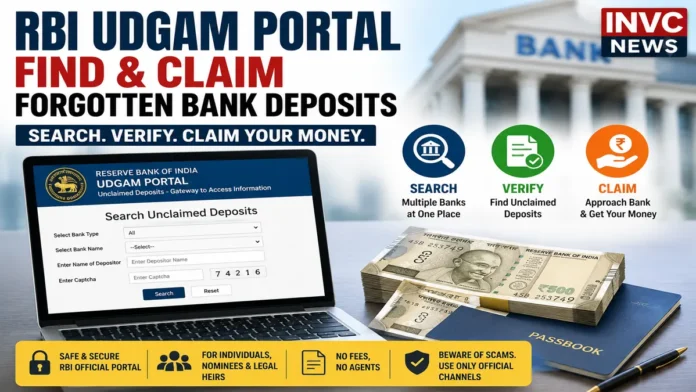
Millions of families have old savings accounts, fixed deposits and bank balances that are forgotten after a change of address, death in the family or years of inactivity. The RBI UDGAM portal offers a centralised way to search for many of these unclaimed deposits across participating banks.
UDGAM stands for Unclaimed Deposits – Gateway to Access inforMation.
The Reserve Bank of India developed the portal so users do not have to separately search the website of every bank where they or a family member may have held an account.
However, one point is crucial: UDGAM helps you find an unclaimed deposit. It does not directly pay the money.
Once a matching deposit is found, the claimant must approach the concerned bank and complete its claim or account-reactivation process.
What Is an Unclaimed Bank Deposit?
A bank deposit generally becomes “unclaimed” when it remains inactive and unclaimed for the prescribed period and is eventually transferred by the bank to the Reserve Bank of India’s Depositor Education and Awareness Fund.
The money does not become the property of the bank or RBI.
The rightful customer, nominee or legal heir can still claim it after completing the required process.
This can include money held in:
- Savings accounts
- Current accounts
- Fixed deposits
- Other eligible deposit accounts transferred to the DEA Fund
What Is RBI UDGAM?
RBI launched UDGAM as a centralised search portal for unclaimed deposits.
Instead of visiting several bank websites individually, a registered user can search multiple participating banks from one place.
The portal currently allows users to search unclaimed deposits transferred to the RBI’s Depositor Education and Awareness Fund by participating banks.
RBI has said the participating banks account for a substantial share of the value of unclaimed deposits covered by the system.
How to Search for Unclaimed Money on UDGAM
Visit the official RBI UDGAM portal:
Create an account using your name and mobile number.
After registration, select the bank or banks you want to search.
For an individual account holder, you will generally need:
- Name of the account holder
- Name of one or more banks
- At least one additional identifying detail
The additional details can include:
- PAN
- Driving licence number
- Voter ID
- Passport number
- Date of birth
RBI also permits address information to be used in certain searches where other identifying details are unavailable.
Can You Search for a Deceased Family Member’s Deposit?
Yes, UDGAM can be particularly useful when a family is trying to identify old bank deposits belonging to a deceased relative.
You will need enough information to conduct the search and, after finding a possible deposit, you must approach the relevant bank.
The bank will then apply its deceased-customer claim procedure.
The documents may depend on whether the account had:
- A registered nominee
- A surviving joint holder
- No nominee
- A will
- Multiple legal heirs
- A disputed succession claim
Also Read – : What Happens to a Bank Account After the Holder Dies? Nominee, Claim Process and Documents Explained
Does UDGAM Show the Bank Account Number?
The portal uses safeguards intended to prevent sensitive account information from being exposed unnecessarily.
A successful search can provide an Unclaimed Deposit Reference Number, or UDRN, associated with the unclaimed deposit.
This reference helps the bank identify and process the claim without publicly exposing the full account details.
Can RBI Pay the Unclaimed Deposit Directly?
No.
This is one of the most important things to understand.
UDGAM is a search facility, not a payment portal.
If a search shows an unclaimed deposit, the claimant must follow the claim or reactivation procedure of the concerned bank.
The bank verifies identity, ownership and entitlement before releasing the money.
What Documents May the Bank Ask For?
The exact documents depend on the type of claim.
An original account holder may generally need identity and address proof along with information linking them to the old account.
A nominee or legal heir may additionally need documents such as:
- Death certificate
- Identity and address proof
- Nomination details
- Legal-heir documents where applicable
- Claim form
- Bank account details for payment
- Other documents required under the bank’s deceased-claim policy
Do not rely on a generic checklist for a large or disputed claim.
Ask the bank for its official written document list.
What If You No Longer Have the Passbook or FD Receipt?
The absence of an old passbook or fixed-deposit receipt does not automatically mean the money cannot be claimed.
The bank can verify the deposit from its records, subject to satisfactory identification and claim documentation.
Any old information can still be useful, including:
- Previous branch name
- Approximate account-opening period
- Old address
- PAN
- Nominee details
- Old cheque book
- Bank correspondence
- Tax records showing interest
Provide only genuine records.
Can Unclaimed Money Be Recovered After 10 Years?
Yes.
The transfer of an unclaimed deposit to the RBI’s Depositor Education and Awareness Fund does not extinguish the customer’s or claimant’s right to recover the money.
The claim is still made through the concerned bank.
The bank settles the eligible claim and follows the applicable reimbursement process with the DEA Fund.
What If the Bank Refuses or Delays the Claim?
First ask the bank to provide the reason for the delay or rejection in writing.
If documents are missing, complete the required documentation.
If the claim is complete but remains unresolved, escalate it through the bank’s official grievance mechanism.
Where the matter remains unresolved after the prescribed grievance period, an eligible complainant may use the Reserve Bank’s complaint mechanism.
Always retain:
- Claim acknowledgement
- Complaint reference number
- Copies of submitted documents
- Emails
- Branch correspondence
- Dates of visits and communications
These records are valuable if escalation becomes necessary.
Beware of UDGAM Scams
A genuine UDGAM search does not require you to send an OTP, PIN or banking password to an unknown person.
Be cautious if someone contacts you claiming they can “release” forgotten bank money in exchange for a fee.
Never share:
- ATM PIN
- UPI PIN
- Internet-banking password
- Card CVV
- OTP
- Remote-screen access
Use only the official RBI portal and the concerned bank’s authorised channels.
Who Should Check UDGAM?
The portal can be particularly useful for:
- Senior citizens with old accounts
- Families managing a deceased relative’s finances
- People who have moved cities several times
- Customers who changed banks long ago
- Families discovering old FD papers
- Businesses searching for forgotten deposits
- People who cannot remember whether an old account was formally closed
A search does not mean money is definitely available, but it can reveal deposits that may otherwise remain forgotten.
A Simple Family Financial Check
Families should consider maintaining a basic financial inventory containing:
- Bank names
- Account type
- Nomination status
- Insurance policies
- Investments
- Loans
- Pension and EPF information
- Location of important documents
Do not store passwords or PINs in an unsecured document.
The purpose is simply to make it easier for trusted family members to identify financial assets when needed.
Frequently Asked Questions
Is RBI UDGAM free?
Yes. It is an RBI facility for searching eligible unclaimed deposits across participating banks.
Can I claim money directly through UDGAM?
No. The portal helps locate the deposit. The actual claim must be made with the concerned bank.
Can a nominee search for a deceased person’s old bank deposit?
Yes, provided sufficient information is available for the search. The nominee must then complete the bank’s deceased-claim process.
What is UDRN?
UDRN is the Unclaimed Deposit Reference Number associated with an unclaimed account or deposit. It helps banks identify the deposit during the claim process.
Does money transferred to the DEA Fund become unrecoverable?
No. Eligible customers or claimants can still recover the money through the concerned bank.
Should I pay an agent to recover unclaimed deposits?
There is normally no reason to hand over PINs, passwords or OTPs to an intermediary. Search through the official RBI facility and deal directly with the concerned bank.
The Bottom Line
A forgotten bank account does not necessarily mean lost money.
RBI’s UDGAM portal gives individuals and families a centralised way to search for unclaimed deposits across participating banks.
The key is to treat UDGAM as the starting point.
Find the deposit, note the reference details, contact the concerned bank, obtain its official claim checklist and complete the verification process.