Kathmandu, Nepal / New Delhi, India | July 16, 2026
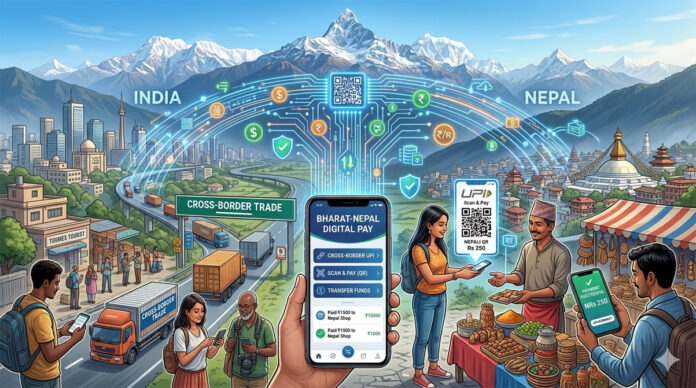
India Nepal Digital Payment Corridor has been identified by the Asian Development Bank (ADB) as one of South Asia’s most promising opportunities for strengthening cross-border trade, tourism, and remittance flows, according to a new report highlighting the untapped potential of digital financial integration between the two neighboring countries.
In its report titled “Advancing Digital Payments in Nepal: Infrastructure Upgrades and Policy Development for Better Trade Facilitation,” ADB said billions of dollars move annually between India and Nepal through trade and remittances. However, despite rapid advances in digital payments, most cross-border transactions still rely on traditional banking channels.
The multilateral lender believes that expanding interoperable payment systems could significantly improve transaction efficiency, reduce costs, and accelerate economic integration.
Digital Payments Offer Untapped Economic Potential
The report quoted Nepali fintech expert Sanjeeb Subba, who said the close economic relationship between India and Nepal creates a major opportunity for digital payments that remains largely underutilized.
According to the report, interoperable payment infrastructure would benefit:
- Businesses engaged in cross-border trade.
- Tourists traveling between the two countries.
- Workers sending remittances.
- Consumers making retail payments.
ADB noted that a fully integrated payment ecosystem could improve convenience while lowering transaction costs for millions of users.
ADB Recommends Stronger Payment Integration
To accelerate digital payment adoption, ADB recommended that India and Nepal strengthen cooperation in several key areas:
- Cross-border payment infrastructure.
- Regulatory coordination.
- Interoperability of payment systems.
- Market integration.
- Institutional capacity building.
- Coordinated governance frameworks.
The report also emphasized the importance of collaboration among governments, regulators, financial institutions, fintech companies, and payment service providers.
UPI-Nepal Payment Integration Already Showing Results
ADB highlighted significant progress achieved through cooperation between the Reserve Bank of India (RBI) and the Nepal Rastra Bank (NRB).
In 2024, the two central banks signed regulatory terms facilitating integration between Nepal’s National Payments Interface and India’s Unified Payments Interface (UPI).
Since March 2024, Indian travelers visiting Nepal have been able to make QR-code payments using Indian payment applications by scanning QR codes provided by leading Nepali payment providers such as Fonepay and Khalti.
Cross-Border QR Payments Growing Rapidly
According to the ADB report, adoption has grown steadily.
Transaction volumes increased from:
- Approximately 500 daily transactions during the initial rollout.
- Nearly 2,000 daily transactions by early 2025.
Daily payment volumes now exceed:
- NPR 6 million (approximately US$42,000) every day.
Since launch, cumulative QR-code transactions have reached approximately:
- NPR 1.6 billion (around US$11 million).
ADB described the early performance as highly encouraging for future regional payment integration.
More International Tourists Now Included
The report noted that Nepal has expanded its QR payment ecosystem beyond Indian visitors.
Since January 2025, tourists from:
- China
- Italy
- South Korea
- Malaysia
- Singapore
have also been able to use NepalPay QR for digital payments across Nepal.
NepalPay serves as Nepal’s national digital payment network, developed by Nepal Clearing House Limited under the guidance of the country’s central bank.
Major Challenge: Payments Still Work Only One Way
Despite these achievements, ADB identified a significant limitation.
While Indian visitors can make QR payments inside Nepal, Nepali citizens still cannot use QR-based digital payment services when traveling in India.
The report said the absence of fully bidirectional payment interoperability limits the overall effectiveness of cross-border digital commerce.
Commission Structure Remains the Biggest Obstacle
ADB explained that unresolved commission and fee structures remain the primary barrier.
Currently:
- Indian users pay a standard 1.95% transaction fee when making QR payments in Nepal.
- QR payments within India generally carry no transaction fee.
As a result, regulators have yet to determine how service commissions should be shared when Nepali consumers make QR payments inside India.
The report stated that differences in pricing models and regulatory approaches continue to delay full payment integration.
ADB Calls for Quick Resolution
The Asian Development Bank urged both governments to resolve commission-related issues as quickly as possible.
According to ADB, implementing reciprocal QR payment services would:
- Simplify travel.
- Improve retail commerce.
- Support migrant workers.
- Increase remittance efficiency.
- Strengthen bilateral trade.
The institution believes resolving operational barriers will unlock substantial economic benefits for both countries.
Cross-Border Fund Transfers Already Expanded
ADB also highlighted another major milestone.
Earlier this year, India and Nepal launched a cross-border online fund transfer service, allowing customers in both countries to send money directly between bank accounts.
The initiative was jointly inaugurated during Nepal Foreign Minister Shishir Khanal’s visit to India alongside Indian External Affairs Minister S. Jaishankar.
The new service is expected to make remittance transfers faster, safer, and more affordable for workers living across the India-Nepal border.
Strengthening Regional Economic Integration
ADB concluded that India, Nepal’s largest trading partner, offers the ideal opportunity for expanding digital financial connectivity.
The report recommends wider adoption of payment frameworks modeled on India’s successful UPI system to simplify bilateral trade, improve payment efficiency, and support deeper regional economic integration.
Key Highlights
- ADB identifies the India Nepal Digital Payment Corridor as a major economic opportunity.
- Report recommends stronger UPI integration between India and Nepal.
- Indian travelers have used QR payments in Nepal since March 2024.
- Daily QR transactions have increased from 500 to nearly 2,000.
- Total transaction value has reached approximately NPR 1.6 billion.
- Nepali users still cannot make reciprocal QR payments in India.
- Commission structure remains the biggest hurdle.
- ADB urges both countries to finalize bidirectional payment interoperability