Washington, D.C., United States | July 16, 2026
Kevin Warsh Inflation
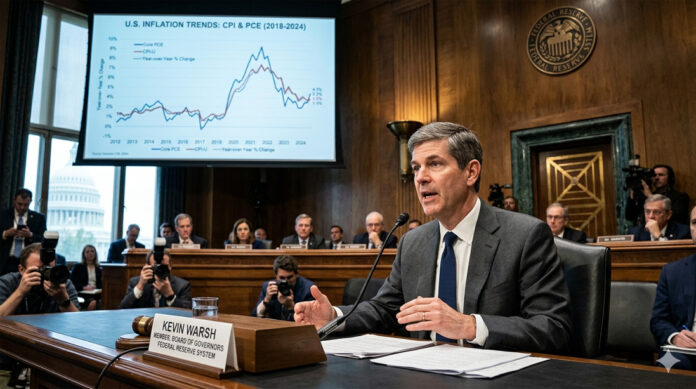
Kevin Warsh Inflation became the central theme of his first semiannual monetary policy testimony before the U.S. Senate Banking Committee, where the newly appointed Federal Reserve Chair pledged that persistent inflation would not continue under his leadership.
Appearing before lawmakers for the first time since taking office seven weeks ago, Warsh reaffirmed the Federal Reserve’s commitment to restoring price stability, describing inflation as a policy challenge that can and must be controlled despite ongoing global uncertainties, geopolitical tensions, and rapid technological change.
“Inflation is a choice,” Warsh told senators. “Our committee will not tolerate persistently high inflation, and we remain fully committed to restoring price stability.”
Fed Holds Interest Rates Steady
Warsh confirmed that the Federal Open Market Committee (FOMC) decided at its most recent meeting to leave the federal funds rate unchanged at 3.50% to 3.75% after reviewing current economic conditions.
He said policymakers believe the current interest-rate setting remains appropriate as inflation gradually moderates while the broader economy continues to demonstrate resilience.
The Federal Reserve has maintained relatively elevated interest rates since launching its aggressive tightening campaign following the post-pandemic inflation surge.
US Economy Remains Resilient
Despite elevated inflation over recent years, Warsh described the U.S. economy as fundamentally strong.
According to the Fed Chair:
- Consumer spending remains healthy.
- Economic activity continues to expand at a solid pace.
- Manufacturing output has strengthened this year.
- Artificial intelligence infrastructure investment has become one of the strongest drivers of business spending.
- The housing sector remains the weakest segment of the economy.
He emphasized that productivity gains from AI investment could support long-term economic growth while improving overall competitiveness.
Price Stability Remains the Fed’s Top Priority
Warsh stressed that restoring price stability remains the Federal Reserve’s most important responsibility.
He argued that if monetary policy is implemented effectively, the inflation surge experienced over the past five years will eventually become a historical episode rather than a lasting economic challenge.
“If we implement policy correctly—and we will—the inflation experienced over the past five years will become a thing of the past,” Warsh said.
Temporary Price Shocks Should Not Become Permanent Inflation
The Fed Chair acknowledged that geopolitical conflicts, energy market volatility, and supply disruptions may continue to push certain prices higher in the short term.
However, he said those isolated increases should not be allowed to evolve into broad-based, persistent inflation.
Responding to questions from Senator John Kennedy, Warsh confidently stated:
“Senator, inflation will not become permanent on my watch.”
He added that the central bank would continue reinforcing its commitment to long-term price stability through disciplined monetary policy.
Fed Launches Five Strategic Task Forces
Warsh announced that the Federal Reserve has established five specialized task forces aimed at strengthening policy formulation and institutional performance.
The review groups will examine:
- Federal Reserve communications
- Balance sheet strategy
- Economic data quality
- Productivity and labor market trends
- Inflation policy framework
According to Warsh, these internal reviews are intended to improve policymaking after inflation remained above the Fed’s target for 63 consecutive months.
Democratic Senators Raise Concerns Over Tariffs and Energy Costs
Several Democratic senators argued that inflation has been driven partly by external supply-side pressures rather than domestic monetary policy alone.
Senator Chris Van Hollen cited:
- Higher global energy prices
- Geopolitical tensions involving Iran
- Trade tariffs
- Supply chain disruptions
as important contributors to rising consumer costs.
Warsh acknowledged that these developments can influence individual prices but maintained that they do not reduce the Federal Reserve’s responsibility to preserve overall price stability.
Balancing Inflation and Employment
The Federal Reserve continues to face the challenge of balancing two key objectives:
- Returning inflation to its long-term target.
- Preserving a strong labor market.
With unemployment remaining relatively stable and economic growth continuing, policymakers are carefully evaluating when future interest-rate adjustments may become appropriate.
Analysts expect upcoming inflation and employment data to play a significant role in determining the Fed’s next policy decisions.
Global Markets Watching Closely
Warsh’s comments are likely to be closely monitored by investors worldwide.
Changes in U.S. monetary policy have significant implications for:
- Global borrowing costs
- International capital flows
- Currency exchange rates
- Equity and bond markets
- Commodity prices
As the world’s largest central bank, the Federal Reserve’s policy direction continues to shape financial conditions across the global economy.
Key Highlights
- Fed Chair Kevin Warsh says “Inflation is a choice.”
- Federal Reserve leaves interest rates unchanged at 3.50%–3.75%.
- Warsh vows persistent inflation will not continue under his leadership.
- U.S. economy remains resilient despite global uncertainties.
- AI infrastructure investment is emerging as a major economic growth driver.
- Fed launches five task forces to review monetary policy and inflation framework.
- Democratic lawmakers cite tariffs and energy costs as inflation drivers.
- Global financial markets remain focused on future Fed policy decisions.