New Delhi | July 16, 2026
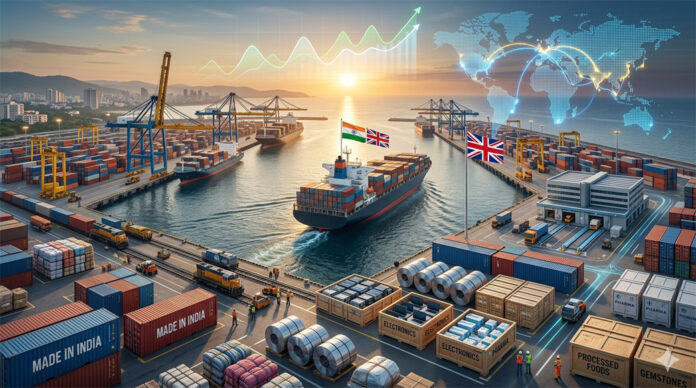
India UK CETA got off to a strong start as Indian exporters shipped more than $140 million worth of goods to the United Kingdom on the first day of the Comprehensive Economic and Trade Agreement (CETA) coming into force. With nearly 99% of Indian exports now eligible for duty-free access to the British market, exporters across multiple sectors immediately began utilizing the benefits of the landmark trade pact.
More than 50 export consignments departed from over 20 ports, airports, Inland Container Depots (ICDs), Special Economic Zones (SEZs), and manufacturing facilities across India on the agreement’s opening day.
Exports Depart From Major Indian Trade Hubs
The first-day shipments originated from several major manufacturing and export centers, including:
- Jammu
- Chennai
- Hyderabad
- Mumbai
- Noida
- New Delhi
- Coimbatore
Export consignments were dispatched through key logistics gateways such as:
- Mundra Port
- Nhava Sheva Port
- Chennai Port
- Mumbai Port
- Kolkata Port
- Hyderabad Air Cargo Hub
Products shipped included:
- Electronics
- Pharmaceuticals
- Gems and jewelry
- Engineering goods
- Textiles
- Leather products
- Processed food
- Marine products
99% Duty-Free Market Access Opens New Opportunities
Under the India-UK Comprehensive Economic and Trade Agreement (CETA), almost 99% of Indian exports now receive zero-duty access to the UK market.
The agreement is expected to significantly improve the competitiveness of Indian products by reducing tariff barriers and expanding market access for exporters across manufacturing and agriculture.
Industry experts believe the agreement will particularly benefit export-oriented sectors with strong labor-intensive production.
Government Targets $100 Billion in Bilateral Trade
An inaugural ceremony marking the implementation of both the Comprehensive Economic and Trade Agreement and the Social Security Agreement was held at Vanijya Bhawan in New Delhi.
Speaking at the event, Commerce Secretary Rajesh Agrawal said the agreement is expected to help increase India-UK bilateral trade to $100 billion by 2030.
He noted that exporters had begun claiming tariff benefits immediately after the agreement became operational.
According to Agrawal, the Commerce Department will organize awareness campaigns across districts nationwide to help exporters and entrepreneurs understand and utilize the opportunities created by the agreement.
The ministry will also work with:
- Export Promotion Councils
- Industry associations
- State governments
to encourage businesses of all sizes to expand exports to the UK.
Major Boost for India’s Steel Industry
One of the most significant gains under the agreement comes for India’s steel sector.
Following extensive negotiations, India and the UK resolved concerns related to Britain’s steel safeguard measures introduced earlier this year.
As a result:
- Indian exporters can now ship more than 1.1 million tonnes of steel annually to the UK.
- Eligible exports will benefit from zero import duty under a country-specific quota and authorized-use mechanism.
The development is expected to improve export opportunities for Indian steel manufacturers in the British market.
Labour-Intensive Industries Expected to Benefit Most
Industry bodies welcomed the implementation of the agreement.
According to Confederation of Indian Industry (CII) Director General Chandrajit Banerjee, sectors expected to benefit significantly include:
- Textiles and garments
- Leather and footwear
- Gems and jewelry
- Marine products
- Processed food
These industries are expected to gain from improved price competitiveness resulting from duty-free market access.
FICCI Highlights Growth Potential
FICCI President Anant Goenka described the agreement as an important milestone supporting India’s long-term economic ambitions.
According to him, the agreement is expected to:
- Strengthen economic growth.
- Increase global competitiveness.
- Expand India’s participation in international markets.
- Generate additional export opportunities.
UK Calls Agreement a Historic Milestone
British High Commissioner to India Lindy Cameron described the trade agreement as a historic step in the modern partnership between India and the United Kingdom.
She noted that:
- Import duty on Scotch whisky has been reduced from 150% to 75%, with further reductions planned over time.
- Tariffs on premium UK-built passenger vehicles will also be reduced gradually under the agreement.
London’s Mayor Dame Susan Langley also welcomed the agreement, calling it a landmark development for bilateral trade and investment.
Long-Term Partnership Expected to Continue
Harjinder Kang, the UK’s Trade Commissioner for South Asia and one of the principal negotiators of the India-UK Free Trade Agreement, said he expects strong bilateral ties to continue regardless of future political changes in the United Kingdom.
He added that leaders across British political and regional institutions continue to support closer economic cooperation with India.
What the India-UK CETA Means for Businesses
The agreement is expected to deliver long-term benefits by:
- Expanding duty-free access to UK markets.
- Lowering export costs.
- Improving competitiveness for Indian manufacturers.
- Supporting employment in labor-intensive sectors.
- Encouraging greater bilateral investment.
- Strengthening supply chain cooperation between India and the UK.
With exports exceeding $140 million on the very first day, the agreement has begun delivering immediate commercial benefits while laying the foundation for deeper economic integration between the two countries.