Islamabad, Pakistan | July 16, 2026
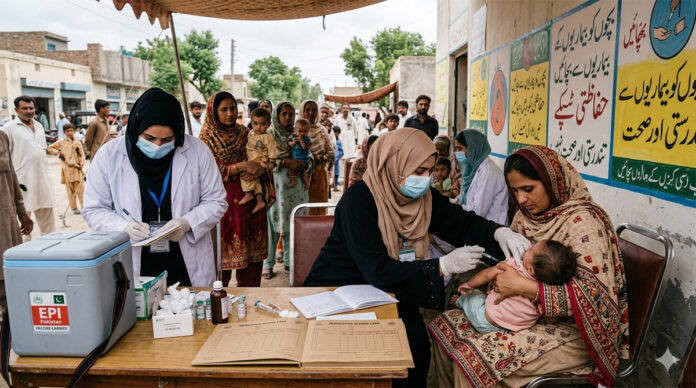
Pakistan Zero-Dose Children have become the focus of growing international concern after the Pakistan Medical Association (PMA) issued a nationwide public health alert, warning that the country is on the brink of a major epidemic due to a sharp rise in unvaccinated infants.
The PMA declared the situation a national public health emergency, citing the presence of 651,000 “zero-dose” children—infants who have not received even the first dose of the DTP1 vaccine, which protects against diphtheria, tetanus, and pertussis (whooping cough).
Health experts warned that such a large immunization gap threatens herd immunity and significantly increases the risk of outbreaks of vaccine-preventable diseases across Pakistan.
PMA Warns of Serious Epidemic Risk
The Pakistan Medical Association said the country’s routine immunization system is facing a critical breakdown.
According to PMA Secretary General Dr. Abdul Ghafoor Shoro, the growing number of zero-dose children reflects a deep failure in Pakistan’s primary healthcare system.
“From both a medical and public health perspective, having more than half a million zero-dose children represents a serious collapse of primary healthcare,” Dr. Shoro said.
He added that the alarming figures expose long-standing structural weaknesses within the country’s healthcare administration.
WHO Data Highlights Regional Concern
The warning follows the latest regional immunization data published by the World Health Organization (WHO).
According to WHO, nearly 90% of all zero-dose children in the Eastern Mediterranean Region are concentrated in just five countries:
- Sudan
- Yemen
- Afghanistan
- Pakistan
- Somalia
Health officials noted that while Sudan, Yemen, and Somalia continue to face armed conflicts and humanitarian crises, Pakistan’s inclusion on the list is largely linked to governance failures rather than active war.
Governance Failures Blamed
The PMA argued that Pakistan’s vaccination crisis stems from years of administrative neglect rather than a lack of resources alone.
The association identified several contributing factors, including:
- Weak management of the Expanded Programme on Immunization (EPI)
- Political favoritism in administrative appointments
- Poor healthcare infrastructure in remote regions
- Inadequate cold-chain management for vaccine storage
- Failure to address vaccine misinformation and public hesitancy
According to the PMA, decades of poor governance have steadily weakened Pakistan’s public health system.
Herd Immunity at Risk
Medical experts warned that declining vaccination coverage threatens herd immunity, increasing the likelihood of outbreaks of diseases that are normally preventable through routine childhood immunization.
Children who remain unvaccinated face significantly higher risks of contracting illnesses such as:
- Diphtheria
- Tetanus
- Pertussis (Whooping Cough)
- Measles
- Polio
- Other vaccine-preventable infections
Health professionals cautioned that widespread immunity gaps could also place vulnerable populations at greater risk.
Calls for Urgent Healthcare Reforms
The Pakistan Medical Association urged the federal and provincial governments to take immediate corrective action.
Its recommendations include:
- Modernizing the national vaccine supply chain
- Strengthening temperature-controlled vaccine storage systems
- Clearing delayed payments for healthcare workers
- Expanding vaccination services to underserved communities
- Providing better salaries, training, and security for frontline health workers
- Launching nationwide public awareness campaigns to improve vaccine confidence
The association stressed that restoring public trust in immunization programs will be critical to preventing future outbreaks.
Healthcare System Under Pressure
The PMA warned that the current crisis reflects broader weaknesses in Pakistan’s healthcare infrastructure.
According to the association, insufficient political commitment over successive governments has allowed vaccination coverage to decline while leaving vulnerable communities without access to essential preventive healthcare.
Officials emphasized that reversing the trend will require sustained investment, stronger governance, and coordinated public health strategies.
Growing Concern for Child Health
Public health experts say routine immunization remains one of the most effective and cost-efficient methods of preventing childhood diseases and reducing infant mortality.
The PMA warned that unless vaccination coverage improves rapidly, Pakistan could face recurring outbreaks that would place additional strain on an already stretched healthcare system.
Key Highlights
- Pakistan Medical Association declares a national public health emergency.
- 651,000 infants classified as zero-dose children.
- Zero-dose children have not received the first DTP vaccine.
- WHO identifies Pakistan among five countries with the highest number of unvaccinated children.
- PMA blames governance failures and weak healthcare administration.
- Experts warn of increased risk of vaccine-preventable disease outbreaks.
- Calls made for urgent healthcare reforms and nationwide vaccination campaigns.