Tehran, Iran — August 20, 2026
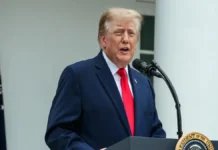
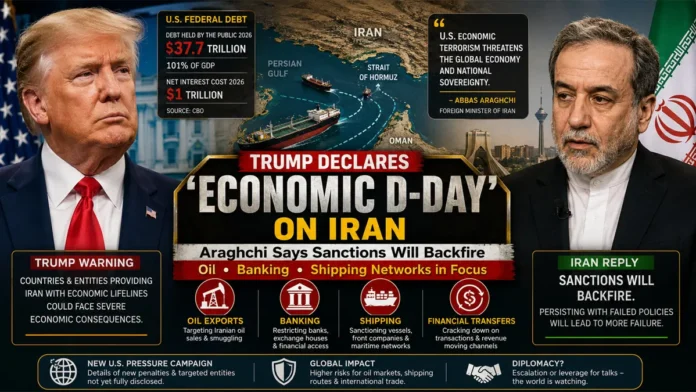
Trump Iran Economic D-Day has triggered a sharp response from Iranian Foreign Minister Abbas Araghchi, who says President Donald Trump’s threat of unprecedented economic pressure will ultimately fail and could create wider risks for global trade, energy markets and national sovereignty.
Araghchi rejected Trump’s latest sanctions push on Thursday, arguing that the strategy amounted to what he called “economic terrorism” and accusing Washington of trying to divert attention from its own fiscal challenges, including record federal debt and rising interest costs.
His response came after Trump warned that countries, financial institutions, companies, airports and government entities providing Iran with an economic “lifeline” could face severe consequences from Washington.
The U.S. president has described the pressure campaign as an “Economic D-Day”, signaling an effort to intensify Iran’s economic isolation by targeting oil exports, financial channels, shipping networks, exchange houses, front companies and other mechanisms Tehran can use to generate or move revenue.
Importantly, Trump has not yet detailed the full package of new penalties or identified every country or company that could be targeted, meaning the announcement should be viewed as a major sanctions threat and policy escalation rather than a fully disclosed new sanctions regime.
Araghchi Says Trump’s ‘Economic D-Day’ Will Backfire
Araghchi dismissed the U.S. strategy and argued that repeatedly relying on maximum economic pressure would not force Iran to surrender.
In his response on X, the Iranian foreign minister linked Trump’s announcement to America’s domestic fiscal situation, pointing to rising federal debt and interest expenses.
He argued that persisting with policies Tehran considers unsuccessful would only produce further failure and greater hostility toward the United States among Iranians.
Araghchi also characterized U.S. sanctions policy as “economic terrorism,” saying such measures could threaten both the global economy and countries’ sovereign ability to conduct trade.
Those statements reflect Tehran’s position. They do not establish that Trump announced the Iran measures to distract from U.S. fiscal problems.
US Debt Gives Araghchi a Political Talking Point
Araghchi’s reference to American debt comes at a time when U.S. fiscal pressures are receiving increased attention.
The Congressional Budget Office projects a $1.9 trillion federal deficit in fiscal 2026, while net federal interest costs are expected to reach about $1 trillion this year. Debt held by the public is projected at roughly 101% of U.S. GDP in 2026.
That provides a factual backdrop to Araghchi’s criticism, but there is no evidence in his statement demonstrating that U.S. fiscal conditions caused the Trump administration to escalate sanctions against Iran.
Washington describes its pressure campaign very differently: as a national-security strategy intended to limit Iran’s ability to generate money for its military, weapons programs and regional operations.
What Does Trump’s ‘Economic D-Day’ Target?
The latest threat appears designed to go beyond sanctions aimed solely at Iranian entities.
Trump has warned that third countries and foreign businesses maintaining financial or commercial lifelines to Iran could themselves face economic consequences.
That raises the prospect of stronger secondary pressure involving:
- Iranian oil purchases;
- financial transfers;
- exchange houses;
- shipping and ship-registration networks;
- front companies;
- trade intermediaries; and
- businesses facilitating Iranian access to international markets.
The details will determine how disruptive the policy ultimately becomes.
If Washington applies broad secondary sanctions aggressively, companies outside Iran could be forced to choose between maintaining Iranian business relationships and preserving access to the U.S. financial system or American market.
Washington Was Already Targeting Iran’s Oil Revenue
The “Economic D-Day” rhetoric builds on an existing U.S. campaign rather than starting from zero.
The Treasury Department has been running a sanctions effort known as Economic Fury, targeting Iranian military-linked oil sales, sanctions-evasion networks and the infrastructure used to move funds.
In May, Treasury said it was intensifying action against Iran’s military oil sales and attempting to prevent revenue from being used to rebuild military capabilities.
The department has also targeted extensive maritime and financial networks connected to Iranian oil exports, including vessels, front companies and shipping operations accused of helping Tehran evade sanctions.
That means Trump’s latest announcement appears to represent a broader and potentially more aggressive phase of an economic campaign already underway.
Oil Smuggling Could Become a Major Target
Oil remains particularly important because petroleum exports are one of Iran’s most valuable sources of foreign currency.
Washington has repeatedly focused sanctions on ships, intermediaries and companies involved in transporting Iranian crude and petroleum products.
U.S. Treasury actions this year have targeted networks accused of helping move Iranian oil through front companies, opaque ownership structures and sanction-evasion mechanisms.
If Trump expands that strategy to punish foreign companies or institutions facilitating Iranian oil purchases, enforcement could become much more consequential for international traders.
Strait of Hormuz Keeps Global Markets on Edge
The sanctions confrontation is unfolding alongside continuing uncertainty in the Strait of Hormuz, one of the world’s most important oil transit routes.
Shipping through the strait has remained below pre-conflict levels, leaving oil markets particularly sensitive to military and diplomatic developments. The U.S. Treasury’s own market advisory discussions in August noted that reduced Hormuz traffic continued to keep energy prices vulnerable to geopolitical headlines.
Washington has also sanctioned what it describes as an Iranian maritime system designed to generate revenue from vessels transiting the waterway, including entities allegedly connected to mandatory maritime insurance arrangements.
Any additional restrictions on Iranian shipping could therefore affect far more than Tehran.
Oil prices, tanker insurance, freight costs and global supply chains could all react if maritime tensions worsen.
Iran-US Conflict Began on February 28, but There Have Been Ceasefires
The broader military confrontation began on February 28, 2026, when U.S. Central Command launched Operation Epic Fury against Iran.
CENTCOM says the operation began at 1:15 a.m. on February 28 and initially focused on targets connected with Iran’s military infrastructure and capabilities.
However, it would be inaccurate to describe the initial U.S. major combat operation as having continued uninterrupted for six months.
The White House said the major combat phase lasted 38 days and culminated in an April ceasefire. Broader U.S.-Iran tensions, renewed hostilities and disputes over Hormuz subsequently continued, including additional attempts to secure ceasefires and negotiations.
The focus has increasingly shifted toward economic pressure as Washington searches for ways to restrict Tehran’s revenue without relying solely on military action.
Why Washington Is Focusing on Iran’s Financial Networks
Economic pressure can affect Iran through several channels simultaneously.
Blocking oil revenue limits access to foreign currency.
Restricting banks and exchange houses makes international payments more difficult.
Targeting shipping networks increases the cost and complexity of exporting goods.
Sanctioning foreign facilitators can make businesses reluctant to deal with Iranian customers even when a transaction is not directly prohibited.
Treasury has already used these methods against networks it says facilitate billions of dollars in foreign-currency transactions and petroleum trade for sanctioned Iranian institutions.
The “Economic D-Day” threat suggests Washington may now try to extend that pressure farther beyond Iran’s borders.
Could Other Countries Face US Sanctions?
Potentially — but the actual scope remains unclear.
Trump’s warning is unusually broad because it refers to countries and entities that provide Iran with economic support.
That could create uncertainty for governments and companies that maintain legitimate trade with Tehran.
However, the administration has not yet announced a definitive list of countries subject to new punishment.
The final rules will matter enormously.
There is a major difference between targeted sanctions on entities linked to Iranian oil smuggling and blanket penalties on countries conducting ordinary commerce with Iran.
Until the U.S. government publishes specific measures, claims that particular countries have already been sanctioned should be treated cautiously.
Why Secondary Sanctions Could Have Global Impact
Secondary sanctions are powerful because they can influence companies that are not American.
A foreign bank may technically operate outside U.S. jurisdiction, but if it relies on dollar transactions or wants access to American financial markets, losing that access could be extremely costly.
The same calculation applies to shipping companies, insurers, commodity traders and multinational corporations.
That creates what economists often describe as an extraterritorial effect: American financial power can change commercial decisions far beyond U.S. borders.
It is also why Araghchi is framing the latest threat as a sovereignty issue.
Could Sanctions Hurt Global Oil Supply?
That depends largely on enforcement and how Iranian oil buyers respond.
If sanctions significantly reduce Iranian exports while Hormuz traffic remains disrupted, global supply could tighten.
That could raise crude prices.
Higher oil prices could then increase transportation and manufacturing costs around the world and complicate inflation policy for major central banks.
However, markets would also consider production from other oil exporters, strategic reserves, global demand and the possibility that Iranian barrels continue reaching buyers through alternative channels.
Sanctions therefore do not automatically translate into a specific oil price.
Iran Says Pressure Will Not Force Surrender
Tehran has consistently argued that decades of sanctions have made the country more experienced at operating under financial restrictions.
Iranian officials say economic coercion will not force them to abandon what they describe as legitimate national interests.
Washington takes the opposite view.
The Trump administration believes restrictions on energy revenue, financial transfers and international commercial access can sharply reduce Tehran’s ability to finance military capabilities.
This disagreement sits at the heart of the latest escalation.
Diplomacy Is Still the Bigger Question
The ultimate issue is whether additional sanctions create leverage for another negotiation or make diplomacy more difficult.
Economic pressure is often designed to bring an adversary back to the negotiating table.
But sanctions can also harden positions if political leaders believe compromise would appear to reward coercion.
The United States and Iran have already gone through ceasefire efforts and negotiations during 2026, without achieving a lasting settlement.
Trump’s “Economic D-Day” indicates that Washington is now prepared to increase the economic cost of continued confrontation.
Araghchi’s response makes equally clear that Tehran is publicly rejecting the premise that greater pressure will produce capitulation.
Trump Iran Economic D-Day: What Is Confirmed?
Several distinctions are crucial for readers.
Trump has announced a major new economic pressure campaign against Iran.
He has threatened severe economic consequences for countries and entities providing Iran with financial or commercial lifelines.
The full mechanics of the new penalties have not yet been publicly detailed.
The United States already operates a substantial Iran sanctions campaign targeting oil exports, shipping and financial networks.
Araghchi has rejected the new threat and described U.S. economic pressure as harmful to the global economy and national sovereignty.
Shipping through Hormuz remains below pre-conflict levels, keeping international energy markets exposed to further escalation.
The Bottom Line
The Trump Iran Economic D-Day confrontation represents a shift toward an even more aggressive economic phase of the U.S.-Iran conflict.
Trump is signaling that Washington may no longer focus only on Iranian companies and officials but could also target foreign governments, banks and businesses that keep Tehran connected to global markets.
Araghchi says the strategy will fail and argues that Washington’s pressure campaign will deepen resentment rather than force Iran to surrender.
For the global economy, the biggest immediate risks are concentrated around Iranian oil exports, international payment networks and the Strait of Hormuz.
The crucial next development will be whether the Trump administration turns its warning into specific sanctions against third-country companies and governments — and how Iran and its major trading partners respond.