NEW DELHI, India | September 30, 2026 — Preventing sexual abuse of boys begins with a question families sometimes overlook: would a son feel safe telling an adult that someone had harmed him? A global review covering 147 countries puts the scale of childhood sexual violence into focus. Yet its strongest message for parents and schools concerns the response children receive. When boys expect ridicule, blame, or disbelief, asking for help becomes harder. Protection requires adults who recognize the risk, listen carefully, and connect children with appropriate support.
INVC NEWS | BEYOND THE HEADLINE
What happened. Why it matters. What comes next.
The Finding Behind the Warning
A systematic review published in Nature Human Behaviour on April 2, 2026, examined 1,412 studies, including responses from approximately 2.91 million males.
Researchers estimated that 16.8% of adult men had experienced at least one form of sexual violence before turning 18. The broader definition included contact and non-contact violence.
That distinction matters. The figure describes adults recalling childhood experiences. It does not mean researchers found that 17% of today’s adolescent boys experienced abuse during the past year.
Separately, the study estimated that 60.9 million boys experienced sexual violence in 2024, including 34.8 million who experienced rape or sexual assault.
These are modeled population estimates, rather than a tally of registered criminal complaints. They also describe 2024, not events recorded during 2026.
Why a Boy May Struggle to Tell Someone
The barrier can begin before a child approaches a parent, teacher, or doctor.
A preliminary study of 272 adolescent boys in Mangaluru examined perceptions of sexual harassment and obstacles to disclosure. Participants identified concerns involving shame, blame, mistrust, social consequences, and safety.
The researchers concluded that targeted education and supportive environments could help boys disclose their experiences.
However, the study involved a limited local sample. It cannot establish how common sexual harassment is among boys across India.
Its practical significance lies in the barriers it identifies: children may need help, yet hesitate because they fear the reaction their disclosure could trigger.
What Parents Should Understand Before a Disclosure
Sexual violence against children does not always involve physical contact. Moreover, adults should avoid assuming that boys’ experiences matter less or that they can manage harm without support.
WHO guidance explains that perpetrators can include adults or other children and adolescents, whether known to the child or strangers. Consequently, a safety conversation focused only on unfamiliar people leaves important gaps.
Parents can make those conversations more useful by explaining that children can seek help about unwanted sexual behavior regardless of who is involved.
The responsibility belongs to the person committing the abuse. A child’s hesitation to disclose does not transfer that responsibility.
The First Response Can Make a Difference
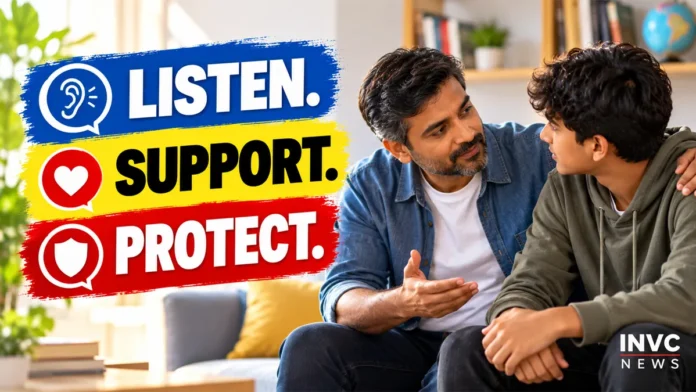
WHO’s clinical guidance recommends attentive listening and an empathetic, nonjudgmental response when a child discloses sexual abuse.
Adults should reassure the child that the abuse was not their fault and that speaking up was appropriate.
A supportive response might begin: “Thank you for telling me. This was not your fault. We will help you.”
Then, prioritize safety and arrange appropriate professional assistance. Protect the child’s privacy while involving the people necessary to provide care and protection.
Avoid demanding a detailed account repeatedly. WHO guidance emphasizes clear, open-ended questions and warns that unnecessary repetition can distress survivors.
The immediate goal is to support the child and obtain help, rather than conduct a family interrogation.
Why Schools Need More Than an Awareness Poster
A child-protection message becomes useful when students know how to act on it.
The global study’s researchers called for coordinated prevention involving health, education, justice, and social services. They also highlighted the need for stronger data and evidence-based programs.
For schools, the editorial implication is practical: students need a clear reporting route, and staff need preparation to respond appropriately.
Schools should explicitly include boys in safeguarding communication. They should also explain who can receive a concern and how the school will connect the child with protection and support.
Otherwise, a general promise of safety may leave a student uncertain about the next step.
How to Read the India Connection
Indian research contributes to the international evidence base. However, a global estimate does not automatically become an India-specific prevalence figure.
Likewise, sexual harassment, contact sexual violence, and broader sexual violence measures do not necessarily describe identical experiences.
Comparing percentages without checking definitions, age groups, sample selection, and reporting periods can produce misleading conclusions.
The researchers themselves called for more standardized data collection, particularly in regions where evidence remains limited.
Where Families Can Seek Help
In India, Child Helpline 1098 connects children in crisis with protection and support services under Mission Vatsalya.
The government integrates the service with the 112 emergency response system, alongside state and district child-protection arrangements. If a child faces an immediate safety threat, contact emergency services through 112.
Families should also seek appropriate medical and psychological support when abuse is suspected or disclosed.
The Question Every Family Should Ask
The research establishes a serious protection challenge. For an individual household, the next step begins with accessibility: does the child know whom to approach, and does that adult know how to respond?
A boy should never have to prove that boys can experience abuse before adults take his concern seriously. Listen without blame, prioritize his safety, and help him reach qualified support.